Tacoma is repaving roads. What’s $600K machine, three-eyed creature have to do with it?
A large milling machine inched forward, grinding away 300 or so feet of asphalt as it worked to prepare a tiny stretch of two-lane street in West End Tacoma for new pavement.
“It’s a lot quieter than I expected,” city spokesperson Maria Lee said of Monday’s operation.
One of the city’s latest infrastructure-improvement projects was a contradiction in some ways: The equipment moved slowly but the job finished relatively quickly, and the machine was less noisy than assumed for a 46,000-pound vehicle removing road material. But the work hadn’t gone unnoticed.
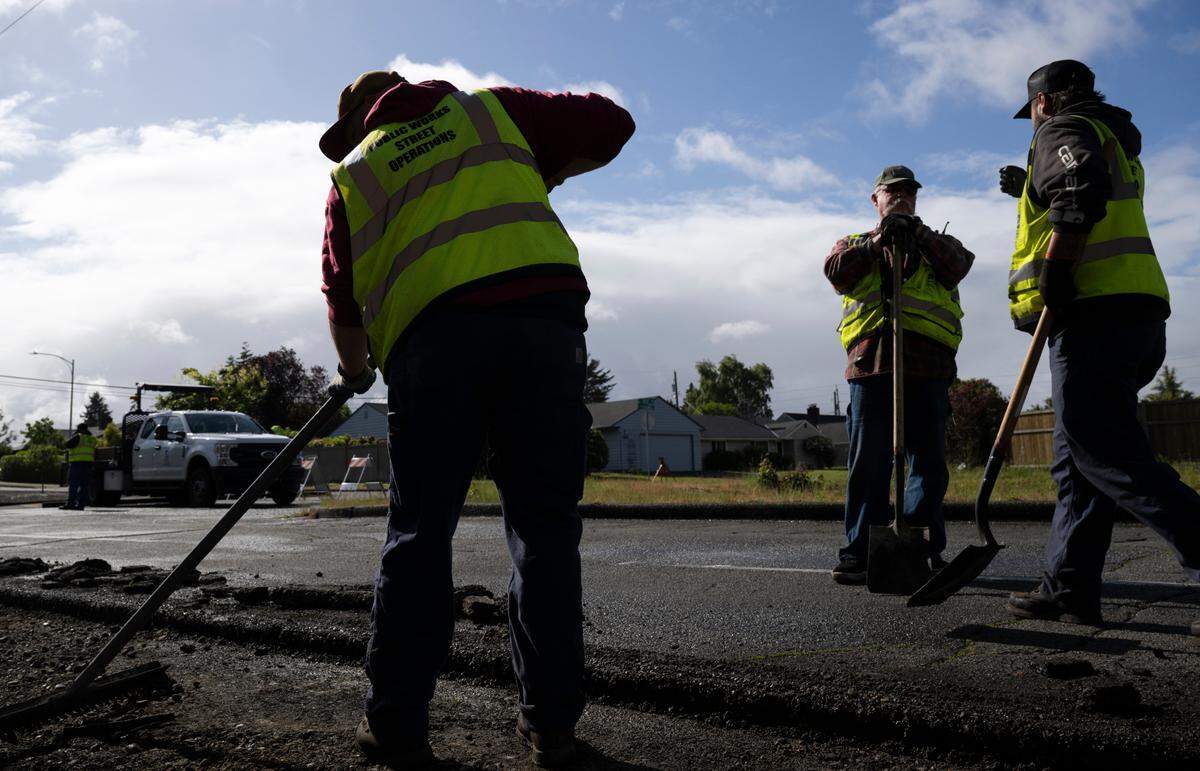
The repavement project Monday in the 5600 block of North 21st Street brought elected officials and news crews to spectate as the city ushered in the first day of a week-long campaign it called “Pothole Palooza.” The branded name for a series of arterial-focused projects — two daily through Friday — represented an effort by Tacoma to increase the visibility of the work performed by the city’s Street Operations Division.
The invitation to observe the road crew in action also offered an up-close view for the uninitiated to learn how a project is completed.
How quickly did it finish?
Work on two North 21st Street westbound lanes began at 9 a.m. The city said asphalt removal and subsequent repaving wrapped up by 5:30 p.m. After providing time to allow the road to dry, the city reopened the lanes to traffic around 6 p.m.
How much did it cost?
The project itself cost an estimated $50,000 to $75,000, according to Rae Bailey, the city’s Street Operations Division manager. The equipment was much more expensive. Tacoma currently has just one milling machine in its inventory and was renting the one used Monday, although the city planned to ultimately purchase it. The cost to own? About $600,000, according to Bailey.
How was this road chosen for repaving?
Despite being part of “Pothole Palooza,” there were no potholes to be fixed on the stretch of North 21st Street or on any other streets chosen for the campaign. All were undergoing pavement replacement in an attempt to prevent potholes in the first place, Lee said. While potholes necessitate isolated repairs, prospects for repaving are considered by reviewing pavement-quality scores, complaints and whether an area is under-served, Bailey said.
For North 21st Street, feedback had been a driving force.
“We get so many complaints about this (section), we figured we’d just come in and do it,” Bailey said.
What did the work entail?
The milling machine — capable of speeds up to 4.7 mph, or 2.2 mph while milling, according to the manufacturer — chewed through the 3- to 4-inch thick pavement in half-lane increments. It took four passes, beginning each time at the same starting point, for the machine to remove the asphalt from both lanes.
The machine, driven by a city worker from an open-air seat atop it, has several hundred carbide-tipped “teeth” it uses for grinding. Each so-called tooth is about 2 inches long and an inch wide, according to Bailey. Through a long conveyor unit in its front, the machine essentially spit 2- to 3-inch wide asphalt chunks into the back of a dump truck it trailed.
Some of the roughly dozen city workers assigned to the project were out with brooms, asphalt rakes and shovels. Workers personally removed pavement near the gutters because the machine, which can chew up concrete as well, purposefully stayed 2 to 3 inches away from the gutter line.
Once the pavement is pulverized, it isn’t necessarily useless. In projects like this one, it will either be hauled out to a waste site or be recycled to make new asphalt later on “down the road,” Bailey said.
The next step after removing asphalt is to replace it. A repaving machine covers a wider territory than the milling machine. It can tackle one lane at a time, meaning only two passes were required to lay down new asphalt. Since rain was routinely an issue, Bailey said that the city would use tape for street lines, returning sometime later to paint.
He added that it was hoped the new pavement would hold up for 15 to 30 years.
What can residents do?
In short, Tacoma residents should dial 311 to report potholes or road concerns. If you’re outside city limits, you can call 253-591-5000. People may also visitcityoftacoma.org/TacomaFIRST311.
Council member Jamika Scott reiterated the importance of not only encouraging feedback on road condition but also responding to it as a city.
“I think that really helps lend people to be like, ‘OK, I feel like we’re being heard, I feel like people are listening to us,’” she said.
Council member John Hines said that city officials recognized that Tacoma had not historically invested in streets but assured that it was seeking to do so now to the best of its ability.
“While your road itself may not have been addressed, we have a commitment to get to everybody’s roads, and there are lots of roads we have gotten to,” Hines said.
As far as Pothole Palooza, which both elected officials cited as being key to illustrating the city’s efforts publicly, it appeared destined to return on an annual basis.
“We can’t let it go away now that we’ve got ‘Phil the Pothole,’” Scott said.
For those not in the know, “Phil the Pothole” is the purple, three-eyed creature drawn up to be Pothole Palooza’s official mascot. He did not make a physical presence Monday. Maybe next year.
With construction season upon us, The News Tribune will examine the state of Pierce County’s roads and streets over the next several weeks as part of its In the Spotlight initiative.
This story was originally published June 5, 2024 at 5:00 AM.