‘Not everything is going to fit everywhere.’ Home in Tacoma Phase 2 plans get first look
Members of Tacoma’s City Council got an extensive review at their Tuesday study session of where Home in Tacoma’s Phase 2 is headed.
Tuesday’s presentation offered the final recommendations from the city’s Planning Commission.
Home in Tacoma is a part of the city’s Affordable Housing Action Strategy and focuses on allowing more types of housing beyond single-family dwellings in more parts of the city, introducing different building types and the option to create more parcels through subdividing lots.
Planning Commission chairman Chris Karnes explained the motivations behind the plan in Tuesday’s presentation.
“Tacoma must not only meet the policy standards that are in state mandates, but we also need to meet numeric targets for housing units by income level,” he said. “So for example, households with the 50 to 80% area median income, we need to be prepared to accommodate 6,283 units by 2044, and those units need to be satisfied with housing types with particular housing unit costs.”
“And one of those housing types to be able to meet that standard is small multifamily, which is part of middle housing,” he added.
Middle housing buildings are designed as residences that fall between single-family homes and large apartment/condo sites with the goal of encouraging a broader spectrum of ownership and/or rent rates.
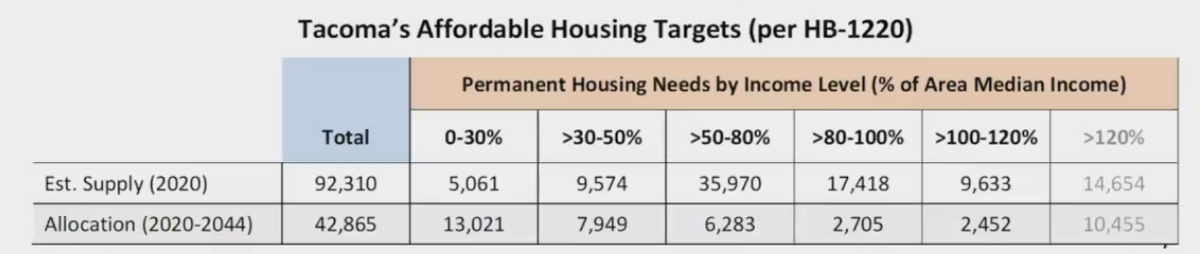
For those in the 0-30 percent of area median income, the presentation noted that 13,021 units would be necessary to meet the city’s housing target by 2044.
“When you’re into the low income and the extremely low income, when you compare the existing supply to the projected need over time, some of those numbers are quite significant,” said Planning Division manager Brian Boudet in his presentation to council.
“When we talk about what is ultimately needed, in some cases, it is subsidized housing to get to the deepest levels of affordability,” he added.
Details of Phase 2
Phase 1 of Home in Tacoma was approved by council in December 2021 and established basic policy direction and vision for new housing.
Phase 2 focuses on residential zoning, new housing types/standards allowed within zones and other implementation features.
Along with meeting or exceeding in some cases state affordable-housing mandates, Phase 2 is a reflection of priorities set since that time following residents’ input of more than 1,500 submitted comments. Those elements include tree-canopy standards, health and environmental impact analyses, building retention and new development incentives to help maximize benefits to the city.
Development “bonuses,” reviewed every three years, would be offered to help boost density, allow for tree credits and bring more “deeply” affordable housing that would expand the reach to different income levels, among other elements.
Karnes explained that one element added to the bonus-incentive structure: “visitability requirements” for middle housing. This is a measure of ease of access to a residence for people with disabilities, so it can be lived in or visited by people who have trouble with steps or who use wheelchairs or walkers.
For example, “In the bonus-one element of the program, we do require one of the units to be visitable and sort of meet the bare minimum level of support for people with mobility needs,” he told council.
Other features of Phase 2, according to the city’s summary sheet, include:
ZONING RECLASSIFICATION: Areas of the city that would come under Home in Tacoma would see three zones applied based on location: UR-1, UR-2 and UR-3. The first two would accommodate smaller, low-scale development and the third one would be applied to mixed-use commercial districts and larger multifamily unit projects.
TYPES OF BUILDINGS: Housing type definitions for all zones could include a “houseplex” (house or other single building with up to six units), “backyard building” (behind another structure at the rear of a lot, which may contain a garage), “rowhouse” and “courtyard housing.” A “multiplex” (seven or more stacked units with the appearance of a large house or a small apartment building) would only be allowed in UR-3.
PARKING: Parking requirements relaxed from 2 required spaces per dwelling to 1 to 0.5 spaces per dwelling based on zone. No parking is required near transit, consistent with state legislation. Also, there’s no parking maximum, so builders could offer more than minimum required. New parking spaces for bikes are part of the plan as well as some short-term bike parking for visitors.
TREES: Planting new trees, retaining existing trees, or some combination, would be required for minimum “Tree Credits”. Optionally, a fee in lieu of planting also is available in cases where planting/retaining for credits is impossible. The project’s summary also states that retention of existing trees would be required based on tree size whether or not new development is proposed, and any removal of trees with trunks over 18” in diameter would require a variance.
Does it go far enough?
As was reiterated by Boudet, the main presenter at the meeting, Home in Tacoma does not eliminate single-family housing nor does it eliminate the restrictions in private covenants or special requirements in areas designated as historic.
Council member Sarah Rumbaugh’s District 2 includes Northeast Tacoma, where, she noted, few options exist to bring affordable housing amid special districts, view-sensitive restrictions, HOAs or private covenant arrangements already in place.
“I feel like one of the issues is when we look at the city, we want to make sure that development can happen everywhere,” Rumbaugh said. “It would be great some time to talk about specific neighborhoods and what other tools we might have available to make some of the great things in Home and Tacoma happen in more parts of the city.”
Boudet noted that in the areas Home in Tacoma doesn’t touch, there is little the city can do short of a rezone.
“The state did take some action this last year, I think, to make it so that new covenants in new neighborhoods would not be able to prohibit the types of housing types that the state is now mandating,” he said. “But that did not retroactively apply to any existing private covenants.”
“The reality is that not everything is going to fit everywhere,” Boudet noted in response to a separate question from Deputy Mayor John Hines.
Karnes acknowledged the challenge of accommodating requirements versus feedback (including a prior public hearing), juggling land space, parking, trees and building sizes.
Testing of scale and proportion of over 30 middle housing configurations were run, using prototype land lots, along with economic feasibility studies.
“We really did wrestle with a lot of the trade-offs after the public hearing,” he said. “The Planning Commission did consider 32 different amendments to the entire package that increase or decrease parking requirements and a number of other elements of the plan.”
Hines, who helped bring changes to the city MFTE program in 2021, also expressed concerns about meeting the project’s original intent to bring more types of housing to more places in the city.
“We need more housing in our community,” he said. “That’s the No. 1 thing in my mind that we need to be looking at. And I think when we talk about every other requirement that we want to place on here, it has to be balanced with the fact that we don’t have enough places for people to live in our city.”
“I just look forward to talking to my colleagues about what we can do to try to make sure that when we look back 10 years from now, we don’t say, ‘Man, if we didn’t do that, X, Y and Z, we may have gotten all the housing we wanted to see.”
Community informational meetings will be scheduled soon, and a public hearing on the recommendations will be held at the Sept. 24 council session. The hearing date was moved by council action Tuesday night from an earlier scheduled late-August date to allow for more residents’ participation by not conflicting with summer vacations and the Labor Day holiday.
The proposal likely will see additional revision and amendments before final council approval later this year.
The city hopes to still meet the Feb. 1, 2025 effective date for Phase 2, city manager Elizabeth Pauli said at Tuesday evening’s council meeting.
For more information
Story updated Aug. 1 to clarify Home in Tacoma in relation to private covenants and special requirements in areas designated as historic.
This story was originally published July 31, 2024 at 1:10 PM.