
Former three-term Washington Governor Dan Evans dies at 98
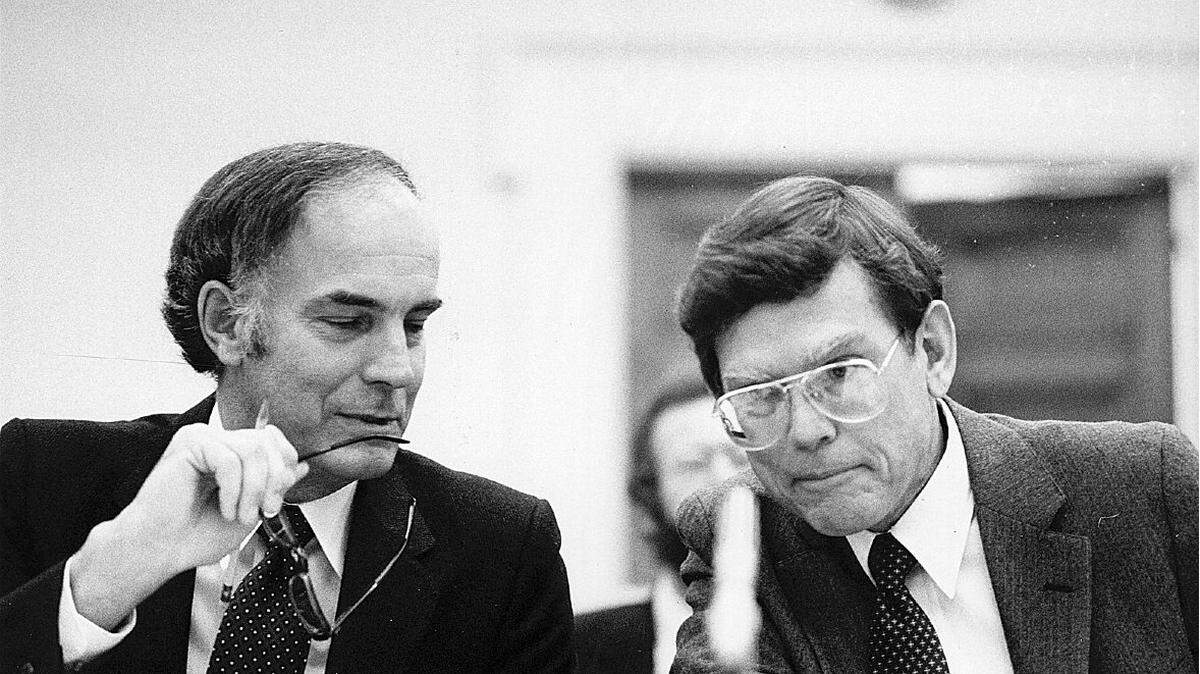
Tall, smart, athletic and blessed with a commanding voice and an integrity that earned him the nickname “Straight Arrow,” former Gov. Dan Evans, who died Friday at the age of 98, had all the qualities of a great politician, but a growing distaste for one aspect of the job: politics.
Make no mistake. As Washington’s three-term Republican governor (1965-1977) and one-term U.S. senator (1983-1988), he enjoyed honest, vigorous debate. And as a campaigner, he had few equals. His failed bid for the presidency of his junior class at Roosevelt High School in the 1940s marked the last political contest he lost.
But as he watched politics became more polarized, and government grow less effective, Evans could no longer contain his frustration.
“I have lived through five years of bickering and protracted paralysis,” he wrote in a 1988 New York Times Magazine piece explaining his decision not to seek re-election to the Senate. “I just can’t face another six years of frustrating gridlock.”
For a man who in past decades had been considered a possible Republican vice-presidential candidate, stepping away from political life was not easy. But he remained in public service, most notably as a University of Washington regent from 1993 to 2005.
“Dad lived an exceptionally full life,” said Evans’ sons Dan Jr., Mark and Bruce Evans in a written statement. “Whether serving in public office, working to improve higher education, mentoring aspiring public servants … he just kept signing up for stuff right until the end. He touched a lot of lives. And he did this without sacrificing family.”
Daniel Jackson Evans, born in Seattle on Oct. 16, 1925, learned an appreciation for wilderness early, summiting Silver Peak in the Cascades at age 12.
At home, the son of a one-time King County engineer and the grandson of a state senator from Spokane learned to be informed and involved.
After graduating from Roosevelt in 1943, he entered the Navy, serving as an ensign. After World War II, he studied engineering at the UW, earning a bachelor’s degree in 1948 and a master’s a year later.
He returned to the Navy as a lieutenant in 1951 during the Korean War, serving until 1953. He married Nancy Bell in 1959. The pair went on to have three sons.
“They were a great partnership,” Dan Evans Jr. said in an interview Saturday. “And I think my brothers and I all recognize just how much he accomplished. He couldn’t have accomplished any of it without her and without literally hundreds of staff members that supported him in all his years in elected office, you can’t achieve a lot without a great team.”
Before entering politics, he was a civil engineer and worked as a structural engineer for the city of Seattle and in private practice.
His life in office began in 1956, when he was elected to the state House of Representatives from Seattle’s 43rd District. Named outstanding freshman legislator that term, he was re-elected to the House three times.
Evans’ background in engineering, some have suggested, helped shape his outlook that problems, even difficult ones, can be analyzed and solved if the proper steps are taken.
The “Blueprint for Progress” he outlined in 1964 helped him become, at 39, the youngest governor in state’s history, defeating the two-term incumbent, Democrat Albert D. Rosellini.
Viewed as one of his party’s rising stars, Evans was chosen to deliver the keynote address at the 1968 Republican National Convention in Miami.
“Leadership encumbered by the past must surrender its place to the party whose hope lies with the future,” he told the convention that would launch Richard M. Nixon’s successful White House bid.
It’s been said that Nixon would have offered Evans the vice-presidential slot on the ticket if Evans would support him, but that Evans preferred Nelson Rockefeller.
Evans was re-elected governor in 1968 and 1972 — the latter a rematch against former Gov. Rosellini.
Education and the environment were key priorities in Evans’ lengthy tenure. He led a large-scale expansion of the state’s community-college system and helped strengthen the state’s four-year colleges.
He helped create North Cascades National Park and Alpine Lakes Wilderness Area. In 1970, he called a special legislative session to promote environmental protection, which led to the creation of the Department of Ecology.
His embrace of Vietnamese refugees in the aftermath of the fall of Saigon in 1975 — amid resistance from then-Gov. Jerry Brown of California — became one of his lasting legacies.
“Here were people who were being driven from their home country, had no place to go, and we were trying to reject them?” Evans recalled in an interview with The Seattle Times in 2015. “It didn’t make sense.”
Evans dispatched a top aide, Ralph Munro, who would later be secretary of state, to a California camp to tell the new arrivals they would be welcome in Washington state. Evans ordered every state agency to aid in resettlement. He asked churches and nonprofits to chip in. He recruited families to accept refugees into their homes.
Not all Evans’ efforts ended in successes. He was rebuffed in his advocacy for a state income tax — among the issues that put the centrist governor at odds with the increasingly conservative leaders of his own party.
His name became a label: An office seeker described as a “Dan Evans Republican” was one who combined a social commitment and environmental ethic with a strong sense of fiscal responsibility.
He was hailed as one of 10 outstanding governors of the 20th century in a 1982 newsletter of the National Governors Association.
After leaving the governor’s office, he served six years as president of The Evergreen State College in Olympia, famously rappelling down the campus clock tower in response to a challenge.
In 1983, at the unexpected death of longtime Democratic Sen. Henry M. Jackson, Evans was appointed by a fellow Republican, Gov. John Spellman, to temporarily fill the Senate seat.
Democrats complained that Spellman should have chosen someone from Jackson’s own party to succeed him, but Evans was a strong choice, winning the seat in a special election within months of his appointment.
A measure of the bipartisan admiration for Evans is that 10 years after that race, the man he soundly defeated, Mike Lowry, had become governor and appointed Evans to the UW Board of Regents.
In 2000, the University of Washington’s Graduate School of Public Affairs was renamed as the Evans School of Public Affairs, and was renamed in 2015 the Daniel J. Evans School of Public Policy and Governance.
Evans’ wife, a former music teacher and librarian in the Shoreline School District, died of breast cancer in January at age 90. UW’s Nancy Bell Evans Center on Nonprofits and Philanthropy had been named in her honor in 2004.
The former governor had a love for Husky football and was planning on attending Saturday’s game against Northwestern.
Evans Jr. remembers his father as someone who was always trying new things. He stitched Christmas stockings for all nine grandkids. Evans also spent time making jam and jellies in his later years.
“I always feel like he did a lot of stuff, and ‘stuff’ is a pretty low-bar word to use, but professionally, personally, it’s pretty impressive for one person,” Evans Jr. said.
His father was an avid hiker and skier who loved to travel.
“We all have treasured childhood memories of hiking, skiing, and traveling with Dad, which in hindsight is remarkable given the demands on his time,” his sons said Saturday. “His loving partnership with Mom was truly special and we know losing her was tough on him. We deeply appreciate all the friends and family who took the time to reach out to Dad in the months since her passing.”
This story was originally published September 21, 2024 at 1:51 PM.