‘Given me my life back.’ Pierce County rehab center looks back on 70 years of service
He doesn’t remember all of it, but Randy Collins can easily recount the doctors urging his family to let him die, the operations and finally, the rehabilitation.
Those were the early days following a head-on collision when he wished he had died.
He was 39 when his life changed forever in the sandy dunes of an Oregon park. The once hard-charging parcel-delivery service employee is now 11 years older, uses a wheelchair, deals with poor eyesight and has memory issues.
Despite all that, Collin says his story is one of success. While the rehabilitation at MultiCare’s Good Samaritan Regional Rehabilitation Center in Puyallup didn’t fully return his life, it’s given him the best life he can have. Today, he volunteers at the rehab center.
“This place — helping other people — gives me a reason to live, gives me a reason to get up,” he says. “Coming here has given me my life back.”
The rehab center is marking its 70th anniversary in 2024.
Welcome to rehab
Patients like Collins often go through a two-step process when they are admitted to the rehab center: psychological and physical.
“One is face up to the losses,” said Dr. Erv Severtson, one of the founders of the rehab center’s psychology program in 1966. “The medical people have to tell you what isn’t working and what’s the probability that some compensatory strength can be found to take the parts of your body, your brain, whatever that still works, and try to build a life with them.”
The other aspect of rehab is physical.
“You try to find every possible strength that remains, physical, emotional, social, spiritual, whatever, and help that patient build a life with the strengths that remain,” he said.
Today, some 600 patients are admitted every year to the Good Samaritan Rehabilitation Center, according to director Jacob Woolman. They stay an average of 17 days and receive about three hours of therapy a day.
It’s one of only three Level 1 trauma adult rehab centers in the state. Other, smaller rehab programs are closing in Washington, he said.
“Rehab is costly,” Woolman said. Insurance companies want to send patients to smaller, cheaper facilities. Wherever the patients go, providers are buried under paperwork and documentation that Medicare and Medicaid requires.
“And you can’t do that with a small program,” he said. “So the dynamic is to shift to these bigger programs like ours, where we’re focused on the neuro population.”
Outpatients
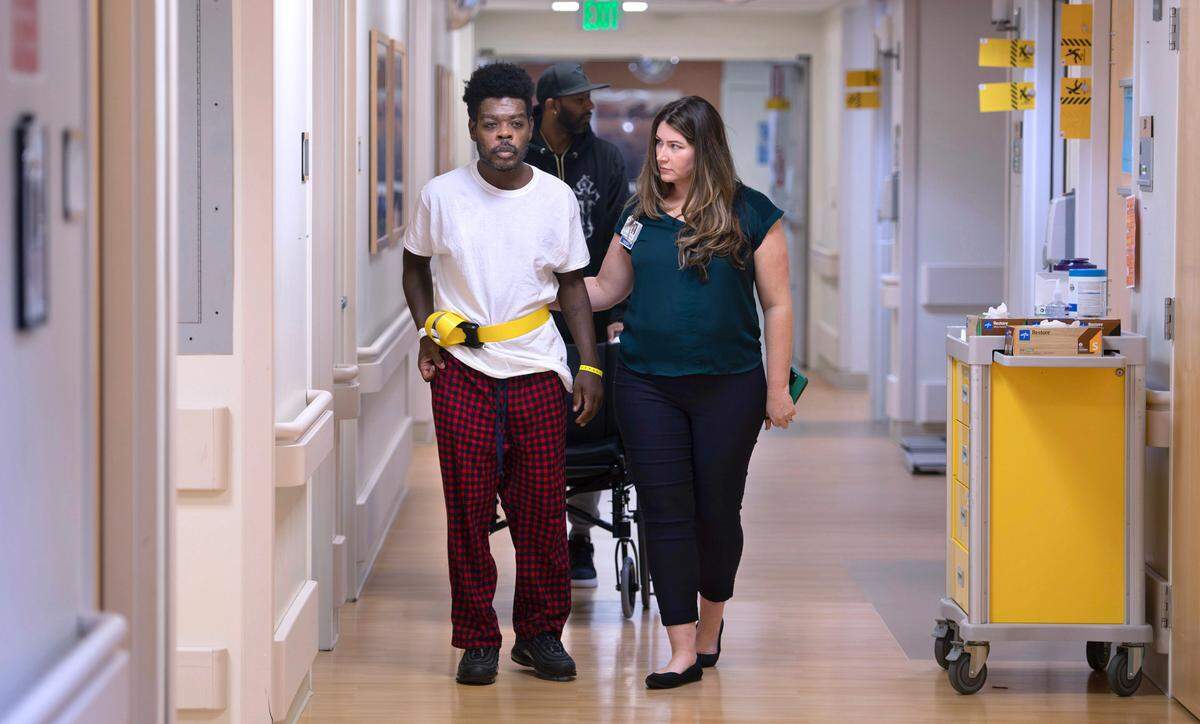
For outpatients, the clinic handles 500 appointments every week. The bulk of those are physical, occupational and speech therapy.
About half of patients at the rehab center are dealing with the aftereffects from a stroke. Other patients have brain and spinal cord injuries. Still others might have had a major medical event where they have lost the ability to walk, get themselves dressed, get out of bed or perform other daily routines. Those patients spend time in occupational therapy. The term is somewhat misleading as it has nothing to do with returning to work.
“How do we get dressed in the morning? How do we get out of bed? How do we shower or bathe ourselves? How do we kind of function in our day-to-day activities? All the things that we kind of take for granted that most of us do, brush our teeth, comb our hair, get out of the car, those kind of things,” Woolman said.
Some patients arrive following heart surgery. Others are dealing with Parkinson’s or a hip replacement.
Patients are aged 15 and up. Good Samaritan’s Children’s Therapy Unit sees pediatric patients.
Inpatients
On this busy Thursday morning, patients are going through a variety of therapies. Everyone’s story is unique.
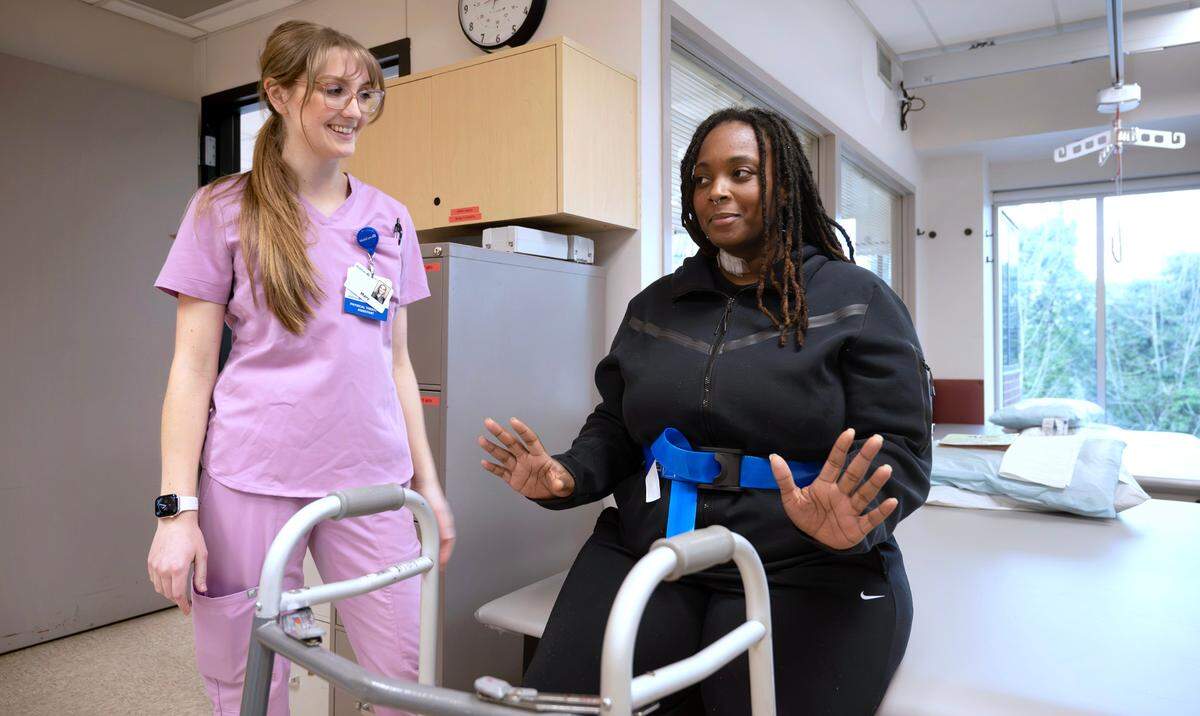
Shaunece Yates, 35, was rough housing with her two sons, 3 and 10, in early December when she fell backwards in her Seattle home. She felt shooting pain but figured it would go away.
“Day two is when I drove myself to the emergency room,” she said. Doctors told her she had crushed the top of her spine and needed emergency surgery.
Just a few days later she was sent to Good Samaritan. On this day, she was going through exercises with physical-therapy assistant Mary Hagen. Yates is trying to build back muscle strength on her right side.
“My goal is to get home for Christmas,” she said.
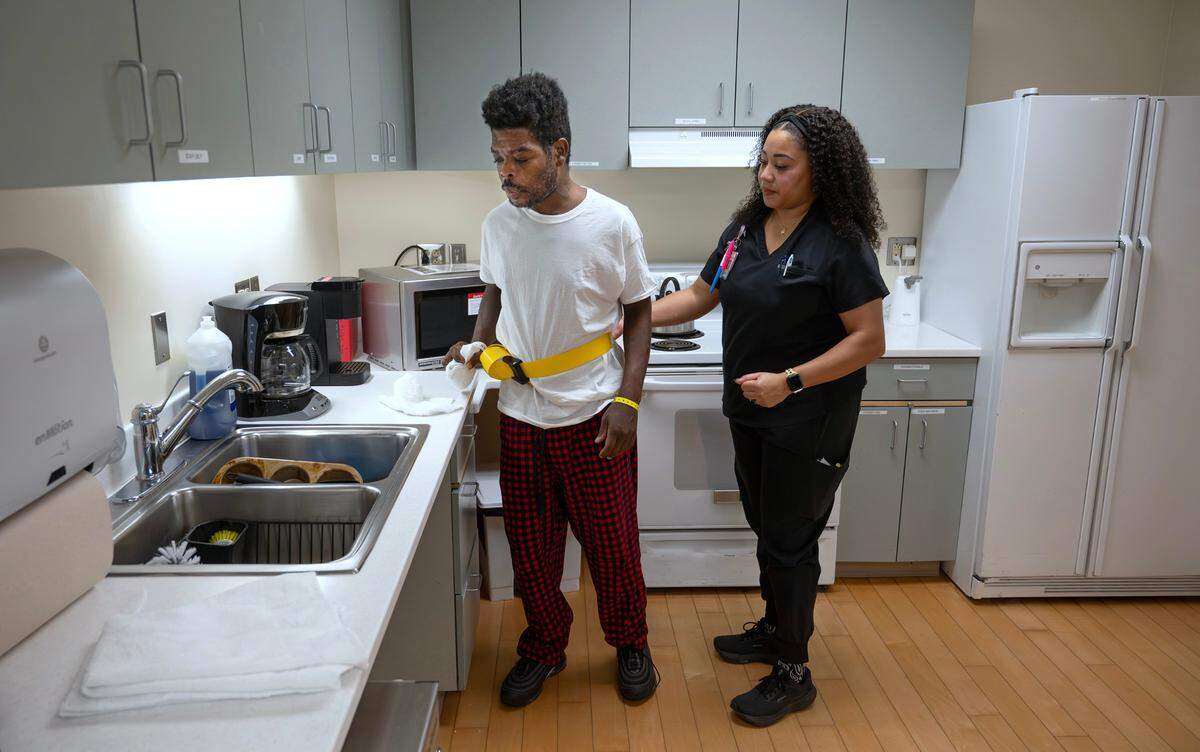
In another part of the facility, Leo Roberson, 43, was making scrambled eggs. What is a simple task for the average adult is occupational therapy for him.
Roberson, a security guard from Graham, had a stroke recently. It’s his third and worst to date. He’s worried about returning to his Seattle job.
“I can’t drive because my left peripheral vision is messed up,” he said. “I can still move around, but my left side was a little bit weaker than my right side.”
He works on his eyesight and muscle strength and other therapies three hours a day.
“My therapist, she kicked my butt yesterday,” Roberson said. “I was so sore yesterday. But she’s showing me the muscles that I need to use.”
He has a quiet perseverance that reflects his upbringing in Chicago and Tacoma, he said.
“Where we come from, you just got to roll with the punches,” he said. “You just keep going, no matter what.”
From patient to staffer
John Haugh broke his neck in 1994 during a game of pickup football when he was 26.
“I tackled the guy and I was paralyzed instantly,” he said.
Within a week of his injury, Haugh was in rehab at Good Samaritan. Now a quadriplegic with limited use of his hands and arms, he gets around the rehab center in a wheelchair.
But he’s no longer a patient. Haugh has been a social worker at the facility for 16 years.
“A lot of the staff that are here were here when I was patient,” he said.
Unable to continue his previous career in construction, he attended Pacific Lutheran University and then the University of Washington Tacoma where he obtained his master’s degree in Social Work.
Today, Haugh helps discharging patients and their families access community resources, which can be meager, he admits.
“Out there in the community, people tend to think there’s a lot more available than there is,” he said.
Haugh is part of a multi-disciplinary team of doctors, nurses, physical therapists, occupational therapists, speech therapists, case managers and others who meet every morning to talk about patients.
“Just so everyone’s on the same page,” he said.
His position as a former patient gives him credibility among current patients, he said. With other staff, patients might respond to advice or direction with, “How do you know? It’s never happened to you.”
“They never say that to me,” Haugh said. “I can get away with saying things that most people can’t or won’t. Patients and families appreciate that.”
The therapists
Most patients don’t ease into the rehab center. Instead, they often arrive after a cataclysmic alteration of their lives.
“They go from being completely independent to dependent on everyone,” said occupational therapist Cathryn Shaffer. “All their choices have been taken away.”
Her role, like the other therapists on staff, is to return them to that life of independence as much as they can.
“We help empower them, show them what’s possible and give them hope for the future of returning to being more independent,” she said.
Recreation therapist Debbie Jankanish said listening to what patients want out of life is key to successful therapy.
“When we ask, what’s your goal, we want to know more than just, ‘I need to walk to my kitchen,’ or ‘I need to make an egg,’“ she said. “We learn that someone loves to go fishing or they love to garden. What is it going to take to get someone back to those things which really promotes life and activity?”
While rehab, like much of medicine, has seen tremendous technological and strategic advances over the past 70 years, it’s not immune to the pressures of health insurers and their endless drive to push down costs.
“Patients who we used to see come through our doors are going home immediately (after a health emergency),” Shaffer said. Those patients could have poorer health outcomes as a result of those early discharges.
Jankanish has been a therapist for 35 years. She’s seen rehab stays get shorter over the decades. She said the therapy world has compensated by connecting patients with outside programs, groups and fellow patients. Good Sam therapists also make home visits to help patients transition back to home living.
Erv’s story
Perhaps no living person in the rehab center’s history has seen more changes and been on all three sides of the provider-patient-family dynamic than 90-year-old Severtson. He has worked there as a health provider, overseen his wife’s care there and finally, been a patient at the center.
Severtson was recruited to the rehab center to found its psychology department in 1966. In 1986, he left to teach at Pacific Lutheran University. After he retired from the college, he went back to work at Good Samaritan for another 10 years.
Severtson found himself back at the rehab center in 2015 after his wife, Nancy, was recovering from a coma and sepsis following a botched surgery.
“When Nancy was injured, they didn’t think she would live when she was in a coma. They didn’t think she would wake up when she was on a respirator. They didn’t think she’d ever get off it,” he said. “But always in the back of my mind, my goal was to get Nancy to the place where she could be accepted into rehab.”
It was a “day of celebration” when she entered rehab, he said, “because I knew whatever function potentially she could have, she’d gain it there.”
When she returned home, Severtson found himself a caregiver in his late 80s. Then things got worse one August day in 2020.
“I was in the shower. I think I fell asleep on my feet,” he recalled. “I have no memory of falling, and that’s where I did the initial damage.”
The fall broke his neck. He’s now technically a quadriplegic although he’s able to walk using a walker.
“I’ve been incredibly healthy, and so it’s frustrating to me to walk with a walker,” he said. “But it also kind of reminds me of all the (spinal) cord-injured patients I worked with, and fortunately, I never said, ‘I know how you feel,’ because you don’t know how another person feels who’s had a severe injury.”
Nancy died in 2021, but he was able to resume his caregiving the last few months of her life.
“I have an apartment in the Proctor District, live alone and look at Metropolitan Market out my window,” he said of his current life.
He doesn’t regret his career.
“Rehab is a great enterprise, and, if I had a life to spend over again, I’d spend it in rehab,” he said.
Randy’s story
The ATV Collins was driving in sand dunes near Coos Bay, Oregon, was hit head-on by another, much larger ATV. Collins was sent flying 20 feet into the air, his brain bouncing against his skull. One hand was hanging by just a thin strip of flesh. He was airlifted to Portland for life-saving treatment.
“I technically died two, maybe three times,” he said.
More than a decade later, Collins’ life is a shadow of what it once was, but it’s still a life.
“I’m doing stupid stuff like cleaning and stocking,” he said while wiping down counters. “They make sense to the staff and patients and making this staff happy makes me happy.”
After his shift is over, he visits patients in their rooms. Even if his message is the same as a therapist’s, he knows it carries a different weight.
“There’s tons of people that see me every day and think, if he can do it, I can do it,” he said.