
Spring forward? More like rain down. PNW to get soaked after Daylight Savings hits
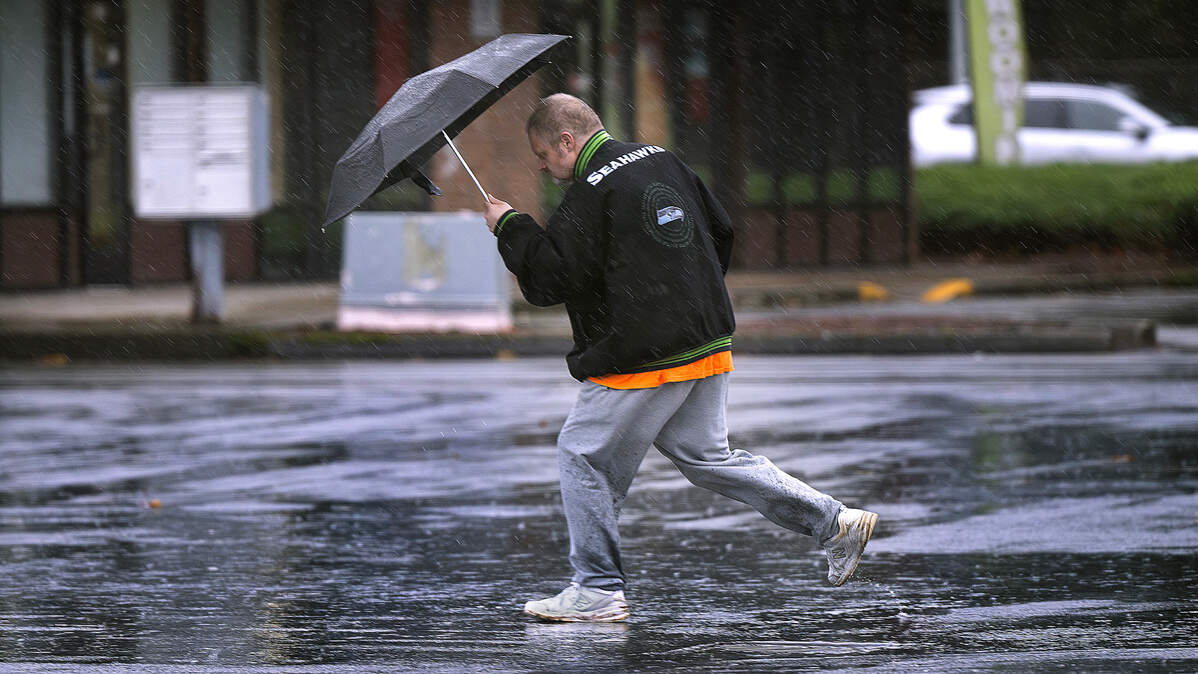
Two dreaded terms will soak the Pacific Northwest this week.
As Daylight Savings Time takes hold Sunday at midnight, the word “rain” is mentioned 11 times in the National Weather Service forecast for greater Seattle and Tacoma.
Showers are expected to begin Saturday afternoon, with mild temperatures in the mid-50s and occasional gusts. While grappling with that lost hour of rest, it will almost definitely rain on Sunday — up to a quarter-inch, according to NWS.
It will continue raining as temperatures dip into the 30s at night.
Expect more drops through the workweek, as temperatures hover in the 40s. Snowflakes might join the cast and crew as Wednesday night looks to Thursday’s inevitable sunrise.
The busy-busy state capital won’t see reprieve and will endure a bit more chill, bottoming out at water’s freezing point Thursday night.
It’s a similar story around the edges of the Olympic Peninsula: rain, 40s, rain, 40s.
Meanwhile, snow is likely to continue in that mountain range and in the Cascades, but temperatures are beginning their annual upward climb — lows are only as low as 23 next week.
NWS SEATTLE PUBLIC ZONE CHANGES
As St. Patrick’s Day rolls around, NWS is preparing to shift how it groups geographical areas for more precise, community-based forecasts. They’re called “public zones,” and they are changing!
The Seattle office can issue weather headlines down to the county level, but Western Washington is a complex region with very nuanced weather patterns — compliments of the Pacific Ocean, the aforementioned mountains, and the varied inlets that make Puget Sound, well, a sound.
The existing “public zone” approach is generally structured by city: Tacoma Area, Everett and Vicinity, Seattle and Vicinity. Bellevue actually has its own, as does Bremerton. Then there are some counties, as in San Juan and western Whatcom, as well as geographical breakdowns like East Puget Sound Lowlands, West Slopes North Cascades and Passes and Hood Canal. The broad strokes of this strategy “can result in considerable over- or under-warning of communities due to their size and climatological diversity contained within each zone,” NWS writes on its website explaining the change.
As investigations continue into the effectiveness of a new emergency warning system in Los Angeles after the devastating January wildfires, NWS-Seattle explains that as it currently stands, “an entire zone may be alerted when only a small portion of the zone is expected to experience the weather hazard,” or a warning may not be issued at all. “These limitations can cause confusion when trying to relay hazardous weather messages to our partners and the public.”
The new public forecast zones have been studiously chosen based on “elevation thresholds, local climatology, major transportation routes, and main population centers,” NWS says, with the goal of improving accuracy of any watch, warning or advisory for a multitude of weather events, including earthquakes, tsunamis, floods, wildfires and windstorms.
They will be most meaningful during Puget Sound Convergence Zone snowfall events, snowfall where mountain-valley areas are unaffected, coastal flooding and tsunamis.
All told, NWS believes the reforms will provide a more specific, on-the-ground service to the public and agency partners.
A couple zones won’t change, including the Olympics (but Port Towsend will move into a standalone zone, as will Lake Crescent with Route 101) and San Juan County. Others will refocus on elevation, as in Cascades of Pierce and Lewis Counties, Foothills and Valleys of Pierce and Southern King Counties, and Lowlands of Western Whatcom County. The City of Seattle will be separated from “the area,” and the Eastside will get its own zone.
Parts of Pierce, King and Snohomish counties have often been subject to over- or under-alerting, said NWS. The rezoning — to be called Eastern Puget Sound Lowlands — will allow for “greater local detail.”