Years ago, Tacoma neighbors wanted alley fixed. Plan’s return caused an uproar
The alley behind Evan Aeschlimann’s Eastside Tacoma home is rundown, peppered with potholes full of dirty spring rain and used most frequently by garbage trucks and neighbors accessing rear parking.
Tacoma offered a solution: For an estimated $408,000 to be borne by 23 property owners, the city said it could fix the entire gravel path splitting two rows of about a dozen homes each, including Aeschlimann’s, east of Pacific Avenue between South 43rd and 45th streets.
The project didn’t come out of nowhere. It was part of a proposed Local Improvement District (LID), which is designed to be neighborhood-initiated and allow property owners who seek infrastructure upgrades to partner with the city and invest in the cost.
A slim majority of Aeschlimann’s neighborhood had signaled support for forming an LID to repair the alley in a 2018 property-owner survey submitted to the city the following year. In the time that passed, there were dramatic changes in home ownership and opinions.
So when the city informed neighbors in January that the project was still alive based on the results of the survey, Aeschlimann and others who now live in the neighborhood say they were caught off guard.
Aeschlimann, 35, and his wife didn’t want the alley repaired. More accurately, they were opposed to forking over the nearly $17,000 it was estimated to cost them to improve their approximately 40-foot-long share of the path.
Aeschlimann also made a significant discovery: Of the 13 properties whose owners had supported the project in 2019, six had new residents, and the owners of four others no longer wanted it. The person who requested the survey was among those who moved.
Even so, a February hearing was scheduled by the city as the next step in the LID-formation process following the survey. Only a City Council vote remained afterward. When the rate of protest arising out of the Zoom hearing didn’t get beyond the city’s 50% threshold, city hearing examiner Jeff Capell recommended the project move forward.
Aeschlimann, who works from home as a graphic designer, scrambled to get the word out. He said many neighbors didn’t show up to the hearing or weren’t even aware of it, so afterward he knocked on doors and left information behind to try to persuade people to submit a formal protest and appeal the hearing examiner’s recommendation.
“It sort of defies logic that people who don’t live here, including the person who submitted the survey originally, they get a ‘vote’ on what happens,” he said in an interview.
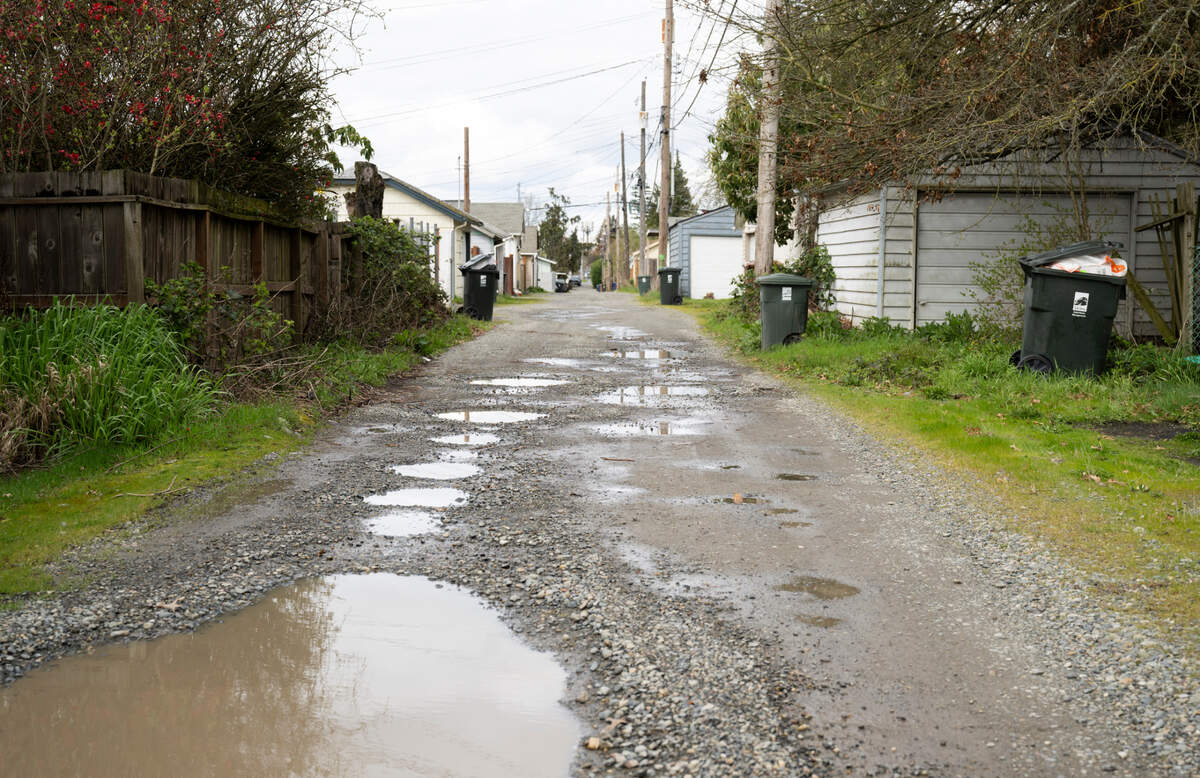
Earlier this month, Aeschlimann and others against the project received good news. Capell formally recommended that the alley repairs not move forward. In doing so, the city’s hearing examiner cited the current pulse of the neighborhood: Fourteen properties filed protests against the project, pushing the overall opposition to above 50%. Tacoma said it counted protests received even after the feedback window had closed.
From the city’s perspective, the public LID process had worked as intended.
The February hearing was crucial to afford property owners an opportunity to protest and to reflect the present views of the community, according to city spokesperson Maria Lee. The survey submitted by project proponents more than five years earlier was just a starting point to gauge interest, she added.
“The city knows that neighborhood perspectives can shift over time,” Lee said.
For Aeschlimann, the situation underscored a flaw in the system whereby such a gap between the survey and public hearing can force neighbors on the defensive about a supposedly neighborhood-driven project they might not want or have known about.
“I don’t know if it’s just a broken process. There seems to be no deadlines or timelines imposed on this,” Aeschlimann said. “If it can be six years later that this is coming up, can it be 20 years later?”
Local Improvement Districts’ long history
Local Improvement Districts allow property owners to collectively pay — over a 20-year period with interest — for infrastructure upgrades that would benefit their property values, such as pavings, sewers, streetlights and underground wiring, in partnership with the city. LIDs, which are managed by the city’s Public Works Department, aren’t unique to Tacoma.
The formation of any LID, which is governed under state law, starts with a property owner or interested party informing the city of an improvement they want. After the city evaluates the site, it prepares an advisory survey outlining a proposal, including estimated costs. The petitioner circulates it to affected neighbors, returning the document once they have collected signatures from owners who represent more than half the total estimated cost assigned to properties within the proposed LID, according to the city.
Once an appropriate level of support is confirmed, a public hearing occurs where the city’s hearing examiner accepts feedback, including protests, and then makes a recommendation based on project support about whether an LID should be formed. The City Council ultimately decides its approval.
LIDs have proven to be a valuable tool in Tacoma, providing an opportunity for local government and property owners to share in investing in vital public infrastructure improvements since 1895, according to the city.
“This long-standing commitment has resulted in thousands of successful projects that enhance quality of life,” the city said, adding that a vast portion of Tacoma’s core infrastructure owed its existence to the collaborative LID process.
There is currently no limit on how much time can pass between the circulation of an LID survey and a scheduled public hearing. There do not appear to be any state laws governing that length, either.
It’s not unusual for multiple years to go by, city records show, but it’s unclear if that gap had previously raised issues.
In an emailed response to detailed questions from The News Tribune, the city attributed the length of time between the 2019-submitted survey and February’s public hearing to the city’s efforts to group other projects into the LID for cost savings.
Officials seek opportunities to bundle multiple unrelated proposals under the same LID with the aim of attracting competitive construction bids and saving money for property owners, Lee said.
The alley repair was the sole proposed project in that part of Tacoma in 2019, according to the city.
It’s now one of three segments of a proposed LID — the others are unrelated plans in other neighborhoods that have garnered support, city documents show. It wasn’t immediately clear when the LID, including Capell’s recommendation that the alley segment not move forward, would go before the City Council for a vote.
Tacoma neighbors push back
Donelle Griffith moved into Aeschlimann’s neighborhood in November 2023. She purchased the home of the person who years earlier had requested the survey that launched the alley project.
“He doesn’t even live here anymore,” she said in an interview.
Griffith, a full-time student changing careers in her late 40s, noted that she missed the hearing because she was out of town. She said she opposed the work due to the cost — her share would be similar to Aeschlimann’s — and was concerned that improvements would encourage motorists to speed through the alley.
Some neighbors either never knew or had forgotten about the proposal until a January letter from the city informed them of the hearing, according to Griffith, who said she learned of the project after finding the petition in property documents dropped off by the previous homeowner six months ago.
“Most everybody just figured it had more or less gone away,” she said.
Tacoma employs a “robust public process” to confirm support in the aftermath of a survey, including by holding a formal hearing, the city said. It did not offer other examples of its process.
“We recognize that various factors, such as changes in property ownership or personal financial situations, can influence a property owner’s perspective between the time they sign a survey and the formal formation hearing,” the city said. “That’s precisely why the formation hearing is such a crucial step — it provides the official opportunity for property owners to confirm their support based on their current circumstances before the project moves forward.”
Aeschlimann said the city should have conducted a fresh survey instead of leaning on a years-old one to determine current sentiment. The city also should have noted his concerns about the now-obsolete survey during the hearing after he earlier raised the issue with the city’s LID administration, he said.
He said he and his wife learned about the proposal from the petitioner shortly after they purchased their home in May 2019 but heard nothing officially of it again until recently.
Not everybody had the time or ability to urge their neighbors to fight it, according to Kara Sale, Aeschlimann’s wife, who noted that the couple’s neighbors include a single mom and a disabled veteran.
Sale, 35, expressed frustration over what she claimed were difficulties getting information from the city. She said some neighbors didn’t understand the impact of an LID and told her they planned to simply ignore the cost if the project was approved. They were unaware, she added, that liens would be applied to their homes until the assessment was fully paid.
During the February hearing, Tacoma LID administrator Ralph Rodriguez said the city received a number of requests this year to improve the alley. Calls for action reportedly dated back longer than two decades.
Advisory surveys for that alley were requested on three occasions between 2000 and 2012 but never returned to the city, according to Rodriguez.
Under the proposed project, the entire length of the alley would be paved approximately 16 feet wide with asphalt wedge curbs on either side, storm drain lines and stormwater catch basins where needed. The improvement was estimated to cost $425 per accessible unit frontage or around $16,715 for a typical 40-foot lot next to the alley, the city said.
Lana Cooper, who was one of the 2018-19 survey’s signatories, announced during the hearing that she and a few others no longer supported the project.
“We were kind of for it until we got the sticker price and then we went into shock,” Cooper said.
Following the hearing, Capell left the record open another eight days for additional protests to be registered. When he issued a recommendation to move forward with the alley project on Feb. 24, the number of protests did not exceed 50%, according to a city filing.
In a chain of emails to the city’s hearing examiner after the hearing, neighbors expressed their displeasure with the proposed project and noted their protests, according to a copy of the chain provided by Aeschlimann. One neighbor said they purchased their property three years ago and knew nothing about the project. Another claimed people were prevented from voicing their opposition during the meeting, which the hearing examiner’s office denied, and another criticized the city for allegedly forcing the project on neighbors.
“You know we’re in a cost of living crisis in this country, and you’re shoving the price of a city project on residents?” the neighbor wrote. “It’s offensive.”
The hearing examiner’s office added the neighbors’ emailed declarations of opposition to the protest tally.
State law requires the city to track protests even up to 30 days from when a LID ordinance is passed. Formal opposition to the alley upgrade eventually surpassed the city’s 50% threshold.
As a result, Capell amended his original recommendation. He now advised against the project.