Here’s sentence for Ex-Sumner hoops coach convicted of sexually abusing players
Ex-Sumner High School boys basketball coach Jacob “Jake” Jackson was sentenced to 40 years in prison Thursday for sexually abusing eight players in a case that resurrected painful memories for many and underscored how a once well-regarded leader exploited his position of trust.
“(Jackson’s) actions have rocked the small community of Sumner to its core,” deputy prosecuting attorney Richard Weyrich said prior to the sentence being delivered. “These are lifelong harms for the eight victims.”
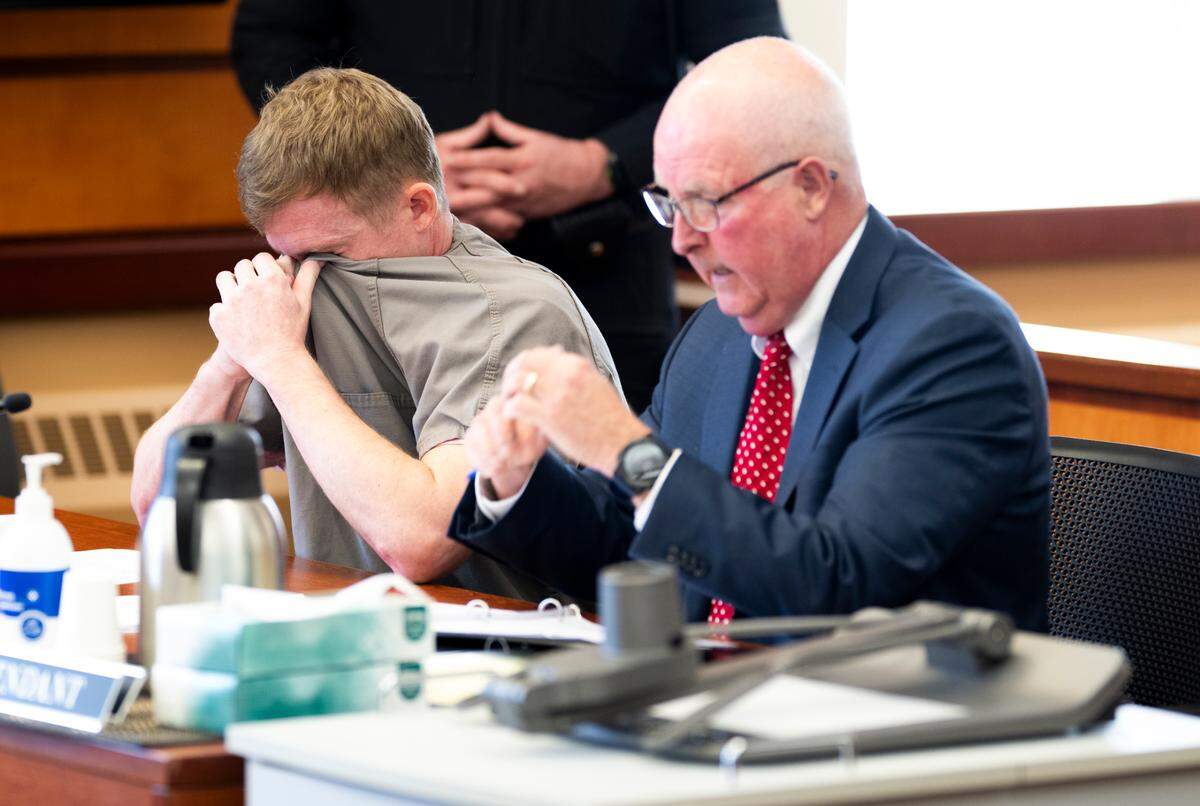
A jury found Jackson guilty on Jan. 30 of 19 crimes, including three counts of third-degree rape of a child and three counts of third-degree child molestation. Wearing a gray jail shirt, he sat unshackled at a courtroom table Thursday and listened to statements from several victims. Most letters were read on behalf of the victims by family, friends or an attorney.
One victim who chose to address the court himself described feeling hyper-vigilant and mistrusting in the aftermath of the abuse, saying that his innocence and security had been stolen.
“I lost the ability to see the world through the same eyes,” he said.
He added that he ultimately had chosen to speak up about Jackson and push fear aside.
“I’m not a victim,” he said. “I am a survivor.”
The News Tribune generally does not name sex-crime victims, who are typically referred to by their initials in court documents.
Ahead of the hearing in Pierce County Superior Court, prosecutors recommended an exceptional sentence of 80 years, saying it was on par with punishments imposed on other coaches in the United States convicted of sexually abusing multiple victims.
“The ongoing sexual abuse and betrayal of trust by a coach, who is meant to guide and protect children in his care, highlights the darkest side of humanity and warrants such an exceptional sentence,” prosecutors wrote in an April 8 filing.
The recommendation, effectively a life sentence for the 37-year-old former coach, appeared to catch Jackson and his defense attorney, Brett Purtzer, off guard.
Purtzer asked the court to limit sentencing to 10 years — the maximum allowed under the state’s standard sentencing range — claiming in an April 11 filing that prosecutors previously told Jackson 10 years would be the maximum penalty if he rejected a December 2023 plea bargain that had recommended five years in prison, which he did reject.
“At this time, however, the State seeks an exceptional sentence of 960 months, which is the first time that has ever been mentioned,” Purtzer wrote in the filing last week. “This recommendation violates the plea offers provided in this case and punishes Mr. Jackson for exercising his right to go to trial.”
Prosecutors denied making any promises to Jackson.
Superior Court Judge Philip Sorensen on Wednesday denied Purtzer’s motions to limit Jackson’s sentence to 10 years and to hold new trials separately with each victim. A day later, he ruled that there was a basis for a longer sentence than the standard range, including the duration of the abuse and the number of victims.
Before he was sentenced, Jackson read from a statement and appeared to be overcome with emotion.
“I am forever sorry for my actions,” Jackson said, and he asked the court to provide him “a second chance at life to prove I’m a changed man.”
Sorensen acknowledged Jackson’s remorse and sadness but questioned whether he was just unhappy because he had been caught. The judge emphasized that the victims’ parents were not at fault for the abuse and recalled that each of the victims were articulate in their trial testimony, as they spoke about subject matters that no boy should ever have to broach, he said.
Still, the judge said he agreed that 80 years was an excessive prison term and he reduced the state’s recommendation by half. As part of his sentence, Jackson was also ordered not to contact any of the victims for 40 years.
After the hearing ended, victims, family and other supporters hugged each other.
“I think that we overall are grateful,” said Tara Bohl, whose two sons played for Jackson but weren’t part of the criminal case against him.
Prosecutors: Ex-Sumner basketball coach groomed players
Jackson became the head coach of Sumner High’s varsity boys basketball team in 2016 but was placed on administrative leave in August 2022 when law enforcement notified the Sumner-Bonney Lake School District of allegations against him. He later resigned and was charged in April 2023.
In addition to aforementioned charges, the jury in January also found Jackson guilty of six counts of communication with a minor for immoral purposes, five counts of sexual exploitation of a minor, second-degree kidnapping and first-degree sexual misconduct with a minor.
“Although Mr. Jackson respects the jury’s verdict, he is disappointed with the outcome,” Purtzer wrote in a court filing Monday.
During the trial, which began in December, prosecutors said Jackson had a playbook he used to target students between 13 and 16 years old whom he largely had met through basketball. He groomed the boys over the course of months, and sometimes years, to become comfortable enough to text him photos of their abdomens and later send or receive penis photos and videos, according to prosecutors.
The eight players, who didn’t attend Sumner High all at the same time, were told to delete inappropriate messages and photos from Jackson, deputy prosecuting attorney Megan Winder said at trial. Those communicating with Jackson by Snapchat were told not to tell others they were interacting via the photo- and video-sharing app, according to Winder.
Prosecutors said that Jackson ultimately masturbated in front of three boys at his house on Lake Tapps.
The trial largely hinged on the testimony of the victims. Two boys testified they had sexual contact with Jackson, including one instance when the coach was accused of commanding a boy to take out his penis after cornering him in a master-bedroom closet. Another boy, whose family also lived on Lake Tapps and was close with Jackson’s family, testified that sexual encounters with the coach were routine.
The boy told jurors that oral sex occurred on several occasions in an upstairs guest bedroom, including once while both their families were exchanging Christmas gifts downstairs.
The coach testified that he wasn’t interested in sex with his players and never sent any of them sexually explicit photos or videos. Purtzer argued that there was no evidence in the case and challenged jurors to identify anything of a sexual nature in cellphone records, including within messages between Jackson and players or the 65,000 photos and videos searched on Jackson’s phone.
Purtzer also sought to discredit victims’ testimony, noting that gold-trimmed underwear described by one victim weren’t found in a search of Jackson’s home and that no victims brought up an identifiable mark: Jackson had a mole next to his testicles. Referring to five pending lawsuits against Jackson or Jackson’s company, Sterling Athletics, Purtzer also suggested that the victims were seeking a payout.
‘Unbelievably proud’
Sorensen told the courtroom Thursday it had been apparent that if the jury believed any of the victims’ testimonies, Jackson was in trouble.
“It appears to me the jury had no problem believing what the boys had to say,” Sorensen said. “Nor did I.”
For the victims, the abuse has had wide-ranging effects. They developed trust issues, particularly with authority figures, and have battled a persistent pessimism, according to statements read or filed in court. Victims described having suicidal thoughts or feeling betrayed, confused and anxious. One decided not to pursue collegiate basketball although he was talented enough to play because he said he couldn’t separate the sport from the abuse he suffered.
One mother revealed that her heart broke when her son shared with her the inappropriate messages he had received from Jackson, according to a victim impact statement filed with the court. Her son was later ridiculed at school for going forward to police, she said, and heckled by opposing teams and fans during basketball games.
“The entire experience has left our family broken,” she wrote.
Another mother, whose son was 12 or 13 years old when he met Jackson, said the former coach groomed him over several years.
“Today, I find it difficult to put into words the depth of the pain and anguish that my family has endured since the day we learned of the horrific abuse inflicted upon (my son) and the other victims,” the mother wrote. “My life, and the lives of everyone who loves (my son), have been irrevocably altered by the actions of the defendant.”
Both women had asked that Jackson’s sentence reflect the gravity of his crimes.
For as much pain as victims and their loved ones expressed, statements also indicated that the boys were determined not to let abuse define them and had come forward to prevent Jackson from hurting others in the future.
In a hallway outside the courtroom Thursday, Bohl said she was “unbelievably proud” of the players who stepped forward and carried justice for “multiple” players who weren’t able to do so.
Bohl had been a “team mom” for seven years and head of the booster program. She said she had known some of the victims since they were 3 years old. While her two sons were not part of the criminal case, Bohl asserted that everyone had been harmed by an “extreme code of silence” that permeated the program.
“It’s been years coming,” she said of Jackson’s sentencing. “This is what we’ve been waiting for, just to really start the healing process.”
Ten letters of support for Jackson were filed with the court on April 11 from family, close friends and people who knew him through basketball, including a former player. Supporters described Jackson as a passionate coach who was loved by many of his players and their parents, court records show. They also said he was an exceptional father to two young children and committed to family. Two people called into question the objectivity and fairness of his trial.

Debate over former Sumner High coach’s sentencing
Jackson’s sentencing became the subject of debate leading up to Thursday’s hearing, according to court records.
During a hearing Wednesday morning, Purtzer told the court he had mistakenly told his client that the range of sentencing was up to 10 years if he rejected the state’s plea offer. Sorensen said the defense was given appropriate notice by the prosecution that the state might seek an exceptional sentence with the addition of aggravating factors.
Pierce County prosecutors Winder and Weyrich declared in filings Tuesday that neither had vowed not to seek an exceptional sentence for Jackson’s crimes. After a plea offer expired, the prosecutors said, a new victim came forward, amended charges were filed and aggravating circumstances were added to each criminal count, enabling the court to consider their recommendation that Jackson’s charges run consecutively.
Prosecutors on Tuesday described the aggravating factors that had been tethered to Jackson’s charges before trial, which allowed the court to decide whether to impose an 80-year sentence. The factors included an allegation that Jackson’s offense, in regard to one victim in particular, was part of an ongoing pattern of sexual abuse over a prolonged period.
“The Defendant was the Sumner High School boys head basketball coach during all of these incidents and held himself out as a mentor and father figure to all of the victims,” prosecutors wrote, identifying another factor.
In arguing for a limited sentence, Purtzer noted in a court filing Monday that Jackson had no criminal history and that all of his convicted offenses were non-violent, except for a second-degree kidnapping charge, which jurors did not find to be a sex offense.
The case didn’t warrant an exceptional sentence that would put Jackson in prison for longer than someone convicted of first-degree murder with firearm enhancements, Purtzer wrote.
“A life sentence does not make sense,” he said in court Thursday.
In a filing last week, the Washington State Department of Corrections agreed with prosecutors’ recommendations but also said that it recommended 10 years in prison if the court didn’t deviate from the standard sentencing range.
As part of the sentence, prosecutors had also sought to prevent Jackson from contacting his biological son for nine years until his son turned 18, according to an April 8 filing.
“The no-contact order is reasonably necessary to protect this minor until he is mature enough to learn of, and cope with, the full extent of his father’s crimes,” the filing said.
In a court-filed response Monday, Purtzer argued that there was no evidence that Jackson was a threat to him or that his son was a potential victim. Sorensen agreed and the order was not imposed.
Staff writer Constanza Montemayor contributed to this report.
This story was originally published April 17, 2025 at 10:52 AM.