Drug-related deaths are surging in Pierce County, with 69% involving fentanyl
AI-generated summary reviewed by our newsroom.
- Pierce County reported 127 confirmed drug deaths in Q4 2024, up from prior months.
- Stimulants and fentanyl were involved in over two-thirds of recent confirmed cases.
- Data gaps and delays in reporting hinder full understanding of drug-related fatalities.
Data from the Pierce County Medical Examiner’s Office suggests drug-related deaths have increased in recent months, but public health officials say the data is not perfect.
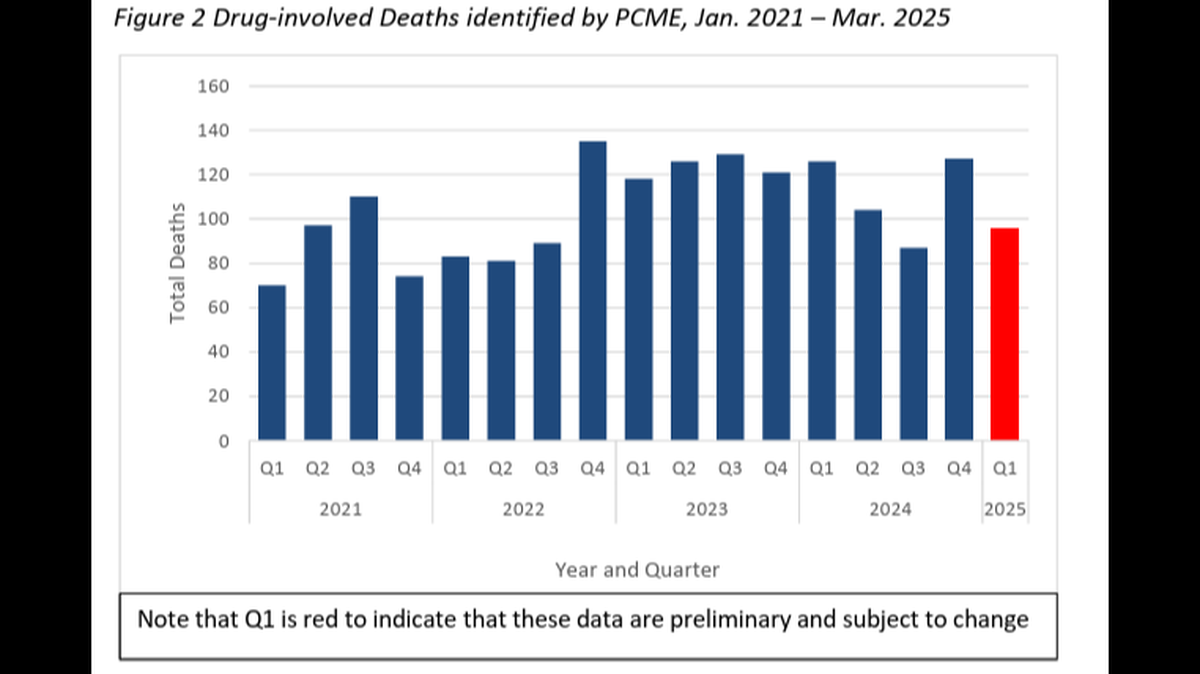
According to a report from that office and the Tacoma-Pierce County Health Department, there were 127 confirmed drug-related deaths in the last quarter of 2024, one of the highest numbers of confirmed drug-related deaths since the pandemic.
The fourth quarter of 2022 recorded the highest number since the beginning of 2021, with 135 drug-involved deaths confirmed by public health authorities.
According to the report, 67% of the 127 deaths involved multiple substances.
“The proportion of deaths where multiple substances were found has been increasing since 2021, though it stabilized recently,” the report said. “We don’t have comparable data from before 2021.”
Stimulants were found in 74% of the deaths in the fourth quarter of 2024, while fentanyl was found in 69%.
In the first quarter of 2025, public health authorities have confirmed 96 drug-involved deaths using preliminary data, but officials say the number of deaths could increase as they process the data.
“They increased notably in the 4th quarter of 2024, and we expect a similarly high number in the 1st quarter of 2025,” the report said.
During the Pierce County Council’s Safety Committee meeting on June 23, several officials with the Medical Examiner’s Office and the health department presented recent trends related to drug-involved deaths and those who died while living unhoused as well as obstacles to collecting the data.
Ingrid Friberg, an epidemiologist with the Tacoma-Pierce County Health Department, said death data is important for public health agencies to be able to prevent and delay unnatural deaths, but “idiosyncrasies” in the process make it difficult to collect the data in the most quick and accurate way.
Friberg said the death-certification process is a multi-agency effort with deaths being recorded by clinics and hospitals, investigated by the medical examiner, then sent to the Washington State Department of Health, which organizes the data before sending it to the Centers for Disease Control and Prevention for confirmation.
Friberg said it can take up to nine months before a single death is confirmed.
She said they can also use quarterly data from the Medical Examiner’s Office to put together quarterly reports, but that data set comes with its own limitations in regards to timeliness and accuracy.
The Medical Examiner’s Office only assumes jurisdiction over a relatively small number of the deaths that occur in Pierce County.
According to data from 2021 and 2022, only about 17% of deaths in the county were investigated by the Medical Examiner’s Office as it only takes jurisdiction over deaths considered to be unnatural. In the same time frame, about 22% of deaths were reported to the office only to be declined by the agency.
That means about 61% of deaths in 2021 and 2022 were unreported to the Medical Examiner’s Office.
“Our data is not reflective of the community at large,” Luke Vogelsberg, the director of operations for the Medical Examiner’s Office, told the committee. “Non-natural deaths are going to be significantly over-represented in our data.”
Additionally, quarterly data from the office does not include Pierce County residents who die in other counties or states. According to data from public health authorities, 9% of all Pierce County residents who died drug-involved deaths from 2016 to 2023 died outside the county.
Vogelsburg said the results of toxicology testing to determine what substances caused or contributed to an individual’s death can take 12 to 14 weeks to come back. He told the committee that the delay is likely due to both the process of the testing, which can involve a wide variety of testing, and the volume of cases.
Vogelsburg said the Medical Examiner’s Office often relies on the Washington State Patrol’s Toxicology Lab, which receives such a high volume of testing requests that it has been sending tests to private labs to reduce a backlog.
There are also questions surrounding the accuracy of the final data produced, with potential blind spots leaving certain deaths uncounted.
When asked if all drug-overdose deaths are reported to the Medical Examiner’s Office, Vogelsberg answered: “I hope so, we are heavily dependent on reporting agencies.”
Vogelsburg said there could be cases in which individuals experience health complications related to substance use and die in the care of clinicians who were unaware the complications were caused by drug use and therefore do not report the deaths as drug-related.
“I fear that we are missing cases that way,” he told the committee. “I think it’s a small number, but I don’t know what I don’t know.”