‘Good proof of concept.’ North End village makes gains against homelessness
AI-generated summary reviewed by our newsroom.
- Tacoma spent $3M over 5 years on a 40-unit tiny home village for the homeless.
- Village placed 50% of 428 clients into permanent housing, outperforming shelters.
- Neighborhood opposition declined as community support and involvement increased.
Over nearly four years, the City of Tacoma has paid roughly $2.5 million dollars to maintain a tiny-home village for the homeless in the North End.
While some neighbors thought the village would bring crime and lower property values, the neighborhood is now actively involved with supporting the families who live there.
The project helped assist hundreds of people into permanent housing, and it appears to be a successful model for transitional housing in Tacoma.
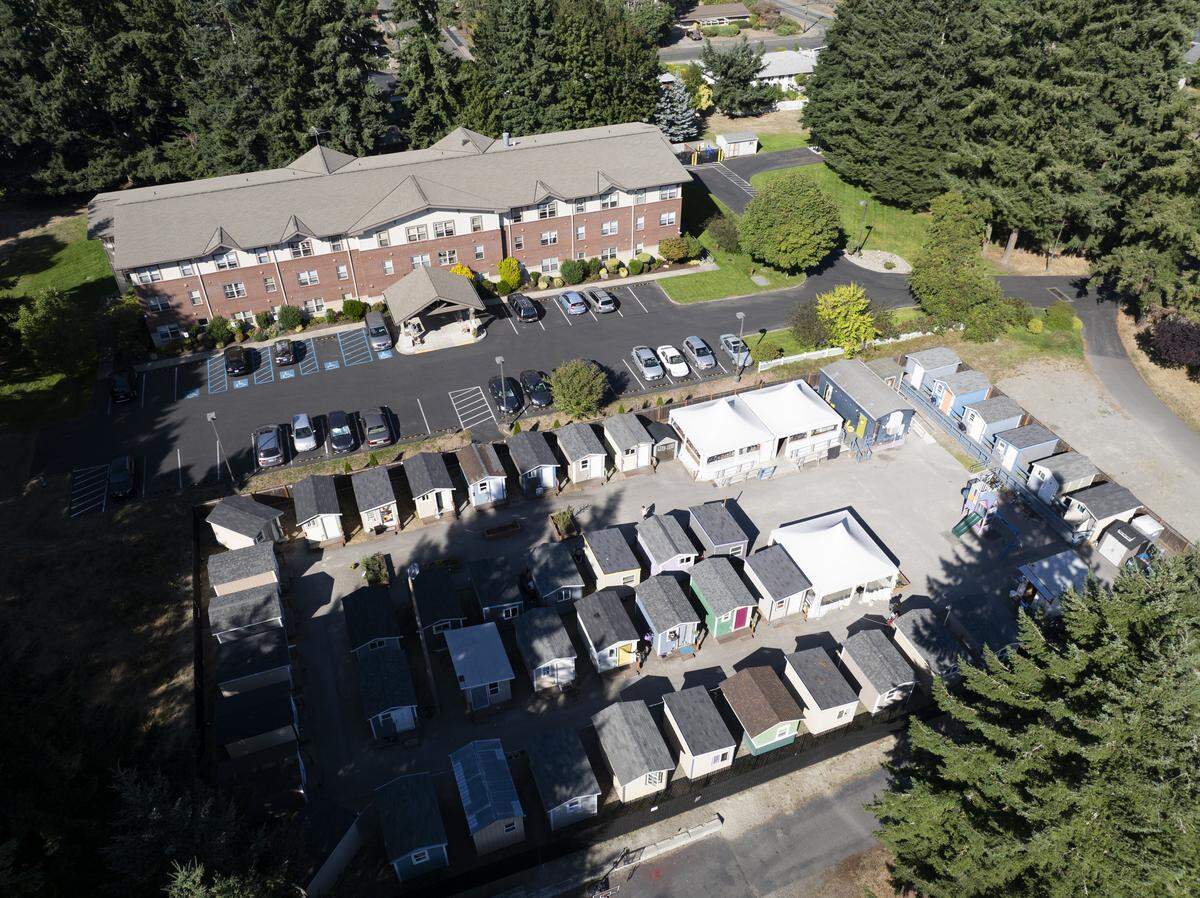
In December 2020, the city helped establish the village on property owned by First Christian Church of Tacoma near the intersection of 6th Avenue and North Orchard Street. The 40-home village was built and operated by the Low-Income Housing Institute (LIHI), an organization which operated dozens of similar villages and affordable-housing projects across the Puget Sound region.
The site at 602 N. Orchard St. would be known by the city as Tacoma Emergency Micro Shelter (TEMS) 3, one of a few shelter stability sites established by the city during the COVID-19 pandemic.
The tiny-village model of separated units was favorable to congregate shelter as the COVID-19 pandemic warranted social distancing.
LIHI’s shelter program manager, John Brown, told The News Tribune the shelter was implemented to help address the homeless crisis, specifically targeting families with children.
“We had a few growing pains to overcome during our first year, such as our location,” Brown said. “Many of our neighbors were unfamiliar with what exactly a Tiny House Village is and how it operates.”
The village was intended to serve as low-barrier transitional housing for those experiencing homelessness to have a stable place to sleep while they received case management, counseling or whatever help they needed to get back on their feet.
According to LIHI executive director Sharon Lee, the village now has a staff of with: two case managers, a site manager and five shelter monitors. Lee said a staff member is on site 24/7, and the site has a security pavilion by the front gate.
According to LIHI, it cost around $400,000 to set up the 40-unit village and around $750,000 a year to operate.
Maria Lee, spokesperson for the City of Tacoma, said the city contracted with LIHI to establish and operate the village for about $3 million from 2020 to 2025 and has spent a little more than $2.5 million during that time.
Pierce County will also have spent more than $1.3 million to the village from July 2023 to June 2026.
The largest expense is the cost to hire employees. In the city’s $450,000 contract with LIHI to operate the village from Jan. 1, 2025 to June 30, 2025, the city agreed to pay just under $318,000 for two full-time case managers, four full-time shelter staff and one full-time manager.
According to LIHI, out of the 428 clients who lived at the village since its opening, 218 obtained permanent housing as of Sept. 3.
The terms of the city’s contracts with LIHI dictate that 40% of the residents at the village exit into permanent housing.
“That means that 50% of the clients we served were able to obtain housing,” Lee told The News Tribune. “These impressive numbers show that tiny house villages are more successful than your typical emergency shelters, including congregate shelters.”
Tacoma Rescue Mission (TRM) is Tacoma’s largest shelter provider. According to TRM data shared with The News Tribune, from July 2024 to June 2025 8% of individuals who exited from the men’s shelter and 6% of individuals who exited the women’s shelter left into permanent housing. During the same time, 42% of individuals who left the family shelter exited in permanent housing, according to TRM data.
According to data LIHI shared with The News Tribune on Sept. 22, of those who did not exit into permanent housing:
- 32 exited to stay with friends and family.
- 73 exited into shelter, a treatment center or a skilled nursing facility.
- 4 exited to another form of transitional housing.
- 3 died while staying at the village.
- 27 people “abandoned” the village without letting LIHI know where they were going.
The remainder continue to live at the village, which is funded through June 2026.
The contracts do not give specific terms for how long residents are expected to stay at the village, but they do mandate that LIHI is to track the length of stay there. LIHI reported the median length of stay for clients at the village was 215 days.
“Many families who lived at the village were previously chronically homeless, and approximately 29% were survivors of domestic violence,” Lee told The News Tribune. “The majority had zero or very little income.”
Neighborhood support
Tacoma City Council member John Hines lives a short walk from TEMS 3. From the beginning, Hines advocated for the shelter, recognizing the need for additional shelter amid the convergence of the homelessness crisis and the oncoming pandemic.
In an interview with The News Tribune, Hines said many residents opposed the idea of putting a homeless shelter in their neighborhood. He said a few of his neighbors said they were worried about the kinds of transient people it might attract and the impact it could have on their property values.
Someone in the neighborhood protested by spreading a flyer with Hines’ phone number on it urging folks to call him and lobby against the village.
Hines said years later, when the village needed renewed funding from the city, the same neighbor who was previously concerned about the village’s impact on his property values was now worried it might go away.
He said the village is a “good proof of concept” that this model of transitional housing works. He said the initial cost of setting up the village was pricey, but the long-term operational cost is “good value,” especially considering the wrap-around services available to residents.
Hines, who is now running for mayor against former council member Anders Ibsen, said the village’s success is due in part to the fact that it hosts families, a demographic he said tends to be more motivated to exit homelessness.
Randy Nix said he lives a few blocks away from the village. In an interview with The News Tribune, Nix said he was initially opposed to the village as he was concerned it would draw in people more likely to commit crime and vandalism.
“None of that has really happened,” he said.
According to Tacoma Police Department spokesperson Shelbie Boyd, there were ten 911 calls and responses at TEMS 3 between Aug. 14, 2021 and Aug. 14, 2024. Two were “cancelled/accidental dials,” four were “medical in nature,” three were online reports and one was a “follow up by detectives.”
Nix said he became a part of the village’s Community Advisory Committee (CAC), a group of local residents and business owners who meet monthly to receive updates about the village and coordinate to see how they can best support the residents there.
Hines said he also is a part of the CAC. In the past he said the CAC has organized donations for things such as bedding and diapers for village residents.
Brown said the village benefits from “endless donations” from local neighbors and community members.
Nix said those at the CAC meeting get regular updates about how the children at the village are doing and what activities they have been up to.
“At first, everybody was up in arms, but their concerns never materialized,” Nix told The News Tribune. “For the most part, the people [living] there are pretty decent, but they definitely need help.”
When asked if he considered the village to be a “successful” program, Nix said he would like to see an even higher percentage of residents exiting to permanent housing — especially for the cost of the village.
“This is a really expensive area to live in, its hard to find a job that pays enough,” he told The News Tribune. “It’s tough.”
The village is contracted by the city to stay open through June 2026. Lee told The News Tribune LIHI is hoping to keep the village open for the foreseeable future.
This story was originally published September 23, 2025 at 5:00 AM.