WA will soon take over probes into fatal Pierce County police encounters
AI-generated summary reviewed by our newsroom.
- The state plans to assume investigations into fatal police encounters in Pierce County.
- A team of local law enforcement members currently probes all use of deadly force.
- The state’s Office of Independent Investigations will take over fatal cases in May.
Pierce County law enforcement agencies soon will cease investigating deaths resulting from officers’ use of force, relinquishing that duty to a nascent state agency formed to bring more independence to the process.
The Washington State Office of Independent Investigations, created by the Legislature in 2021, announced Monday it plans to take over conducting probes into fatal police encounters in Pierce County beginning May 1.
Since 2020, that job has belonged to the multi-jurisdictional Pierce County Force Investigation Team (PCFIT).
PCFIT comprises detectives, forensic investigators and public information officers from law enforcement departments throughout the county to ensure investigations remain external. It also has community representatives. It was created to comply with a 2018 statewide ballot initiative, known as the Law Enforcement Training and Community Safety Act, which bans agencies from investigating their own use-of-force cases resulting in death or significant injury.
So-called independent investigation teams, such as PCFIT, are common across the state.
PCFIT says it’s committed to independence and transparency and ensuring the investigative process is free from conflicts of interest. Lakewood Police Sgt. Charles Porche, a PCFIT spokesperson, said investigators have given cases the same amount of scrutiny as they do any other homicide.
“We have no issues with the office taking over the investigations,” Porche told The News Tribune.
PCFIT’s timeliness in releasing information, such as the identities of officers involved in fatal encounters, has come under scrutiny in the past, including by police accountability advocates and The News Tribune’s editorial board.
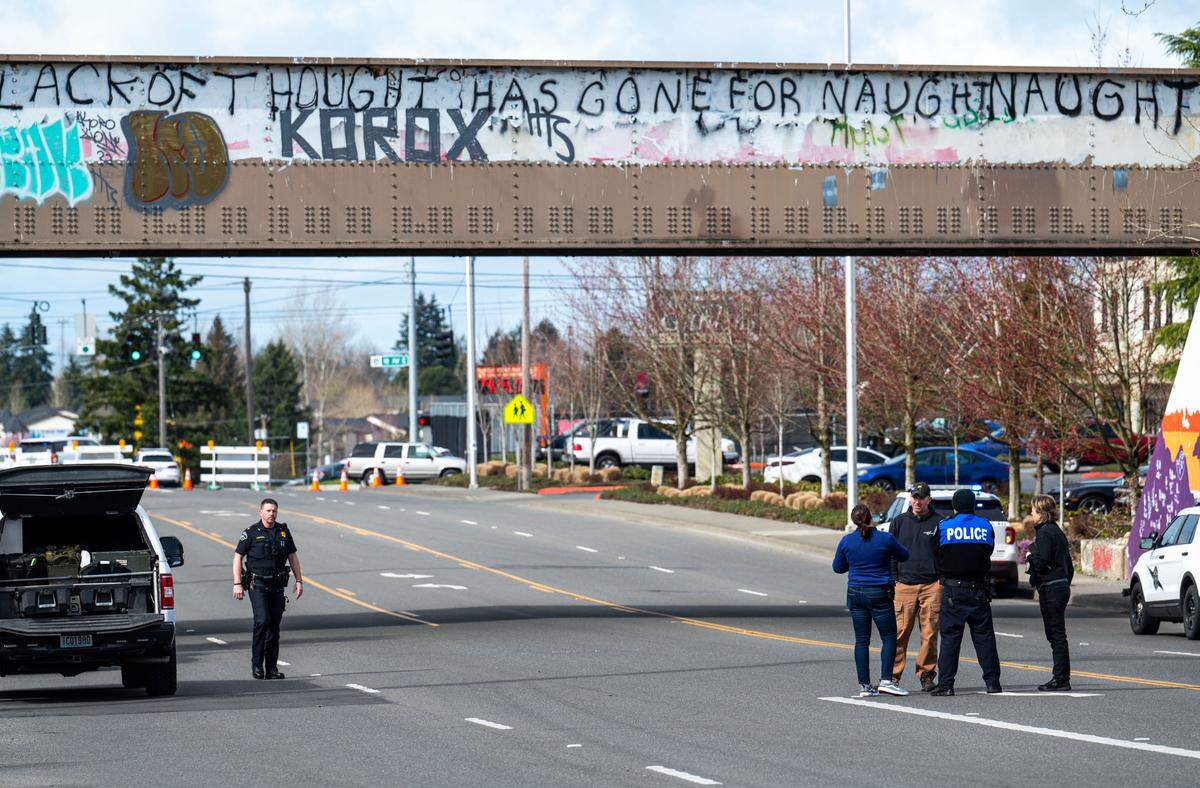
Since the Office of Independent Investigations (OII) plans to investigate only fatal incidents, at least initially, PCFIT will continue to handle probes into non-lethal cases as well as the underlying alleged crimes preceding the use of deadly force in all cases, OII spokesperson Hector Castro told The News Tribune in an interview.
Although it was known to Pierce County law enforcement to be an eventuality, the takeover’s timing had been unclear until the Office of Independent Investigations began reaching out last week to let local authorities know the agency had chosen May to start its work here, according to Castro.
“It took us some time to get going,” he said.
OII currently maintains a workforce of roughly 66 people, split nearly evenly between investigators and its other divisions or support staff, Castro said. The limited law enforcement agency works with an 11-member advisory board representing various groups, including the public, law enforcement and the criminal-justice system. The board’s co-chairs are a police chief and a person whose loved one was killed by police, according to OII’s website.
OII has taken a phased approach to operations while drawing up its staffing and resources. In December 2024, it began investigations in a dozen counties in southwest Washington and the Olympic Peninsula, which compose the agency’s “Region 1” in a self-defined, six-region map of the state.
Now, a year later, OII is preparing to enter “Region 2,” or Pierce County.
“OII is committed to serving all of Washington State by growing our operations,” agency Director Roger Rogoff, a former King County Superior Court Judge, said in a statement Monday. “Being able to expand to Region 2 is a significant step forward.”
The Tacoma Police Department is aware of the planned expansion, according to spokesperson Shelbie Boyd. In a statement Monday, Boyd said TPD continues to work collaboratively with regional partners, including OII, to ensure cases are handled appropriately, while respecting the rights of involved officers.
“TPD supports approaches grounded in the law that lead to effective outcomes in complex investigations,” she said. “As practices evolve, we remain focused on ensuring clear roles, consistent communication, and strong coordination between agencies, so investigations proceed efficiently and fairly.”
Boyd said the department’s priority is to continue serving the community while maintaining established investigative standards. As changes are implemented, she added, TPD will evaluate any operational effects and address concerns with its partners.
A Pierce County Sheriff’s Office spokesperson declined Friday to comment on the announcement.
Concerns prompted agency formation
The OII was formed exclusively with support from Democratic lawmakers in April 2021.
Its introduction followed conflict-of-interest and other concerns over the Pierce County Sheriff’s Office’s investigation into the death of Manuel Ellis in Tacoma police custody in March 2020. Not until three months after Ellis’ death did then-Sheriff Paul Pastor disclose to Prosecuting Attorney Mary Robnett that a sheriff’s deputy helped to restrain Ellis, The News Tribune previously reported.
Gov. Bob Ferguson, then the state’s attorney general, said the Sheriff’s Office violated requirements forbidding agencies from investigating their own officers and mandating probes be independent as outlined in the Law Enforcement Training and Community Safety Act.
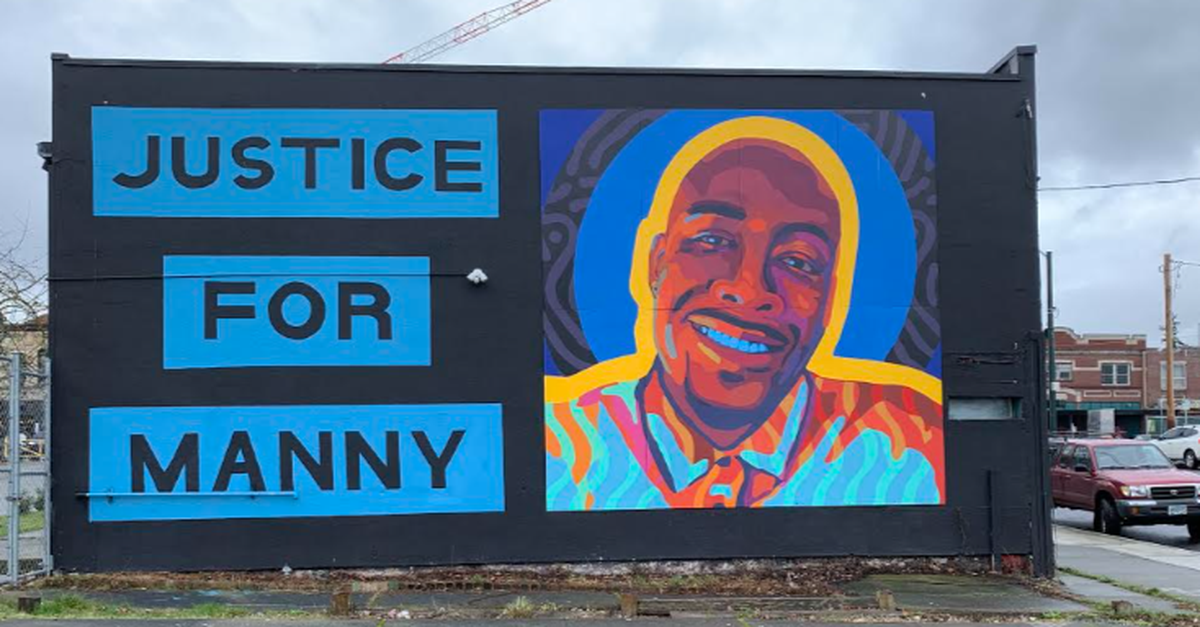
In the aftermath of the disclosure, Ferguson announced in June 2020 a statewide probe into 30 lethal use-of-force cases to ensure adherence to the act. Surveys on 18 investigations revealed five were in full compliance with the law. A governor’s task force was formed and House Bill 1267, which established the OII, was based on the task force’s recommendations.
“The new Office of Independent Investigation will help our state rebuild the trust between law enforcement and communities of color by ensuring that there is true accountability for unnecessary police violence,” Rep. Debra Entenman, D-Kent, said in a statement after the bill’s passage in 2021. “It is simple, we cannot have police investigating police.”
Still, the OII four years later has been met lukewarmly by a statewide police accountability organization that lobbied for its creation, citing concerns that the agency hasn’t done enough to shed itself of significant law enforcement involvement.
“Police, whether or not they work together, seem to have a vested interest in protecting each other,” Dominic Campese, a spokesperson for the Washington Coalition for Police Accountability, said in an interview.
In Campese’s view, the OII could “curb that inherent bias.” Instead, he said, the agency has sought out hiring ex-law enforcement, which he called “disappointing.” Campese also expressed frustration with another of OII’s functions, saying it has taken far too long for the agency to finish reviews of old cases to determine whether new evidence warranted reopening an investigation.
“I think we just hope they fulfill their mandate with investigating these potential crimes and producing unbiased reports,” he said.
Castro said he understood concerns.
OII was looking to speed up its process in screening prior cases, Castro said, although he warned there were no shortcuts and some cases included thousands of pages.
As for the agency’s reliance on staff with law enforcement backgrounds, he said investigators with expertise were necessary to build up staffing, get the agency’s operations rolling and ensure its probes were conducted credibly. The office currently has 31 investigators, most of whom possess a background in law enforcement, but OII’s goal is to increase the amount of staff who don’t have that history, he said.
Castro added that people in key roles, including the agency’s director, have never worked in law enforcement and that staff members also undergo training on avoiding bias and racism.
“We are growing as best we can,” he said.

What to expect
OII’s goal is to be independent, transparent and remove bias from the investigative process, Castro said.
The agency maintains a Family Liaison Program to keep loved ones of a person killed by law enforcement apprised of an investigation and to help them navigate matters such as engaging with the medical examiner’s office. There’s also tribal and public liaisons. PCFIT and other independent investigations teams typically designate a single detective to serve in a liaison role, according to Castro.
For the most part, OII will conduct probes similarly to independent investigations teams, yet Castro said it also will publish a post-investigation report on its website that’s shared with the prosecuting attorney’s office, investigated agency and affected family.
“No other law enforcement agency does something like that,” he said.
OII also posts on its website reports compiled by prosecutors to explain their decisions to decline filing charges in a case, according to Castro. OII, itself, does not make charging recommendations or weigh in on whether an officer was justified in their use of force.
While PCFIT publishes weekly news releases about cases it’s investigating, oftentimes providing no new information, Castro said OII’s updates will be much more incremental.
It’s expected by statute that OII completes probes within 120 days, but thus far it has typically taken longer, he said. Since beginning investigations a year ago, the office has finished two of the six it’s undertaken and submitted those cases to prosecutors in the jurisdiction in which they occurred.
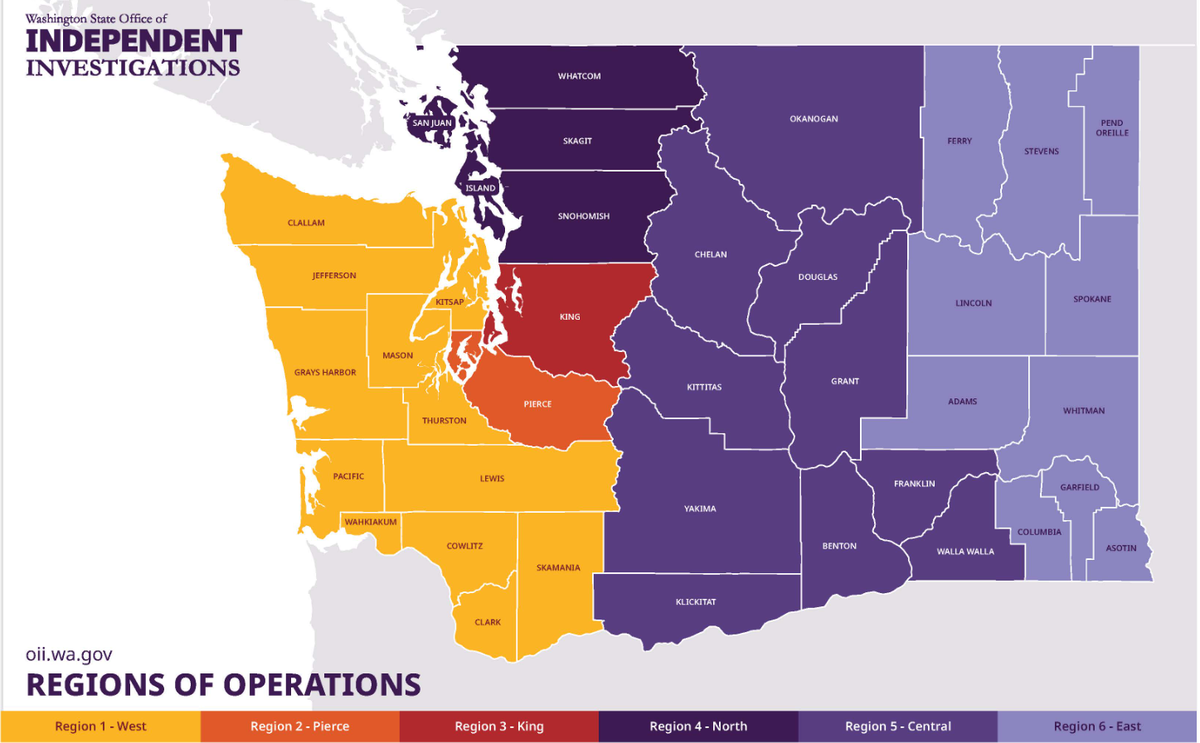
OII’s regional map separates the state into six parts of varied geographical size, but each region has roughly the same number of annual deadly-force incidents, Castro said. In a news release Monday, announcing the agency’s expansion into Pierce County, OII said it’s estimated that 12 to 18 investigators were needed per region to effectively respond to incidents.
After Pierce County, OII said it plans to next enter a region encompassing 10 counties in Central Washington, but it didn’t specify when.
As for whether OII has been controversial within law enforcement agencies, Castro described it as “a mixed bag.”
“I think in general, we’ve done a lot of outreach with law enforcement over the past several years,” he said, adding there had been significant skepticism early on about whether the agency could be successful.
Now, it has some progress to point to.
“In terms of whether or not there’s going to be controversy, a lot of it depends on the law enforcement agency,” he said.
Castro said he has spoken with police chiefs who are supportive. Sensitive investigations will no longer fall on any local agency that must then continue to work with the investigated agency, he said, and departments will have more detectives freed up to work on normal caseloads who otherwise would be assigned to a use-of-force incident.
“These are the only types of investigations that we conduct, so we are developing expertise specific to this type of investigation, which is another reason I think why some in law enforcement are supportive of this idea,” Castro said. “That being said, there are certainly some who remain skeptical, some who frankly would rather continue doing it the way things are now.”
“Change is always difficult,” he added.
This story was originally published December 15, 2025 at 2:00 PM.