Tacoma Refugee Choir fosters joy as discord over immigration roils the nation
AI-generated summary reviewed by our newsroom.
- Tacoma Refugee Choir meets weekly, welcomes immigrants and allies, fosters community.
- Choir trains by ear in multiple languages, promotes leadership and inclusion.
- Performances and outreach offer refuge amid rising anti-immigrant sentiment.
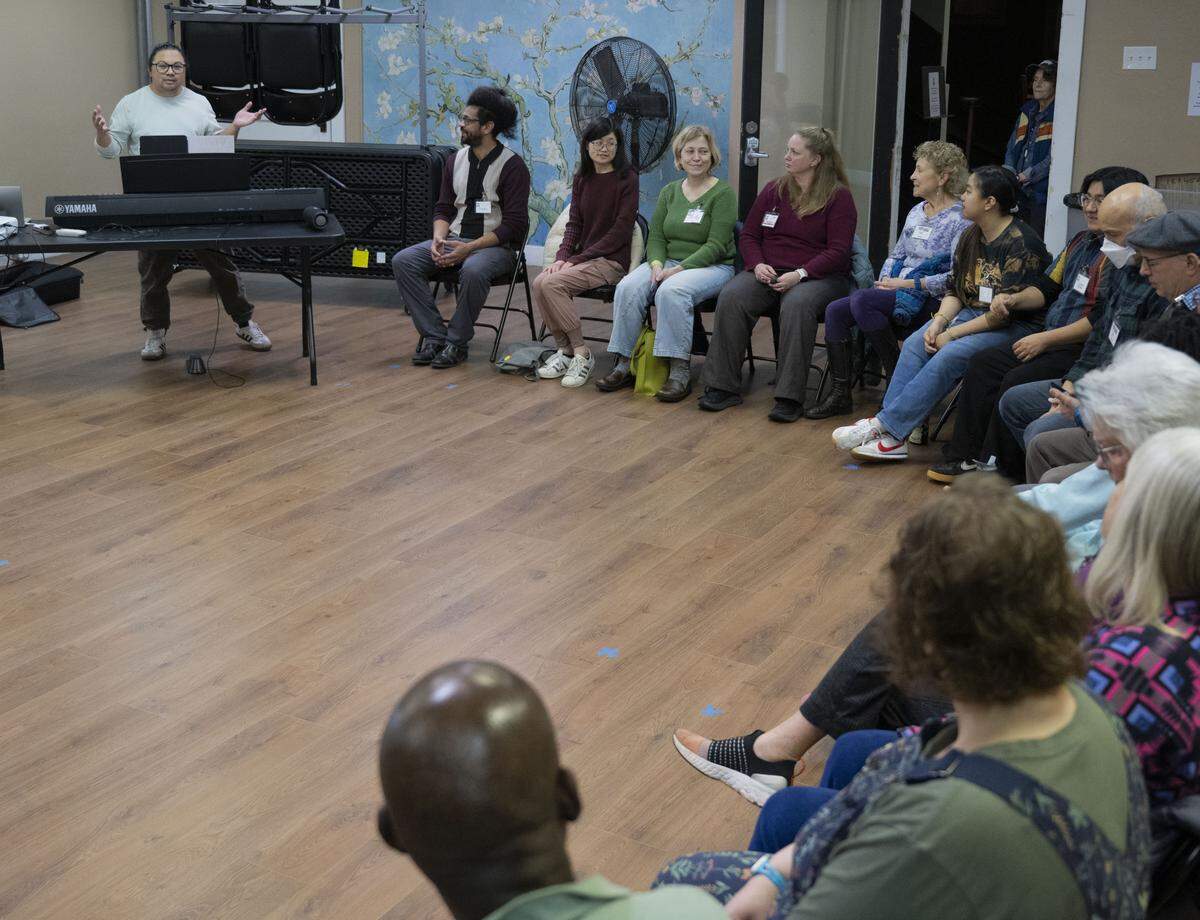
Music drifted through an open window and into the streets of Tacoma on Tuesday night as a group of about 30 immigrants and allies gathered in a U-shape, rehearsing for the Tacoma Refugee Choir’s concert next week.
Some attendees had only been with the group for two weeks. Others had been coming regularly for almost nine years. The choir doesn’t follow sheet music or hold auditions — everyone is welcome regardless of skill level or the language they speak.
Founded in 2016, the Tacoma Refugee Choir has had members from more than 80 countries, said 42-year-old artistic director Orlando Morales, whose parents emigrated from the Philippines. Last year there were about 40 members on the roster from 16 countries. The group meets weekly (and locations are kept private, for security reasons). They perform two free concerts a year and sing at about a dozen other local events annually, Morales said. The next concert is at 2:30 p.m., Jan. 24., in the Drost Auditorium of Lincoln High School. Recruitment is still open for 2026.
Their repertoire changes, and, unlike many choirs, choral members take on conductor roles as leadership opportunities, Morales said. The choir sings music not only in English but in languages like Belarusian, Spanish, Swahili, Mongolian, Ukrainian and Russian, he said. By design the choir teaches songs by ear rather than with sheet music “as a way to honor the different musical traditions that folks come into the space with” and push the boundaries of members who aren’t used to practicing that way, Morales said.
Many members are first- or second-generation immigrants who have found camaraderie and joy through song.
Iuliia Didkivska, 45, fled Ukraine as a refugee in June 2022, shortly after Russia invaded her country. At first, Didkivska said, she felt very lonely and stressed adjusting to life in Tacoma without her family and friends. In 2024 Didkivska joined the Tacoma Refugee Choir to find community, despite not considering herself a good singer.
“The choir became my place for support. People who understand your fear, your pain, who support you, who smile to you. I do not feel different. I felt accepted, even in small things. Everyone would try to understand me, my needs,” she said. “The first couple of months I was afraid even to sing. But then I felt so comfortable, I realized that I have [a] voice. I can sing and I can sing really nice. They inspire. It’s a big, nice family. People who care.”
Cristian Arguijo-Romero, 47, is a refugee from Talanga, Honduras who has lived in Tacoma for 12 years and joined the choir in August. Arguijo-Romero said he was shy at first and had stage fright because his English was poor and it was hard to understand what everyone was saying.
“My first time, I closed my eyes,” he said. “The second time, I opened them a little bit because now I’m feeling more confident.”
In a time of high-profile immigration arrests and debates over ICE tactics, Arguijo-Romero said he understands why people are scared to leave their homes and knows how it feels to be detained. Despite the fear, Arguijo-Romero said the choir provides a welcoming and respectful atmosphere. Morales said the choir has discussed additional security measures for its upcoming concert.
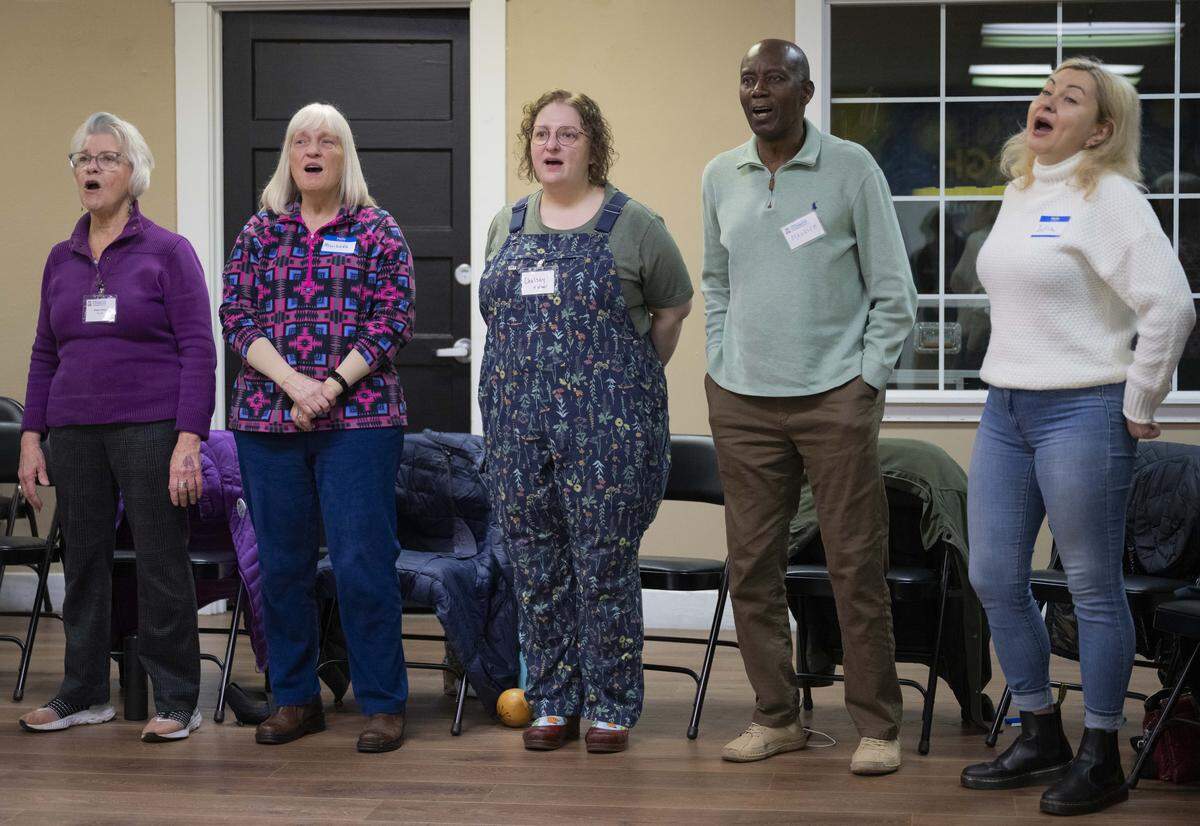
Diane Tilstra, 78, is not an immigrant but joined the choir as an ally eight years ago. Over the years she has watched members become more confident and resilient as a result of the choir. Some, like Didkivska, have gone on to serve on the City of Tacoma’s Commission on Immigrant and Refugee Affairs.
“It goes deeper than just a group of people that are singing together. Year after year, it’s something I really look forward to. I don’t care how bad the weather is, or how much negative news we’re being exposed to. When we sing together, it feels good,” Tilstra said. “Going, to us, is a form of resistance. I keep going because it’s my way of demonstrating that I want to live in a community that embraces the diversity.”
As a nonprofit, the choir is apolitical although it does have a commitment to advocate for and uplift immigrant refugee experiences in Tacoma, Morales said. Members aren’t politically homogenous however, he said, and people have political and ideological differences, he said.
“It’s been really great to have folks in a space where they can teach each other about what it means to coexist,” Morales said. “I think the most that we can do is truthfully and sincerely bring people into our experiences. And that’s the perspective of being able to really see each other as human.”
On Tuesday night, the choir practiced three-part harmonies and shook different instruments to keep time as Morales led the group on his keyboard. People smiled, swayed and danced.
“Todo aquel que piense que la vida es desigual / Tiene que saber que no es asi, que la vida es una hermosura, hay que vivirla,” the group sang in unison. “Todo aquel que piense que esta solo y que esta mal / Tiene que saber que no es asi, que en la vida no hay nadie solo, siempre hay alguien.”
(“Anyone thinking that life is unfair / Needs to know that’s not the case, that life is beautiful, you must live it / Anyone thinking they’re alone and that’s bad / Needs to know that’s not the case, that in life no one is alone, there is always someone.”)
This story was originally published January 15, 2026 at 5:15 AM.