She thought all of her son’s ashes were home - until a text 18 years later
Eighteen years after Tiffani Robinson’s son died, a piece of him came back to haunt her.
Since her 20-year-old son, Dowell “Randy” Davis Thorn III, was killed in 2007, she’s had to endure every parent’s worst nightmare. She said her goodbyes to her oldest son at the funeral services handled by the House of Scott Funeral and Cremation Services.
For almost two decades, the gray and golden urn containing Randy’s cremated remains sat on her couch side table.
While she grieved her late son, she found solace in knowing that his remains were with her.
At least, that’s what she thought.
On Nov. 20 last year, her brother P.J. Robinson FaceTimed her with an unexpected message.
Some of Randy’s ashes were still at the funeral home.
Tiffani was immediately confused.
“My first question was who’s sitting at my table?” she said.
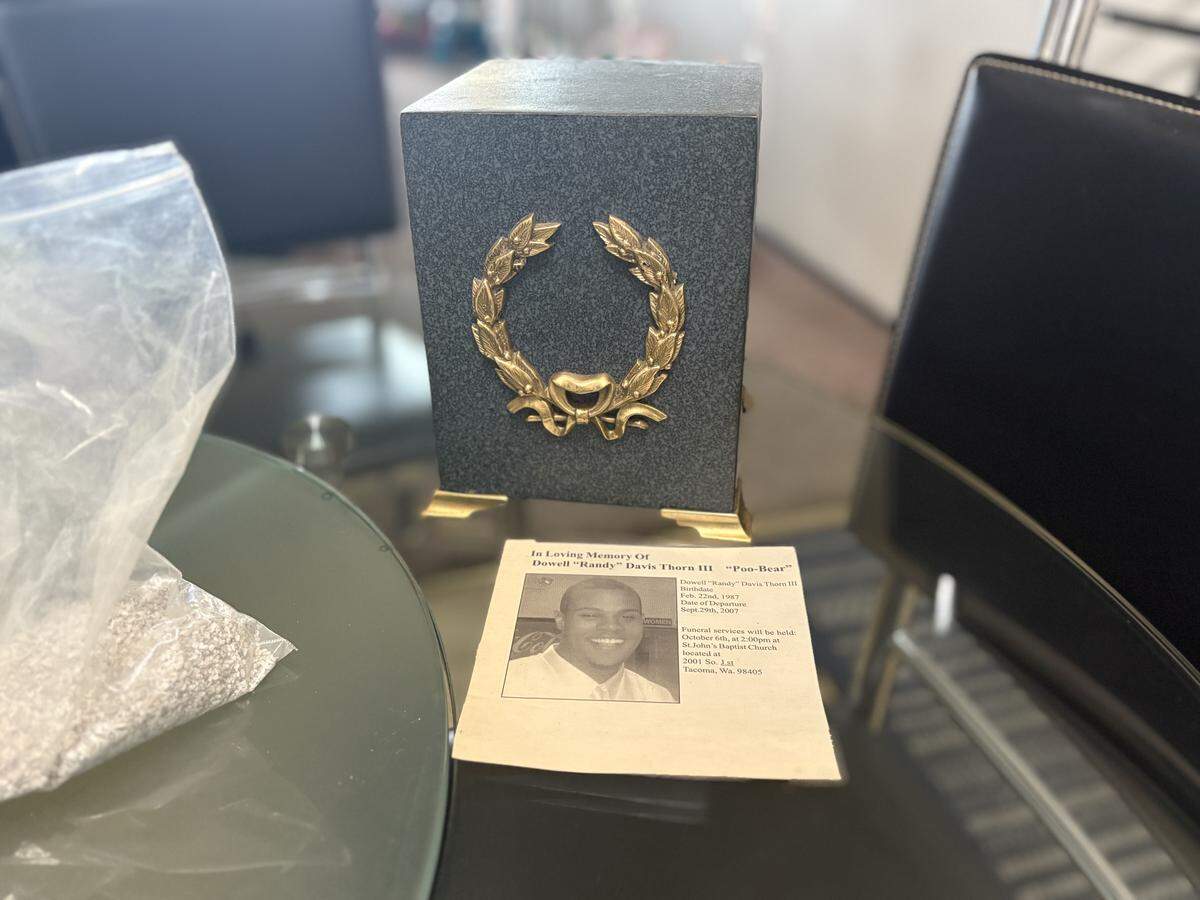
Her brother had just received the text from a family friend who worked with someone from the Scott family, Tiffani said. The funeral home where Randy was cremated, House of Scott, closed in 2018. The succeeding business, Scott Funeral Home and Cremation Services, inherited its unclaimed ashes.
“Why they didn’t reach out to my sister, I’m not really sure,” P.J. said. “That’s so disrespectful to my sister, to put her business anywhere other than in her hands and ask her what we could do about it.”
Tiffani, too grief-stricken to go to the funeral home, gave her brother permission to pick up the ashes.
So on Dec. 3 that’s what P.J. did.
According to P.J., the associate at the funeral home told him they didn’t exactly know why Randy’s ashes were still there.
“There was basically no excuse that she could come up with why they had contacted anybody so long after the situation,” P.J. said. “There was nobody there from that time period to provide her with an explanation of why they didn’t return the remains at that time in 2007.”
More than just ashes
When Tiffani finally received the black box containing the remains, she didn’t just find ashes.
Besides a gallon-sized Ziploc bag filled partly with cremains, the box contained a small metal crochet hook, printed instructions for adding remains to memorial jewelry and a label for a 14-karat gold cross necklace.
Tiffani had purchased memorial jewelry at the time of her son’s funeral in 2007, which could explain the labels in the box. But Tiffani has no explanation for the crochet hook.
The arrival of the extra ashes also made Tiffani wonder whether these new remains were even her son’s.
She lost her second son, Kerry Edwards, after he was shot by while attempting a burglary with two other men in Portland, Oregon, in 2021.
“My heart is telling me it’s my baby [Randy]. But I had another son cremated, and [the funeral home] kept some of the ashes for jewelry and things like that, but it was nowhere near this amount, and it wasn’t 18 years later.”
It’s not immediately clear why the family was notified in November about the ashes, and how the person who notified them got the information in the first place. But Tiffani has a theory.
Shortly after Randy’s funeral in October 2007, she went to the funeral home to pick up his ashes, which were placed in two brown gift bags.
She was under the impression her son’s remains would be in an urn, so she asked to come back when the funeral home took care of that.
“I think that’s when the mix-up came,” she said. “The leftovers were in the other bag or something, and they just set it to the side and forgot about it. I think they were cleaning and stumbled across it.”
What Washington law says
Though it may seem out of the ordinary for funeral homes to hold onto unclaimed ashes, it’s actually quite common, said Pamela Griese, an inspector for the Washington Funeral and Cemetery Board.
Funeral homes are required to hold onto cremated remains for 90 days following cremation, according to Washington law.
The notification process for unclaimed remains involves sending written notification by mail, Griese said.
If the next of kin do not respond within 45 days, then funeral homes are permitted to dispose of the cremated remains in any legal manner, according to RCW 68.50.230.
“Of course, funeral homes are tasked with following the directions of the persons having the right to control disposition,” Griese said.
Not just anyone can come by and pick up remains. Whoever acquires the remains from the home must have the right to control disposition, as established in RCW 68.50.160. This can be a person designated by the decedent, the decedent’s spouse, adult children, parents, siblings or a court-appointed guardian.
Many funeral homes hold onto cremains even though they aren’t legally obliged to in case someone eventually does come years down the line to retrieve their loved ones.
“It’s kind of a problem because families will circle back to pick up the cremated remains and all of a sudden it’s 90 days, six months, two years, five years, and they still haven’t done that,” she said. “For some people that’s a very difficult thing to come and receive cremated remains of their family member.”
Tiffani reported the Scott Funeral Home to the Washington Funeral and Cemetery Board.
In an email to The News Tribune, the Washington Department of Licensing confirmed it received her complaint and a board member is currently reviewing the case.
A director seeks answers
For Coretta Harwood, the funeral director of Scott Funeral Home, the Robinson family’s situation is just as shocking as it is for Tiffani.
In fact, she had no idea P.J. was notified about the ashes through text from an outside party. She didn’t even know that Tiffani was upset until The News Tribune called her Dec. 12. Prior to that Tiffani did not reach out to them at all with concerns, she said.
Having started a new funeral home business in 2018 when her mother, Kitty Scott, closed her own, the situation with Randy’s ashes was not on her radar. And why would it be, when it happened 20 years ago with at a different business with different staff?
Since finding out about the issue from The News Tribune, she has done everything in her power to get to the bottom of how the ashes made their way to the family 18 years later, she said.
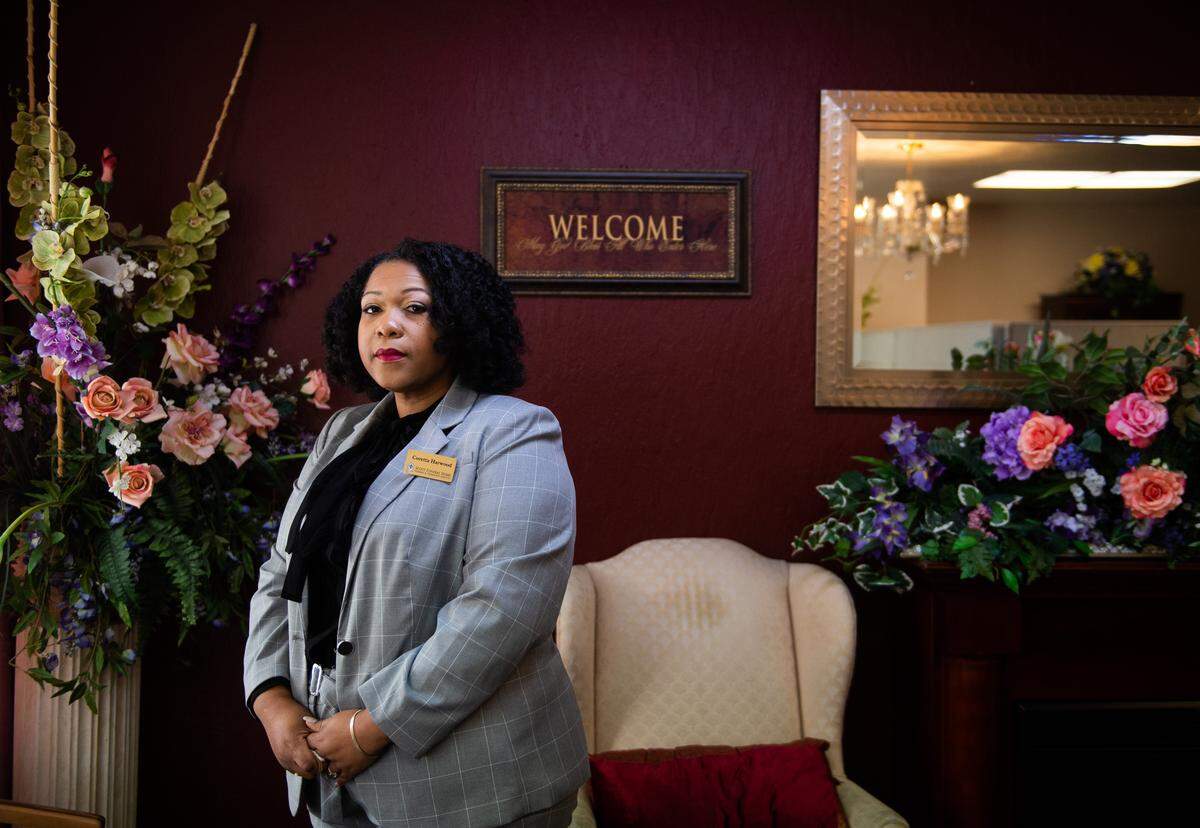
But with limited communication from the Robinson family, as well as contradicting statements from employees and family members, the case is bringing up more questions than answers.
After looking through records, Harwood found that the House of Scott staff attempted to contact Tiffani about the ashes multiple times following the funeral, and again in 2014. They never received a response.
“We have no records of anybody calling her at all in the last ten years, because there was no response to the communication that was sent out,” Harwood said.
Despite legally being allowed to scatter the ashes, the funeral home held onto Randy’s ashes as they do with many leftover cremated remains that they’ve received no communication from loved ones about.
When P.J. picked up the remains last year, nothing seemed out of the ordinary. The employee working there that day retrieved the ashes from storage, opened the box and didn’t see anything other than the cremains inside of it, she said.
“I have to believe the staff,” she said. “They have no reason to lie. We release ashes daily to people.”
Coretta prides herself on her empathy and honest communication, she said. As a funeral director, she constantly has to work with people during the hardest moments of their lives.
Yet the situation with Randy’s ashes, and how Tiffani was notified a few months ago, has left her completely befuddled, she said.
“Did somebody move and find a bunch of old mail and then decide to tell Tiffani about this all this time later?” she said. “I’m like, why would somebody do this to you? This is cruel. I told her this.”
Still, she has faith that the funeral board will investigate the situation and get to the bottom of it.
“I’ve asked questions trying to figure out what’s going on, and I’m having to hunt and search for questions and get answers,” Harwood said. “I’m gonna just wait and see what the State Board says, because ultimately, outside the court of public opinion, what they say is going to be critical. But everything that she accused me of, it’s not factual.”
“Everybody loved Randy”
Dowell Davis Thorn III, who also went by his nickname Randy, was born on Feb. 22, 1987, when Tiffani was just 15, her first son of four children.
He was a funny guy beloved by the community who loved animals and cars, Tiffani said. Randy was a hard worker, having worked jobs since he was a young teenager.
He also had a particular affinity for his mom’s home-cooked meals, using his allowance to buy steak and fish for her to cook instead of getting candy like the other kids.
On Sept. 29, 2007, Randy was visiting his girlfriend’s house in Tacoma when her ex-boyfriend, Quincy Hawkins, showed up uninvited and started a fight, according to court documents.
Hawkins fatally shot Randy in the stomach, which led to a 2008 jury trial and conviction. Hawkins was sentenced to 32 years in prison.
At Randy’s funeral that October, the St. John’s Baptist Church on J Street was so packed there was no sitting room, Tiffani said.
“There were so many people outside,” Tiffani said. “Everybody loved Randy.”
Three months before he passed, Randy had a daughter, Jaya. The 18-year-old is tall, like her father, and shares his same toothy grin and work ethic, Tiffani said. She credits Jaya for saving her life.
“I think without her, I wouldn’t be here anymore,” she said. “I lost my best friend, and he left me with this beautiful little girl.”
Looking to the future, Tiffani is searching for grief counselors to help her and her family process the situation.
“I lost my baby once,” she said. “Why do I got to go through this again?”
This story was originally published February 18, 2026 at 5:00 AM.