Sheriff Keith Swank’s would-be lawyer told to pay $167K. Not so fast, court says
AI-generated summary reviewed by our newsroom.
- Washington Supreme Court paused proceedings, including fee award, pending ruling.
- Prosecutors seek upwards of $167,244.59 for work opposing attorney’s UPEPA motion.
- Dispute centers on action challenging attorney’s authority to represent Sheriff Swank.
Editor’s note: A Washington State Supreme Court commissioner on Thursday, Feb. 12, stayed Superior Court proceedings pending the appeal of the order that denied Joan Mell’s motion for expedited relief filed under the Uniform Public Expression Protection Act and which awarded costs and attorney fees to Prosecutor Mary Robnett.
The stay was granted on the condition that Mell furnish a bond or other security in the amount of $167,244.59.2.
The attorney temporarily barred from acting as the official lawyer for Pierce County Sheriff Keith Swank has been asked to pay upwards of $167,000 for prosecutors’ work combating her assertion that she had a First Amendment right to represent the sheriff.
That effort over the last seven months involved hundreds of hours of labor from four attorneys and three legal assistants working for the Pierce County Prosecuting Attorney’s Office, according to court records.
Whether the attorney, Joan Mell, will have to pay up remains to be seen. On Thursday, the Washington State Supreme Court put a temporary pause on the court proceedings pending a ruling on a Jan. 26 motion Mell filed with the high court. That motion requested a stay on all further litigation in the trial court, including the entry of a fee award.
The fee award came after prosecutors defeated Mell’s attempt to have a judge dismiss Prosecutor Mary Robnett’s lawsuit seeking to permanently bar Mell from representing Swank. In July, Mell cited Washington’s Uniform Public Expression Protection Act (UPEPA) in an email to Robnett. It’s a law designed to shield free speech from the threat of lawsuits, and invoking it effectively paused the court proceedings.
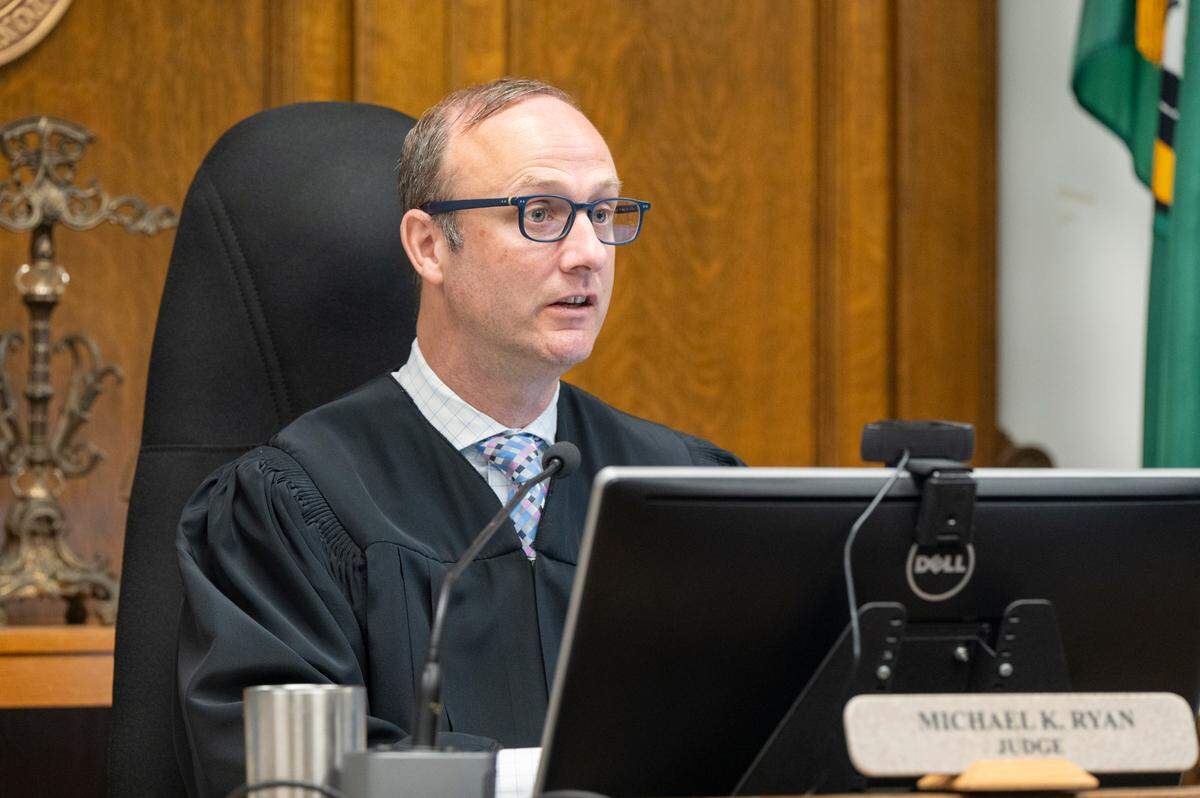
On New Year’s Eve, King County Judge Michael Ryan denied Mell’s subsequent motion that argued her work for Swank was protected free speech and petition activity. Mell had further argued that UPEPA entitled her to an expedited dismissal of the lawsuit, to include a $10,000 penalty along with fees and costs.
Ryan found that Mell filed the motion with the sole intent of delaying the case, and that the motion was not substantially justified. The judge said her motion rested on the faulty assumption that she legitimately formed an attorney-client relationship with Swank and that she had used UPEPA’s stay on the proceedings as a “weapon” against the Prosecutor’s Office. As a result, Mell was ordered to pay Robnett’s fees and costs.
Attorneys for Robnett and Mell subsequently met to try to come to a consensus on the amount of fees and costs Ryan would award. According to court documents, hourly rates for three county attorneys were later agreed upon — between $525 and $600 each — but that was the extent of any agreement between the parties.
Attorneys for Robnett filed a motion for fees and costs Jan. 30 asking the court for an award of $167,244.59. They also asked Ryan to consider ordering Mell to pay more than that due to her behavior, which they described as unruly and intended to cause delay.
Contacted by The News Tribune on Thursday, Mell did not comment on Robnett’s motion for fees and costs. In her pleadings to the Washington State Supreme Court, Mell’s attorney said Ryan’s finding that her UPEPA motion was frivolous relied on a misreading of Mell’s argument — that she was claiming “derivative” rights of those “purportedly possessed by Sheriff Swank.”
Mell’s attorney, Eric Stahl, wrote that overlooks authority recognizing arguments of constitutional importance. Citing case law, Stahl also said cases that present debatable issues of public importance are not frivolous.
Stahl wrote that Ryan’s finding that Mell filed the motion solely for delay cited no reason why Mell wished to delay resolution of the case.
“There is none,” Stahl said.
Robnett, Mell seek review by Washington State Supreme Court
Now both Mell and Robnett have asked the Washington State Supreme Court to review Ryan’s Dec. 31 order that denied Mell’s UPEPA motion, joined Swank as a necessary party to the case and awarded attorney’s fees to Robnett.
Adam Faber, a spokesperson for the Prosecutor’s Office, told The News Tribune the office wants the state Supreme Court to hear this case as soon as possible, stating that they were anxious to get to the merits of their quo warranto — the type of legal action they’ve brought against Mell — and to have a court make a summary judgment ruling. Prosecutors have said quo warranto literally means “by what authority,” and it has to do with challenging a person’s right to hold a public office.
In an email, Faber said the trial court ruled that Mell’s UPEPA motion was not supported by the law or the facts, and was filed for the sole purpose of delay. He said it also ruled that UPEPA’s automatic stay of the proceedings was still in place. That stay, as it applies here, Faber said, treads on the right of the electorate to choose who will carry out a core government function.
“It also impedes the judiciary’s ability to manage litigation and its own dockets,” Faber wrote. “UPEPA is a fairly new law, and there is not much case law around it. This litigation is a good opportunity for the court to speak to its applicability and its limits.”
“We are seeking review from the Supreme Court because we believe that the trial court should be able to rule on fee amounts and summary judgment even as Ms. Mell’s appeal goes forward,” Faber continued. “We also contend that UPEPA should not be invoked in a quo warranto action.”
Mell filed her brief to the state Supreme Court stating her grounds for review Jan. 26. Stahl said Ryan’s denial of the UPEPA motion failed to apply “decades of precedent” recognizing that county officials are entitled to engage independent counsel where they do so at their own expense, to obtain a second opinion or to pursue a matter where the county prosecutor has a conflict or no duty of representation.
Stahl gave four reasons why direct review was appropriate. The first, he said, is that Mell’s appeal implicates fundamental issues of public importance regarding the scope of private attorneys’ rights to consult with and represent public officials and the scope of prosecutorial authority under state law, RCW 36.27.020.
“Robnett’s theory would effectively give prosecutors plenary authority to block public officials’ access to courts and counsel, even in matters where the prosecutor is the subject of the claim or has other disabling conflicts,” Stahl wrote.
A ruling from the state Supreme Court on Ryan’s denial of Mell’s UPEPA motion might not be the end of Robnett’s lawsuit against Mell. If the case returns to the trial court, a decision is still needed on whether the court will grant Robnett a permanent injunction barring Mell from representing Swank in his official capacity.
UPEPA motion needed ‘extensive’ legal research
Michael Sommerfeld is an attorney who has worked on the case for the Prosecutor’s Office with three decades of experience as a lawyer. Sommerfeld said in a court filing that the UPEPA motion concerned “novel and complex issues” necessitating extensive legal research.
Another attorney on the case, Michelle Luna, said in a court document that the 70 filings related to the UPEPA motion were, in her experience, beyond what is average in a litigated case. She said there were no cases locally or nationally that have addressed the application of a UPEPA motion to a quo warranto case.
Luna also wrote that she had never litigated a case where the attorney on the other side is representing herself. Although Mell did have two attorneys working to defend her from the lawsuit, she frequently advocated for herself during hearings. Luna said Mell was entitled to represent herself, but she felt it resulted in the parties having less ability to agree on “even the smallest matters,” increasing time spent on briefings and motions.
To calculate how much time they spent on that aspect of the case, the attorneys reviewed their email records, calendars, minute entries and docket notes from related court hearings, search histories on software they use for legal research and Microsoft Teams records. Also included was a 1.2-hour “moot court” three attorneys participated in ahead of oral arguments on the UPEPA motion, a sort of practice run for that important court date.
The attorneys said they tried to give conservative estimates of the time they spent on tasks related to the motion, such as generally limiting time on emails to 0.1 hours.
Some work was omitted, such as time Robnett put toward reviewing and sometimes editing briefs or attending meetings. They excluded the work of Randall Gaylord, a former elected prosecutor for San Juan County who was assigned to represent Swank in the case. Luna said she didn’t include time spent on phone calls and in-office conversations.
Time spent on the UPEPA motion came out to about 115 hours for Luna, 62 hours for Sommerfeld and 105 hours for Pamela Loginsky. The fourth attorney was retained only to conduct depositions of Swank and Mell. Only Swank’s deposition, which was 6.75 hours long, became part of the UPEPA motion. Hamilton noted his contract with the county pays him $400 an hour, making his work on the deposition $2,700.
This story was originally published February 9, 2026 at 5:00 AM.