
‘Enough is enough.’ WA picks fight with operators of immigration lockup in Tacoma
Washington Gov. Bob Ferguson and Attorney General Nick Brown announced Tuesday that the state is seeking a federal court order to stop the contractor that runs the immigration-detention center in Tacoma from blocking state health inspections at the facility.
Over the past three years, the state Department of Health has received more than 3,500 complaints from people detained at the Northwest ICE Processing Center about poor water, food and air quality, allegations of sexual assault, lack of access to religious services and medical neglect. According to court filings from the state, complaints continue to be made almost daily.
Inspectors have been prevented from entering the detention center to investigate complaints 10 times, according to the Attorney General’s Office. Despite an August ruling from the Ninth Circuit Court of Appeals affirming that the DOH has authority to inspect the facility, inspections have continued to be blocked as recently as April 20.
The Northwest ICE Processing Center is run by the GEO Group, a Florida-based company that operates detention facilities around the world. In March, it signed a six-month extension of its contract to run the detention center for U.S. Immigration and Customs Enforcement for more than $69 million.
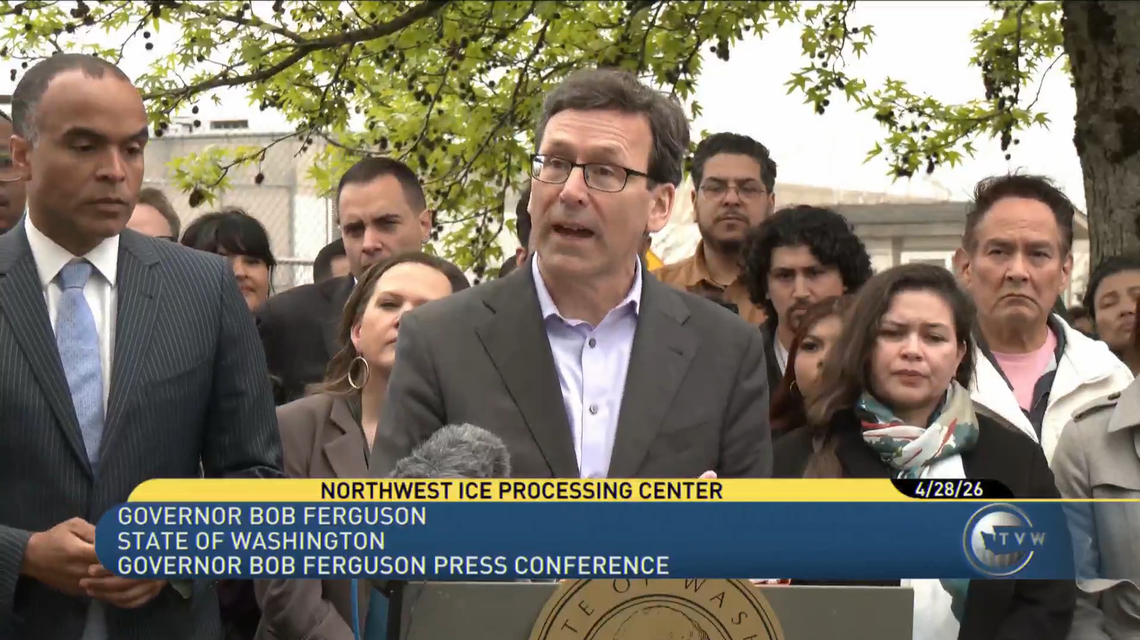
At a news conference outside the facility on the Tacoma Tideflats, Ferguson described some of the complaints from detainees and said the state was being blocked from investigating them. He said he was confident the state would beat the GEO Group in court.
“I want to be perfectly clear, we will not allow GEO Group’s continued obstruction and brazen disregard for state law to go unchallenged,” Ferguson said.
A representative for the GEO Group referred a request for comment Tuesday to ICE. The federal agency did not immediately respond to an email.
A little more than a fourth of the 3,564 complaints the DOH has received from detainees relate to food, water and air quality. Ferguson said detainees have complained that food appears rotten, has been served on dirty trays and contains bugs.
“They state the food tastes bad, smells bad, and that they do not receive enough,” Ferguson said. “One complaint reports that quote, ‘Yesterday for dinner, they served us raw meat. You can see the blood inside the meat. Many of us in the unit, 54 people, chose to throw it away, but others made the decision to still eat it. The water tastes disgusting. It does not taste like normal water you usually drink, which makes sense, because all the staff here bring in their own water bottles because they know the water here is not safe to drink.’”
More than 100 complaints are about assaults, discrimination and religious concerns. Last year, the University of Washington’s Center for Human Rights said it had identified “patterns of neglect” in police responses to the facility. Asked during the news conference if there was a possibility for individual criminal charges based on the complaints, Ferguson said the state first needed to get inside the facility.
“All of the complaints are serious,” Ferguson said. “Start with that. But there are some that obviously are, sexual assault, things that are crimes. And so I think we need to go one step at a time, get inside, see what’s going on. And as you heard from, you know, the department, hey, if there are allegations of criminal activity, that gets referred to the appropriate individuals.”
The state’s request for a preliminary injunction is the latest development in a years-long battle over inspections at the detention center. In fall and winter 2023, inspectors from DOH and the Department of Labor & Industries were denied access when they tried to investigate complaints from detainees and alleged workplace safety violations.
The inspections came after a new law passed from House Bill 1470 set health and safety standards for private detention facilities and which gave state health and workplace agents authority to conduct unannounced inspections. After the inspections were blocked, a federal judge in March 2024 ruled that much of the new law was not constitutional. Another bill passed into law in 2025 that attempted to increase state oversight was also blocked in the courts.
In August, the Ninth Circuit vacated the preliminary injunction that blocked those laws, and it was formally lifted in March.
Ferguson said during the news conference that the only acceptable outcome of this fight is safe conditions for everyone inside the detention center. As of April 9, according to ICE statistics, the facility’s average daily population is 1,289. It has a capacity for 1,575 people.
Lauren Jenks, assistant secretary in the DOH’s Environmental Public Health Division, also spoke at the news conference. She said there are some “big financial sticks” in state law, but that the department’s approach with inspections is not always punitive, it’s to make sure that the issues that are pointed out are fixed.
Jenks said the DOH had already brought the GEO Group data about their water and offered technical assistance to create a water management plan to make sure the water is safe and pleasant to drink.
“We know that this facility is on Tacoma Water (from Tacoma Public Utilities),” Jenks said. “We know Tacoma Water is perfectly fine. We also know we’re getting lots of complaints about the water, and what that looks like to us is an older building that hasn’t had its pipes well maintained.”
During state health officials most recent attempt to inspect the detention center April 20, according to federal court documents, the officials told a guard they were there to investigate complaints about the water, and that they had concerns that a lack of adequate water management could increase the risk of legionella, a type of bacteria, in the water.
The state officials who went to the facility were the director of the Office of Environmental Health and Safety, Todd Phillips, and the Environmental Public Health Division’s policy director, Joseph Laxson. According to a sworn declaration filed in court, the guard they spoke with called GEO’s facility administrator, Bruce Scott. He reportedly gave them a form to fill out and told the officials they needed to contact ICE’s Seattle Field Office.
Laxson’s declaration says he reached out to the email he was given for ICE multiple times and never received a response. He wrote that he didn’t believe he would ever get a response.
Brown said during the news conference that by refusing to let inspectors do their job, the GEO Group was violating the law and sending the message that Washingtonians don’t deserve to know what is going on in their facility. He said the allegations in the complaints were unacceptable and needed to be investigated.
“We are here because enough is enough,” Brown said. “Enough is enough. And we are here because as the governor summarized in our complaint details, people are being harmed in this facility, and inaction is no longer acceptable.”
