Are the kids OK? Report shows plight of ‘disconnected youth’ in Pierce County
AI-generated summary reviewed by our newsroom.
- More than 14,000 Pierce County residents ages 16–24 are not working or in school.
- Disconnection rate for ages 16–24 in Pierce County was essentially unchanged from 2013.
- Report finds disconnected youth concentrated in specific areas of the county.
A new report from Pierce County’s local Workforce Development Board contends little progress has been made in more than a decade in improving employment outcomes for whom it calls “disconnected young adults” in the county.
The report, published online May 11 by WorkForce Central, said, “More than 14,000 young people in Pierce County — roughly 1 in 8 residents between the ages of 16 and 24 — are not working or enrolled in school.”
The report estimated about 13 percent of the county’s young adults fall in this category. The most recent figures from Measure of America, a nonprofit initiative of the Social Science Research Council of Brooklyn, put the U.S. total of ages 16 to 24 in that category at around 10.9 percent.
The peak intervention period to change course is between ages 19-21, according to the WorkForce Central report, “suggesting that transition support during and immediately after the high school years is a critical intervention point.”
The report, which looked at data between the years of 2013 and 2024, noted that it was young men who faced a “disproportionate risk.”
“The majority of disconnected young adults across most racial groups in Pierce County are male, with particularly high rates among men identifying as some other race, Black and Asian,” according to the report.
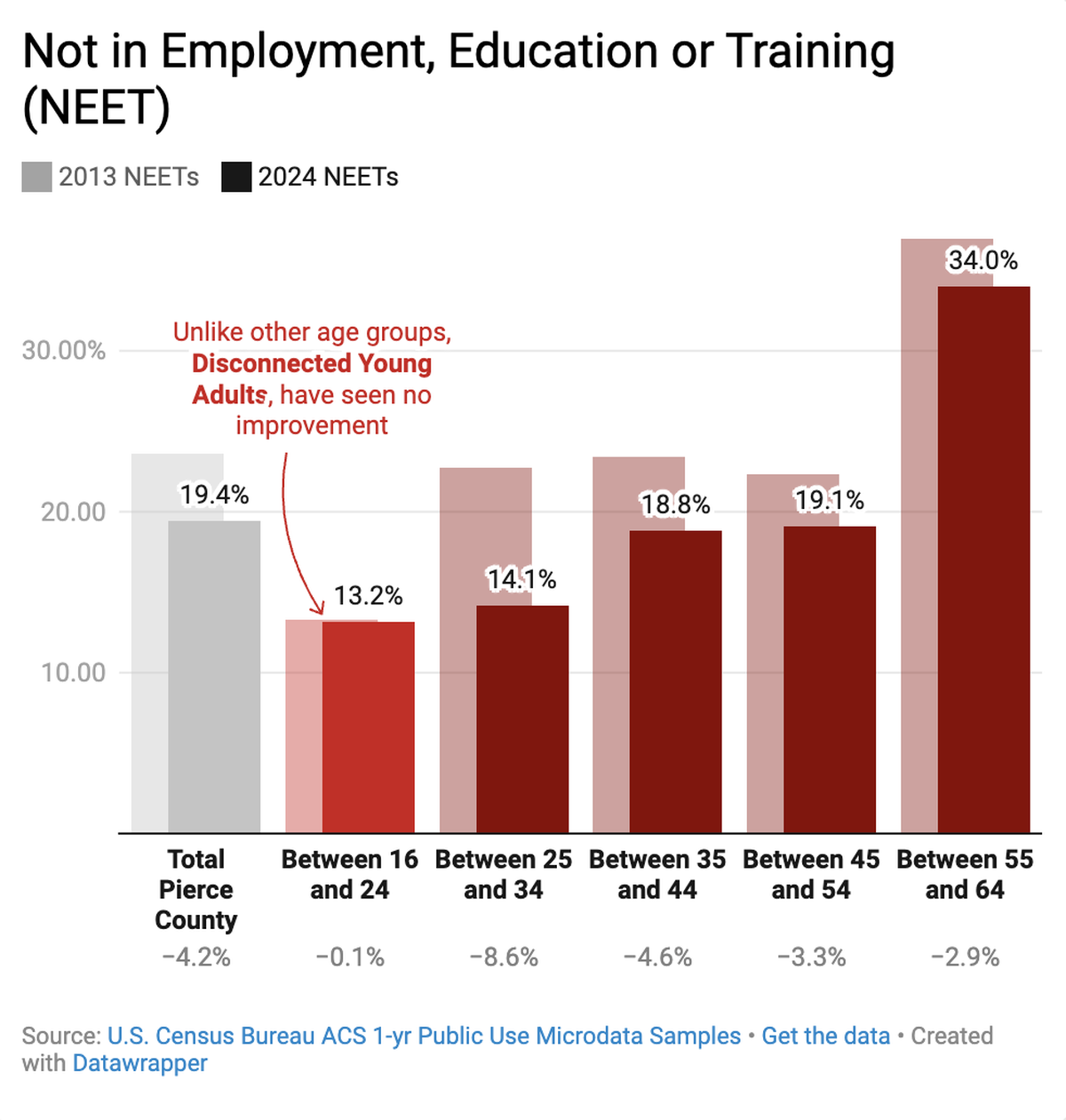
It added, “Despite years of economic growth and workforce investment across Pierce County, the rate of disconnection for local young adults has remained stubbornly flat — the same today as it was in 2013, even as every other adult age group has improved.”
Katie Condit is CEO of WorkForce Central. In a May 20 interview with The News Tribune, she noted that the results weren’t blaming any specific thing, but rather, “it’s a compilation of factors,” including the effects of a pandemic and economic upheaval.
But, she added, “The status quo is not going to get us where we need to go.”
Multiple, overlapping barriers to success
The report pointed to common “multiple compounding barriers” frequently overlapping in such cases, including poverty, lack of a high school diploma, disability and early parenthood, “underscoring the need for sustained wraparound services.”
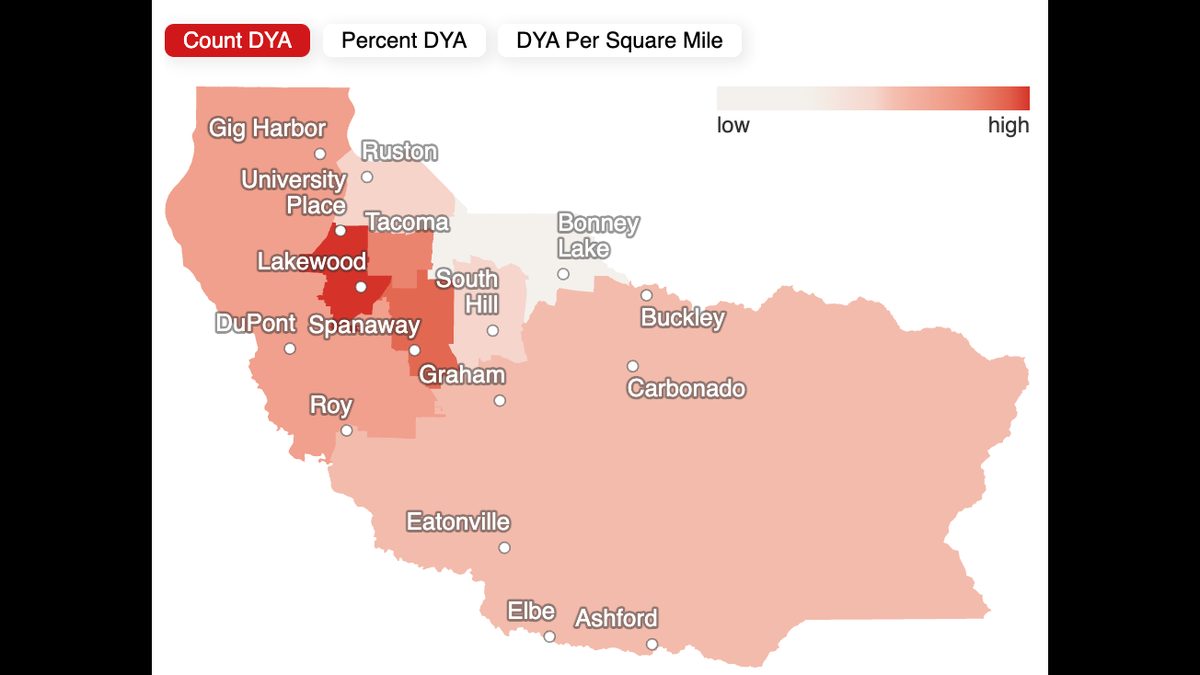
Those youths also appear concentrated in certain areas, with the report pointing to South Tacoma, Parkland/Spanaway and Lakewood/University Place. Those areas, it added, “account for more than half of all disconnected youth in the county at roughly 10 times the average density.”
The percentage of those not in employment, education or training among the total county population decreased by 4.2 percent in the time frame examined. For those between ages 23 and 34, the percentage decrease was nearly 9 percent.
Other noticeable declines were seen in every age group except among those ages 16-24, where the rate moved lower by 0.1 percent.
The report also tackled artificial intelligence’s effect on the labor market, with entry-level hiring among the first areas to be automated or restructured. AI-screening of applicants also has created higher barriers to entry, it noted.
The report stated, “While overall employment may continue to grow, these shifts are narrowing early‑career pathways and disproportionately affecting young adults with limited work history or nontraditional resumes.”
It also warns that cuts to the federal safety net, including the Affordable Care Act subsidies and Supplemental Nutrition Assistance program eligibility, hit that population group particularly hard and recommended “proactive outreach to young adults who may be newly eligible for services” amid federal cuts.
Ultimately, the report concluded, single-service intervention targeting just one cause of youths dropping out of the system is generally not enough.
“Effective reconnection strategies will need to pair workforce and education programming with access to support for basic needs, childcare, disability accommodations and alternative credentialing pathways,” it added.
Paths forward and funding challenges
The report and Condit both emphasized the importance of targeting the specific geographic locations called out in the research to deliver support services, a change her agency has adopted.
“We are moving forward going to be more geographically targeted — looking at this data and saying, ‘How do we place human capacity and resource where concentrations of young people are,’” she said.
“It’s also changing how we’re talking to employers,” she added. “In our paid work experience programs that have about an 80% retention rate, we’re focusing on disconnected young people, saying to an employer, ‘You might be reticent to give them a chance, so we’re actually going to pay their wages for the first two to three months in hopes that you’ll hire them afterward,’ and that has had an 80% retention rate.”
Kari Plog is Executive Office press secretary and communications specialist for Pierce County. In response to questions, Plog said in an emailed statement that the report confirmed what county officials have already recognized in terms of teens’ transition to adulthood. She noted the associated vulnerabilities tied to factors including social media contributing to “more loneliness and disconnection.”
Plog noted that Pierce County Executive Ryan Mello’s “Forward Together” plan “specifically lists ‘helping youth thrive’ as a priority,” and that a roundtable on that topic was convened last June “to help inform” budget development for 2026-27.
“In the 2026-27 budget cycle, for example, we have invested more than $7.7 million of behavioral health tax revenue in youth services countywide. This funds a wide range of services, including counseling and peer support in schools, free mental health care for uninsured LGBTQ+ youth, and crisis prevention for neurodiverse youth, to name just a few,” she said via email. “We also routinely update a web page that lists youth programs offered across the county.”
Plog also noted the funding challenges on the state level, in addition to federal dollars, as many such programs “rely on Puget Sound Taxpayer Accountability Account sales tax revenues to operate. That funding is volatile.”
“And many schools, hospitals and nonprofits are also grappling with funding challenges and having to make difficult decisions about programs and services,” she added.
Condit said she hopes the takeaway of those who read the report is that the problems are solvable.
“I think it’s really easy right now to be in the headspace that everything is broken and that the problem is too big,” she said. “And I would say that Pierce County, specifically with our ecosystem of resources, is well-positioned to tackle this opportunity.
“It’s a call to action, and it’s a call to action for everyone, because these are our young people.”