Moonshine, bootleggers and panoramic views of the Sound. Life on Salmon Beach
AI-generated summary reviewed by our newsroom.
- About 80 people live at Salmon Beach below the cliffs of Point Defiance Park in Tacoma.
- Houses at Salmon Beach face landslides, King Tides and close‑quarter fires.
- The community began as fisherman’s shacks and hosted moonshiners during Prohibition.
Hidden behind an unassuming locked gate by Point Defiance Park is a community of people who like their privacy.
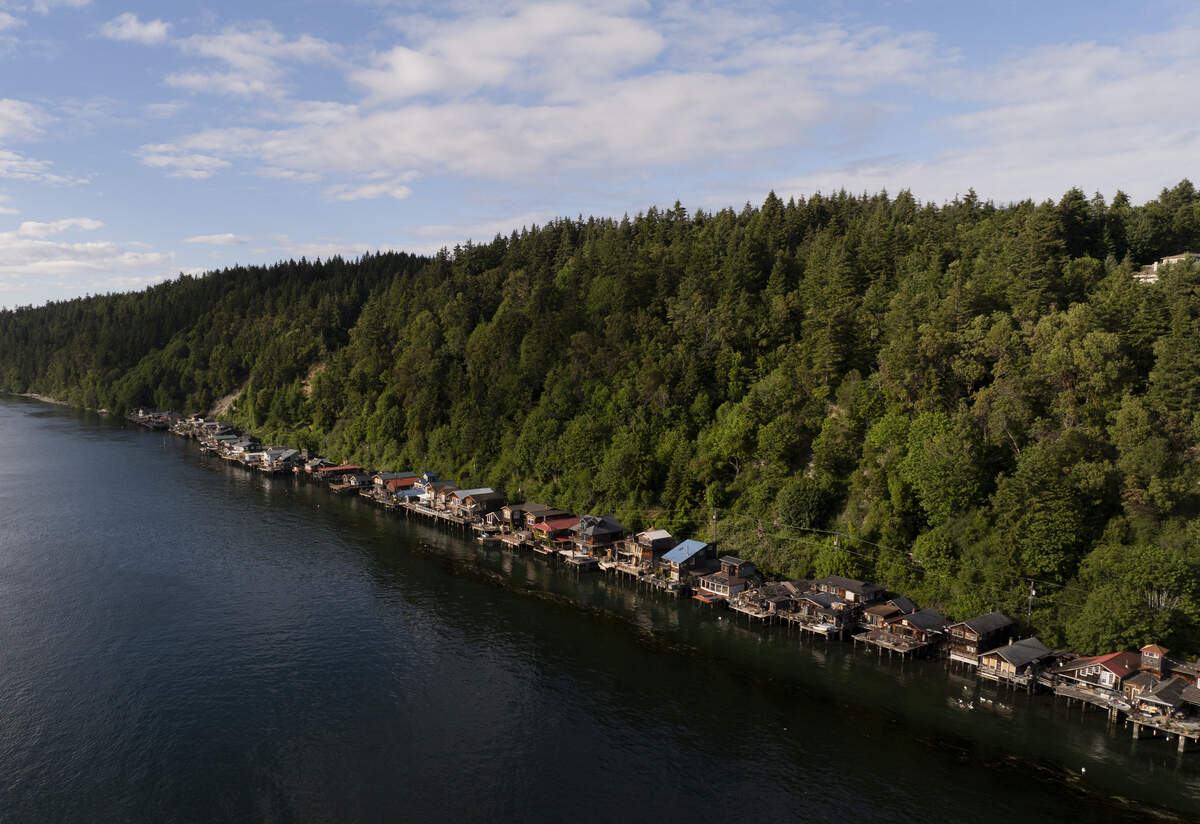
Through a thicket of forest and down a steep flight of nearly 300 stairs rest 104 homes, held up by stilts over a narrow stretch of beach. Waves toss driftwood against the houses’ pilings, and the soft trickle of dirt running down a steep cliff blends into the repetitive hush of the tide going in and out.
More than 100 people call Tacoma’s Salmon Beach home. It’s arguably one of the most unique neighborhoods in the South Puget Sound and was once home to fishermen, working families, moonshiners and bootleggers who held parties during Prohibition.
Residents value their privacy, but neon artist and fourth-generation Salmon Beacher Galen Turner (@gaytron on Instagram) took The News Tribune on a tour of his home (Cabin 64) on June 3 and the thin wooden boardwalk that serves as the neighborhood’s only road. On Salmon Beach, he says, you make do with what you have, and neighbors are quick to help out or come over for dinner.
Turner’s father, Richard Allen Turner, bought the house for $47.15 during a poker game at age 15, the story goes. The back deck has panoramic views of the Tacoma Narrows Bridge, and the walls and shelves are covered with art, knick-knacks and figurines. A long, jagged-toothed timber saw hangs on the wall in the living room, and jars of agates Turner has collected over the decades rest on the window sills. An elk’s white antlers (a gift from a neighbor) sit on the wood-burning stove, and there’s a porthole in the floor near the toilet, so you can watch the waves crash while you’re on the john.
Turner says he was conceived in this house and lived on Salmon Beach up until he graduated from high school before returning as an adult. Now 47, he breathes a sigh of relief whenever he returns home, after working in his neon studio “up the hill” near Wright Park.
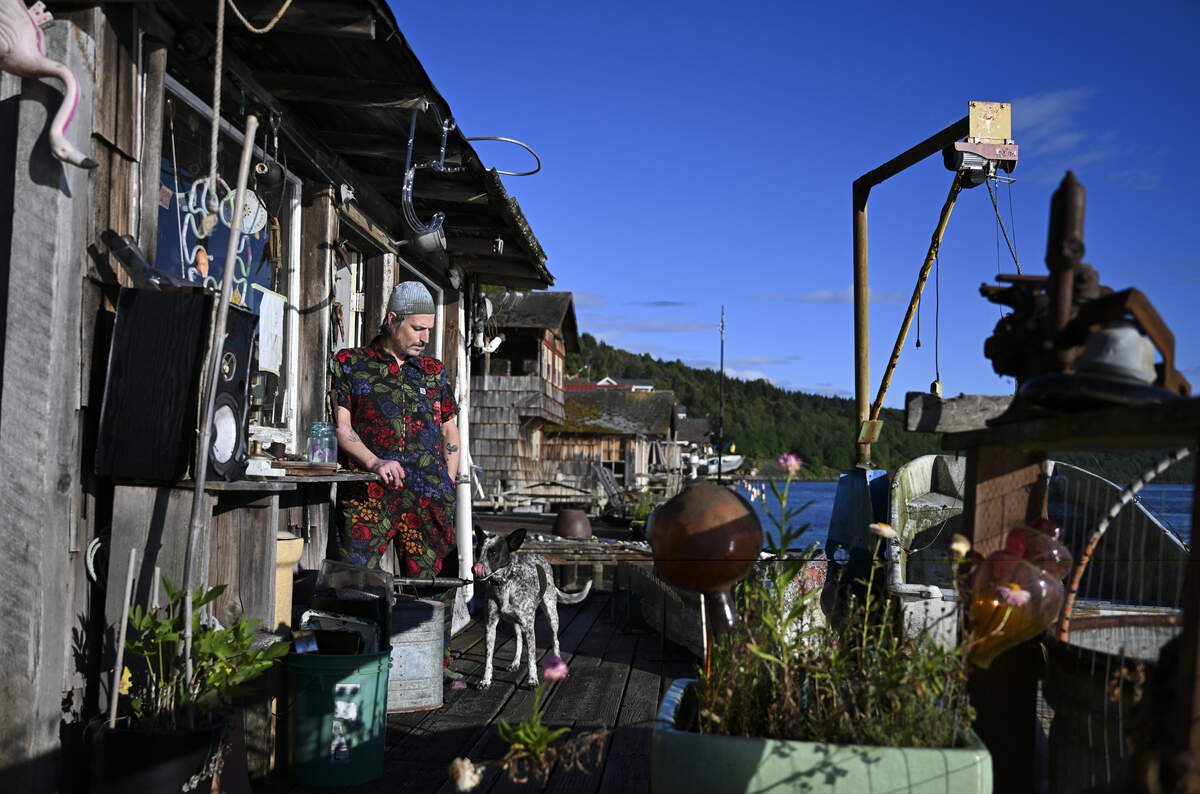
Residents here are gritty, self-sufficient and crafty. Most heat their homes with wood stoves, collecting logs and driftwood and stacking them in rows next to their houses. Some use well water. Electricity didn’t go in until the 1930s, and a sewer system didn’t go in until the 1990s. The only way to reach Salmon Beach is down the stairs, or via boat (some new neighbors had to rent a barge to move in their furniture).
The greatest risk to the community is the natural elements. Houses are raised to adapt to king tides (the highest tides of the year). Fires can cause severe damage here, as the houses are built very close together, and most are made of wood. Turner has seen homes washed away or crushed as a result of landslides from above.
Yet, there’s something special about Salmon Beach that continues to draw people to live there, as it has since the 1900s.
Andrew and Jennifer Phelps moved into Cabin 10 in 2014 and live there with their son Sequoia, age 8. It’s not easy to find affordable waterfront housing in Tacoma, but “the stairs deter a lot of people,” Jennifer said. When they moved in via barge, within minutes half the neighborhood showed up to greet them, and the barge was emptied in 20 minutes, Andrew said.
“I think a lot of people think that we’re like, a hoity-toity waterfront gated community. That’s not Salmon Beach’s roots. It’s very blue collar, rugged individualist. It draws a lot of artists, a lot of craftsmen, writers,” Jennifer said.
“What sells you down here is the view,” Andrew said. “But the greatest part is your neighbors and the community that’s down here. It’s special. It’s like nothing for people to just show up and come over and hang out.”
Sequoia loves to look for sea glass, bones, rocks, agates, shells, crabs, octopus, star fish, eagles, seals, sea lions and beach worms during low tide. From their back deck, he’s seen whales jumping and splashing. While walking the boardwalk, Andrew said there are bioluminescent pools on the beach that glow at night.
During the long winters, you learn to make your own fun, Turner said. His father hosted “Dead Poets Society” poetry nights and parties. Neighbors go caroling for Christmas and have competitive row-boat races and costume contests for July 4. They commemorate the anniversary of the Mount St. Helens eruption with a potluck and a burning effigy of the mountain “packed full of fireworks” and sent out to sea, he said.
Turner’s father has a memorial plaque on the stairs leading down to the beach. Although it’s rare to have someone move off the beach in their final days, whenever someone has to leave, they’re taken out on a boat to say goodbye, Turner said.
“We go up and down the beach, and everybody comes out on the deck. And if they play an instrument, [they do so], or shoot fireworks or shoot a cannon off, or you know, just whatever way they can say goodbye and love you, and things like that,” he said. “They get really creative. Sometimes, they’ll take the ashes and build a little tiny boat and do a Viking burial, set it on fire out there and watch it sink.”
Turner said, “It takes a little bit of crazy to live down here, and you’d be amazed how many different kinds of crazy there is.”
“But also, you have Point Defiance as your backyard and the Narrows as your front yard,” he said. “I mean, that is just wonderful.”
Moonshiners and misfits
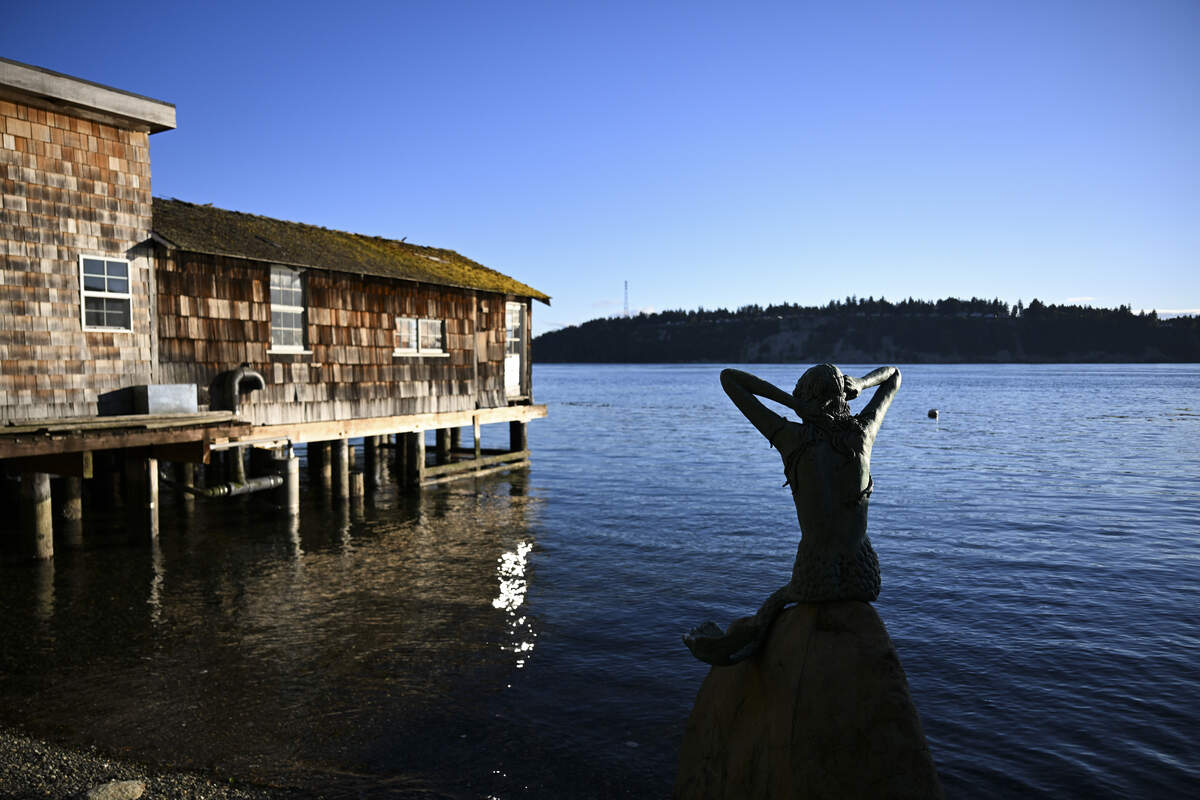
To learn more about the history of Salmon Beach, The News Tribune dug through hundreds of newspaper clippings, in addition to research papers, articles and the book “Tacoma’s Salmon Beach,” written by longtime historian and resident Roger Cushman Edwards. While walking the neighborhood June 3, The News Tribune met Edwards, who was sitting next to Chloe, a life-size bronze mermaid statue on the beach made by his late partner, artist Marilyn Mahoney.
According to historic records and analyses, Indigenous people often fished at Salmon Beach prior to the permanent erection of shacks and one-room cabins by fishermen, loggers and working families between 1890 and 1910. At that time, the Tacoma shoreline had become industrialized with mills and smelters, and there was no place on the waterfront for workers to find peace and solitude, or a place to fish, according to records kept by the Tacoma Public Library. Fishermen came from as far as Spanaway (then the logging center of Tacoma) to Salmon Beach to catch commonly-seen three-foot-long salmon and enjoy the view.
The popularity of the spot prompted Andrew Foss to build the Narrows Boat House on the beach in 1906, which proved to be a lucrative business. By 1930 there was a large two-story building, fishing pier and 125 boats stored there, about 80 of which were rentals. In 1918 the Salmon Beach store opened, selling dry goods, coal oil, kerosene and fishing equipment. It later functioned as a post office and dance hall with a baby grand piano (but it was later demolished in 1969 to build another house). It’s said that beachfront moonshiners supported the store’s “brisk sales in bulk sugar,” per an article written in 1984.
By 1919 about 100 houses were along the beach, mostly young Tacoma workers and their families. That January a massive landslide destroyed 14 homes on Salmon Beach. It was that disaster and the beginning of Prohibition in 1920 that marked the first extreme change in population. Fearing landslides, many families began to leave the beach empty and in ruins. Loggers displaced by mechanization in the logging industry, and others, found mostly empty houses that could be bought for $25, “if anything at all,” per historic records. Bootleggers and alcoholics became drawn to the beach, which had clear spring water that was ideal for brewing.
Limited accessibility made Salmon Beach a prime spot for parties and drinking, as it was hard for police to enforce laws there. Historic records show that it was common for parties to last for several weeks, not always in one cabin. Trails were guarded, and children were directed to alert adults if they saw any strangers, so they could hide all traces of brewing and beer drinking. Residents largely consisted of unemployed or retired bachelors and remained so until the Great Depression era, during which there was a greater flux of permanent residents, particularly families looking for cheaper housing.
Another severe landslide nearby in April 1949, caused by an earthquake, prompted the landowner at the time to issue eviction notices to 300 residents, given the geological instability of the 400-foot cliff above. That set off lengthy legal battles with residents fighting to keep their homes and way of life. Ownership claims became complicated as bills of sale were often informal in nature, sometimes written on paper napkins at bars and consummated with a handshake, as The News Tribune reported in 1976.
Today the city of Tacoma says there are about 100 homes along the one-mile stretch of shoreline. Most of the land is held by the Salmon Beach Improvement Club, a nonprofit run by the residents. Homeowners own the structures and lease the land, said spokesperson Maria Lee on Thursday.
Salmon Beach Historic District is listed on the Washington Heritage Register, as it “represents a rare glimpse of the waterfront lifestyle from the first part of the 20th century,” per the city’s website. Cabin 97 has been certified as a National Historic Landmark and is also on Tacoma’s Register of Historic Places. It is a one-room structure with shingle siding constructed in 1916 that remains “basically unaltered” and is considered the best example of a fishing shack structure commonly found on the Puget Sound prior to World War I.