
Puyallup Fish Hatchery helps mother heal from loss of son
To Paula Harmes, the Puyallup Fish Hatchery is more than slowly crumbling fishery infrastructure with broken windows and leaky plumbing.
The historic state trout farm on Maple Springs along Clarks Creek is where some of her childhood memories with her dad happened. Where her five kids used to sneak off to, crossing the street — a no-no — and sometimes losing a shoe or a boot in the mud in the process.
Where her son Jacob Steinle promised his children he would take them, before dying mysteriously on Valentine’s Day 2012, days after an altercation in front of a Bellevue bar.

Two months after Steinle’s death, the Rogers High School alumnus was in her pajamas and watched as people sized up the property for a proposed long-term lease to Pacific Seafood.
The hatchery site also houses the Puyallup Historical Hatchery Foundation, a nonprofit formed to protest the proposed lease, which would have given Pacific Seafood control of the hatchery and its right to the pathogen-free water there.
Harmes felt she couldn’t lose the hatchery, too.
“It was giving back to the community, even with the state it was in,” said Harmes, 57. “Who could not love a place like that?”
So she did some old-fashioned research, just like her father taught her. It was something to take her mind off her loss.
That research helped Harmes submit successful applications for the hatchery to the Washington Heritage Register and the National Register of Historic Places, where it is the sole listed hatchery.
Last month, the Washington Trust for Historic Preservation named the Puyallup Fish Hatchery one of the state’s most endangered historic properties because of the state Department of Fish and Wildlife’s plan to refurbish the hatchery and increase its salmon-rearing capacity.
Harmes submitted that application, too.
It was giving back to the community, even with the state it was in. Who could not love a place like that?
Paula Harmes
Puyallup resident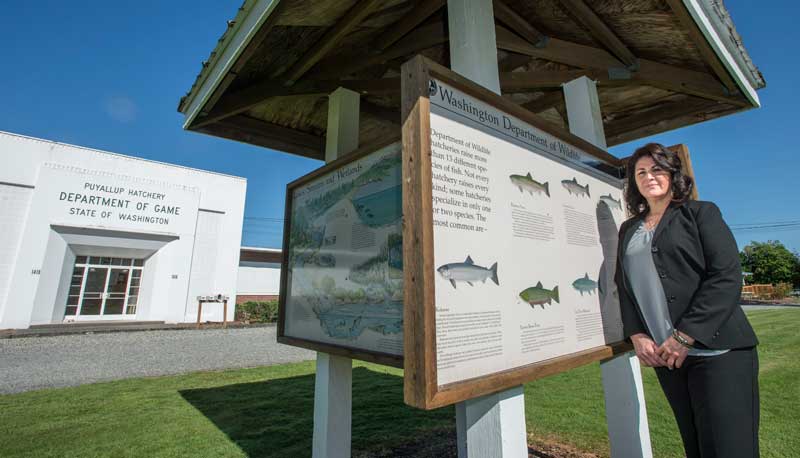
The hatchery has value because raising fish is historically important in the Northwest and because the main building is stylistically representative of its era, even if it isn’t fancy, said Chris Moore, executive director of the trust.
“We feel pretty confident that the Department of Fish and Wildlife understands the historic value of the fish hatchery,” said Moore, whose nonprofit organization is celebrating its 40th anniversary. “And when they implement the needed conversion, we feel confident that they’re going to do as much as they can to retain the character-defining and historic features of the hatchery.”
Fish and Wildlife has just started the design phase of its planning process, said Jim Jenkins, the department’s regional hatchery and reform operations manager.
The Legislature allocated $5 million for the design work and to start construction, though the final budget will not be known until designs are complete.
We feel pretty confident that the Department of Fish and Wildlife understands the historic value of the fish hatchery.
Chris Moore
executive director of Washington Trust for Historic PreservationJenkins said the department plans to stay on the property at 1416 14th St. SW, maintain its original water right of 15 cubic feet per second and have a more dynamic multispecies fish production.
It wants to do that with preservation in mind.
“I think we both share the same goal,” Jenkins said. “I see it as a positive effect. The Department of Fish and Wildlife wants to maintain the historical integrity, and that just lends support to our cause.”
Construction isn’t expected to be complete until 2019 or 2020 because the work must be done in sync with the life cycles of the rainbow trout and chinook and coho salmon raised there.
The trout raised at the hatchery are used to stock lakes throughout Western Washington for sport fishing, while the salmon are raised for conservation efforts.
The department has entered into a memorandum of understanding with the Puyallup Tribe of Indians to raise salmon in Puyallup, which means Fish and Wildlife must move some of the trout production to other Western Washington hatcheries.
Currently, the trays in which newly hatched salmon live are in one small corner of the main building’s two incubator rooms. Original troughs for newly hatched trout, their light blue paint peeling, fill the rest of the incubator rooms’ space, where light leaks in through an array of broken windows.
The Department of Fish and Wildlife wants to maintain the historical integrity, and that just lends support to our cause.
Jim Jenkins
Washington state Department of Fish and Wildlife hatchery manager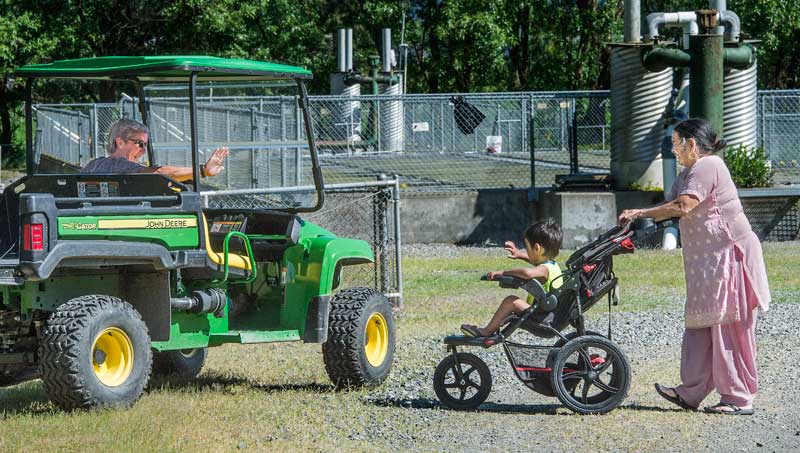
Outside are the round cement ponds that juvenile trout like and the long “raceways” that young salmon prefer, with the original plumbing leaking into the gravel around them.
A healthy heron population hangs out there, though nets over the water keep them out. All of the round ponds and many of the raceways were built at the time the hatchery was, though some raceways were added later.
Because of the state of the original plumbing, Jenkins doesn’t expect to be able to retrofit the ponds.
“Round ponds are part of the historical element here that we’re trying to consider,” Jenkins said.
The facilities that contributed to the hatchery’s National Register of Historic Places application are the hatchery building, the superintendent’s house, the shop/garage and the ponds and raceways.
Trout and coho salmon stay at the hatchery for more than a year, while chinook salmon are there for a few months before being released. Fish arrive at the hatchery already hatched; the eggs are fertilized at other state facilities.
The hatchery site also houses the Puyallup Historical Hatchery Foundation.The group was founded on May 18, 2012, to protest the privatization of the hatchery, which was set to be finalized June 2.
Dozens of people mobilized.
By May 31, Pacific Seafood backed out of the deal.

I might not be able to resurrect him, but I might be able to save this building.
Paula Harmes
Puyallup residentThe all-volunteer foundation now runs an education center there, and will help all fourth-graders in the Puyallup School District come to the hatchery each year, starting in November, when the hatchery is most active.
“It didn’t bother our foundation that they wanted to add salmon to the hatchery,” said Patty Carter, the group’s founding director. “It certainly can accommodate it — it’s huge — and money certainly follows salmon.”
The hatchery site was in a rural setting when it opened in 1948, but the growth of Puyallup brought houses to three of its sides.
Harmes first moved nearby nearly 50 years ago and came back as an adult, and she’s found healing in the hatchery after losing her son.
“I might not be able to resurrect him,” Harmes said, “but I might be able to save this building.”
Kenny Ocker: 253-597-8627, @KennyOcker
This story was originally published May 12, 2016 at 2:14 PM with the headline "Puyallup Fish Hatchery helps mother heal from loss of son."