
Lead poisoning: Where the hidden danger lies
When news broke last month about possible lead contamination in Tacoma water, the city sat up and took notice. And when reports of lead in some Tacoma schools’ water followed, parental anxiety increased a beat.
But health experts say many parents worried about lead exposure in children need look no farther than their own windowsill. Or their backyard gardens.
Lead house paint that dates from before the 1978 federal ban is the No. 1 source of lead poisoning of children in the United States, and children who live in older homes can be exposed through peeling paint.
Friction from opening and closing windows — or remodeling — can loosen old paint chips and dust that kids ingest. Babies learning to crawl and toddlers are most at risk.
“Water feels more like a public health issue,” says Elisabeth Long, who oversees the childhood lead poisoning surveillance system for the state Department of Health. “But paint is the big culprit.”
Lead that has settled into soil from old industries — such as the Asarco smelter in Ruston that closed in 1985 — and from past use of leaded gasoline is a significant contributor as well.
Other risk factors in Washington include living on former orchard lands, where lead-containing pesticides were used.
Dr. Bruce Lanphear is a health sciences professor at Simon Fraser University in British Columbia and an expert on the effects of lead and other toxins on children.
He said most studies on how lead in water affects children have measured lead levels of water in their homes, rather than schools.
“We don’t have any (studies) that attempted to test the impact of school water fountain contamination on children’s or teachers’ blood lead levels,” he said.
“Still, we know that water lead greater than 5 parts per billion in homes was associated with a 20 to 30 percent increase in blood lead levels among children and women, respectively.”

Lanphear believes the way the government regulates toxins, which implies there is a safe level, fails to protect children.
He says the 15 ppb limit set as the U.S. Environmental Protection Agency threshold for public water systems (20 ppb for schoolhouse water) is inadequate.
“It wasn’t intended to be used as a health standard,” he said. “It is an administrative standard.”
In other words, the EPA standard is based on what’s do-able — not what’s best for kids based on current science.
Others point out that children consume far more water at home, through drinking and cooking, than they do at school. And water is not a huge contributor to lead poisoning in children, Long said.
“It’s hard to put a finger on the health effects,” she said. “It depends on how much a child drinks, what their nutritional status is.” (Diets rich in calcium, iron and vitamin C can block the absorption of lead in the body.)
The federal Centers for Disease Control and Prevention says exposure to lead in drinking water alone likely would not elevate lead blood levels in most adults.
But it adds that babies fed on powdered formula mixed with lead-tainted water might be at higher risk because of the large volume of water they consume when compared to their body size.
And lead can accumulate in the body over time, so children who live in poor housing with peeling paint might add to their bodies’ lead burden by drinking tainted water.
The CDC and most other experts say there is no safe level of lead in the blood.
One way to look at children’s exposure to lead is through blood tests.
When Tacoma Public Schools announced last month that high lead levels were found in 13 city schools, some parents wanted to know whether the school district would pay for blood tests for their children. (The district said it would not).
Federal guidelines call for blood screening of all children on Medicaid, the government’s health insurance plan for the poor.
Long said that some Head Start programs in Washington offer blood lead screening tests, and the state Health Department has equipment it loans to those programs.
But outside of federal Medicaid requirements, states are free to set their own guidelines for blood screening of children.
Washington has one of the lowest childhood blood screening rates in the nation. In 2012, the rate was less than 4 percent, compared with a national rate of more than 11 percent.
Screening rates also vary by counties within Washington, with Pierce County falling roughly in the middle.
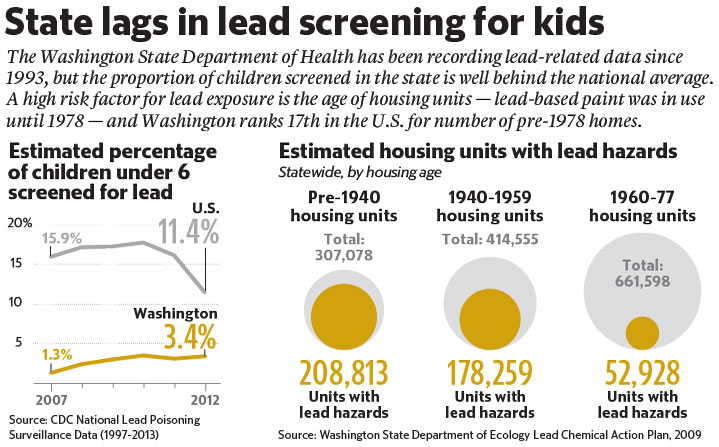
Last year, the state Health Department convened a panel of experts to review national research on the subject. Long, who headed the panel, said past state guidelines simply have urged physicians to use their clinical judgment to determine which children to screen and how to do so.
The state panel recommended targeting children with increased risk factors, rather than mandating universal blood testing. It also urged doctors to consider testing when parents ask for it, or in children with disabilities such as autism, ADHD and other learning delays.
“I would rather we screen the kids who need to be screened and use our limited public health resources on kids with the highest risk,” Long said.
Risk factors include children who live in or regularly visit older housing, or whose older homes are undergoing renovations. Poverty is a major risk factor, in part because low-income families tend to occupy older housing that may contain lead paint.
Children who are immigrants, particularly from countries where leaded gasoline is still in use, are at risk as well.
The state Health Department developed an interactive mapping tool on its website that allows the public to determine health risks from lead and other health hazards.
The tool uses age of housing and poverty levels as weighted indicators for lead exposure. Long says the map is a powerful tool that can give users a sense of what risk factors might be in their communities.
“It’s a tool for (health care) providers as well as for the public,” she says.
Experts note that reductions in lead paint and leaded gasoline have dramatically reduced lead toxicity in children over the past few decades. Compared to previous generations, most American children are exposed to far less lead than their parents or grandparents might have been.
“Across the nation as a whole, we’ve made great progress in reducing children’s exposure to lead,” said Dr. Catherine Karr of the University of Washington’s environmental health specialty unit.
But risks vary from community to community.
“The worst places tend to be places where people without economic resources live,” she added.
Scientists have discovered that even relatively low levels of blood lead can affect the rapidly developing brains and nervous systems of children — beginning in utero.
“Little shifts matter,” said Lanphear of Simon Fraser University. “On an individual level, it may be subtle. But on a population level, the effects can be dramatic.”
The effects can include lowered IQ, learning disabilities, decreased attention span, increased aggression and other behavioral issues. Some research has correlated crime rates with the introduction and subsequent gradual withdrawal of leaded gasoline in the environment.
The difficulty for researchers is teasing out how much of a given condition is due to lead exposure.
Symptoms of lead toxicity might overlap with other conditions, such as fetal alcohol syndrome, said Dr. Sheila Marcus, service chief of child and adolescent psychiatry at the University of Michigan.
“The same children who may have had exposure to lead paint may also have post-traumatic stress disorder due to other social factors,” Marcus said.
Karr says the current spotlight on lead risks stemming from concerns about contaminated water might have a beneficial result in the future.
“Sometimes it takes having the spotlight shown (on an issue),” she said. “Hopefully, we can use this opportunity to get the resources to get the job done.”
Debbie Cafazzo: 253-597-8635, @DebbieCafazzo
To keep up to date on water testing for lead in Tacoma Public Schools, click on the district website.
This story was originally published May 14, 2016 at 7:36 PM with the headline "Lead poisoning: Where the hidden danger lies."