
‘I’ll live in my car with my dogs.’ Low-income residents feel vulnerable when complex loses rent subsidy

Theresa Betts has been rallying her Gig Harbor neighbors to find ways to keep paying the rent.
A handful of low-income, senior and disabled residents face displacement or homelessness because the Laurelwood apartment complex, one of the few subsidized apartment complexes in the city, is being sold.
“We are being priced out of Gig Harbor,” said Betts, who is disabled and a Laurelwood resident.
Because of a federal loan Laurelwood’s owners received almost 30 years ago, the complex gets a subsidy that helps keep rents low for residents in need. Now, with the loan being paid off, the owners are negotiating to sell the complex to a private owner, who will not be required to keep the rents low.
“A group of owners came together to purchase this complex as a form of investment,” said Annette Brianna, spokeswoman for the group, Shelter Resources Inc. “But now it’s just time to sell.”
Laurelwood is one of three subsidized apartment complexes in Gig Harbor, along with Norwegian Woods Apartments, next door to Laurelwood, and Colvos Terrace. Of the three, Laurelwood is the only one fit for younger, disabled residents, Betts said.
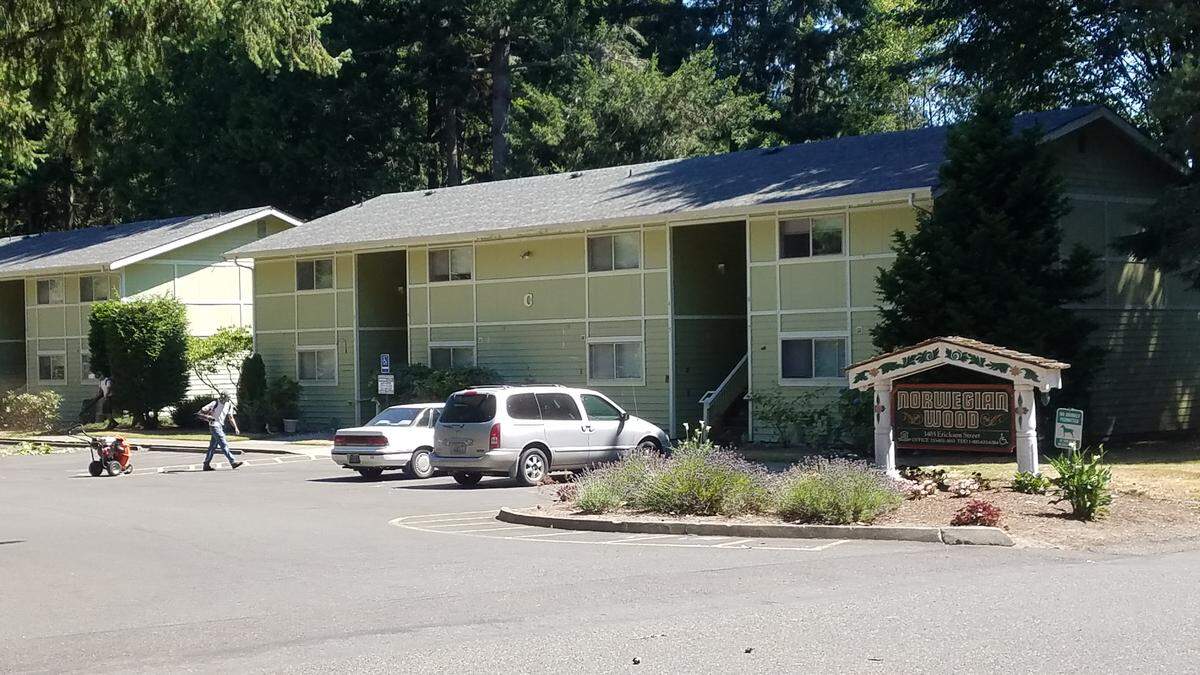
“The one is for seniors only and the other is for all ages,” she said. “But they don’t have elevators, only stairs. That doesn’t really help a lot of us who are disabled.”
On average, the residents of Laurelwood have lived there for at least one year; many have been there for almost 20.
“I have been here since 2002,” said Jane, who asked that her last name not be used to avoid problems with the new owner. “I love living in Gig Harbor. I have family here.”
But residents who want to stay in Gig Harbor face slim chances of finding low-rent places to live in a reasonable amount of time.
Wait lists across the state for low-income, subsidized housing usually are at least three years, said Amy Tower, spokeswoman of the nonprofit Tenants Union. Laurelwood residents have run into 7-year-long wait lists, she said.
“It’s really unfortunate how little investment the government has put into affordable housing, especially for poor people,” Tower said. “(The U.S. Department of Housing and Urban Development) has been basically under investing for years. … at the local level there is a crunch. Some just close the wait list. It’s an unbelievable shortage.”
What the residents know
Laurelwood residents first learned of the potential loss of the subsidy that kept their rents low in October 2017.
Betts and other residents got a letter from Shelter Resources, advising them that the company planned to pay off the loan it had received through the U.S. Department of Agriculture’s Rural Housing Service.
“The prepayment of this loan could ultimately impact the rental amount paid on your apartment unit,” the letter stated. “However, in no event will you be required to vacate the property (due to the loss of the subsidy).”
On June 18, residents received a letter from the Agriculture Department, stating that the loan will be paid off in October.
Brianna said the owners sought out nonprofits and public agencies to buy the property at its appraised value, as required by the Agriculture Department, but none was interested.
Now, Brianna said, the owners are negotiating to sell to a local resident, who she declined to name. She said the new owner likely will not keep the low rents.
The Agriculture Department will provide some residents with rental vouchers.
“To help protect you from the likely increase in rent, you may be eligible for a USDA voucher that will provide a short-term rental subsidy and allow you to remain where you are, or to move somewhere else,” stated a letter from the agency.
A meeting is scheduled for Aug. 14 between residents, an Agriculture Department representative and the current owners. The meeting will be the first response residents have received from the owners and the government since June, Betts said.
“Nobody, including management, has come out and explained to anybody anything about these letters,” she said.
“We have people here who are blind, and all they received were paper letters. So I went and talked to them. So I took it upon myself to have a meeting once a month so the residents understand how serious this is.
“We need to start filling out applications. I am helping them find resources and fill out paperwork. I’ve become a makeshift social worker.”
Feeling pushed out of Gig Harbor
Many Laurelwood residents, vouchers or not, have been looking in and around Gig Harbor for new homes. The long wait lists and unstable economic conditions have left them wondering what their future holds.
“If the rent goes up and I can’t pay it, then I’m homeless,” said Judy, a disabled Laurelwood resident. “I’ll be living in my car with my dogs.”
“Gig Harbor has always been a money town,” said Cheryl, a lifetime resident of the city. “We can’t afford to live here anymore.”
Recent news stories about the high cost of living in Gig Harbor and the city’s residential development moratorium made her realize that the vulnerable in Gig Harbor were left out of the city’s conversation, Betts said.
“We can’t afford assisted living, and our families are here,” she said. “We don’t want to move away.”
The regional housing crisis has made Gig Harbor the most expensive place to live in Pierce County. In May, the median selling price for a home was nearly $500,000, up $6,110 from a year ago, according to the Northwest Multiple Listing Service.
The average rent in Gig Harbor is $1,459 a month, according to research from RentCafe.com, an online internet listing service. For a two-bedroom home, the average rent is $1,498, a 9 percent raise since 2017.
In Tacoma, the average monthly rent is $1,276. The lowest average monthly rent in the area is in Spanaway at $1,075.
In Tacoma, the City Council approved assistance to residents of the Tiki Apartments after the building’s owner told the low-income renters they would have to move so new owners could renovate the apartments.
Tower said cities and counties should look into ways they can help their residents stay within their boundaries.
“What we learned from the Tiki Apartments is the lack of accessible housing,” she said. “Even with social work and city support, some people might still end up homeless.
“It sounds like Gig Harbor is at least acknowledging the housing crunch. But residents should go to the city and City Council and see if they can gain support.”
Gig Harbor Mayor Kit Kuhn said he has heard about Laurelwood losing its subsidy.
“I have not had time to get into more details to help figure out what can be done,” he said in an email to The Peninsula Gateway. “I do know many of the people have been there a long time and this will be a huge burden on many.”
Tower said situations such as this is why her organization hopes society one day will see housing as a right, and not a sales item.
“We are treating housing as a business, but the government should put in more regulations to protect tenants,” she said. “It would be great if housing wasn’t treated as a commodity.”