
‘Women have brains and we are going to use them.’ Students work to attract more girls to STEM clubs
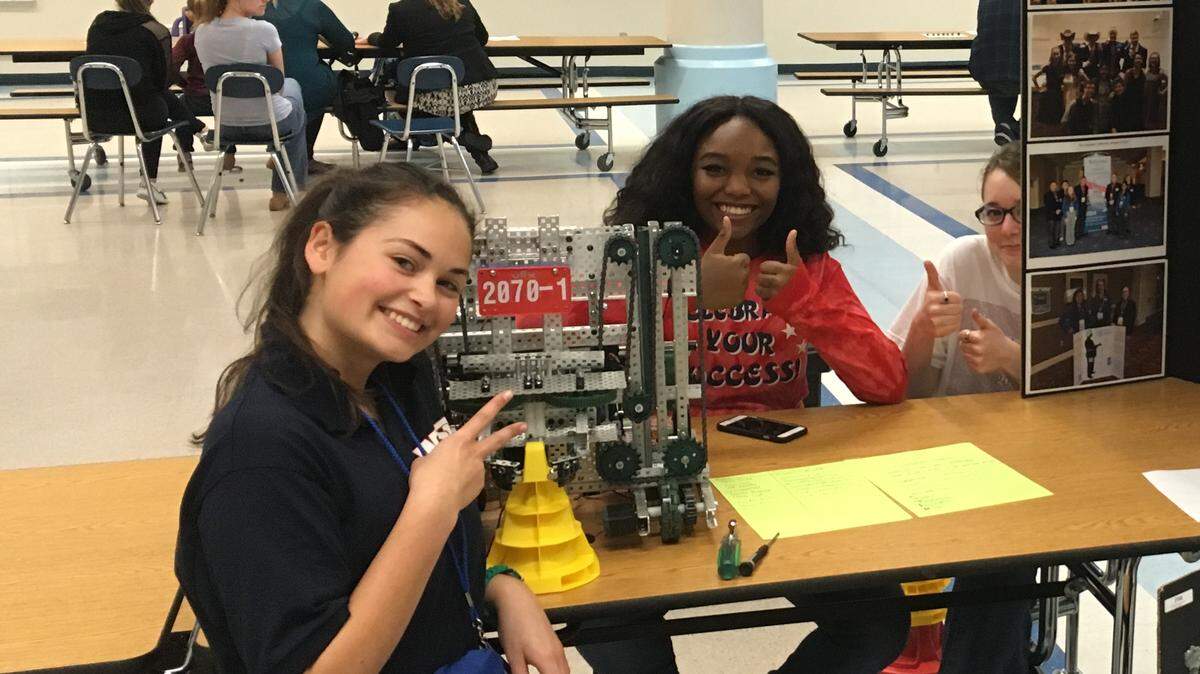
Being in the minority of a group can make you feel like you’re on an island.
That’s how it feels for four teens in the Peninsula School District.
Out of the 30-plus students in the Gig Harbor and Peninsula high schools’ STEM clubs, they’re the only girls.
Iman Stephenson, a senior at Gig Harbor, Reina Nagata, a sophomore at Peninsula, Kira Rosenlind, a junior at Gig Harbor, and Ellie Hood, a junior at Peninsula, are members of each club and have championed women in STEM (science, technology, engineering and math) through competition and teamwork.
Stephenson and Nagata are presidents of their groups, a small triumph in a club filled with boys.
The girls’ next step is to find more young women to join their ranks, in hopes of showing that STEM is for both genders and can be used universally in any career field.
“It’s a nice healthy environment you can learn in,” Nagata said. “And STEM is useful in any field, including things such as interior design, fashion design and photography.”
Added Hood: “A lot of people don’t realize how STEM fits into their career. I know a lot of young women who say they want to be a nurse or a doctor, but that is a STEM career. Interior Design is engineering.”
Hood a writer at heart, she said she’s able to write short stories and technical directions in STEM club.
The girls joined STEM club for different reasons.
Stephenson was inspired by her grandmother, Joyce Stephenson, who worked at NASA on the Hubble, Voyager 1 and 2, Cassini, Spirit, and Opportunity projects.
Rosenlind’s brother started in STEM in middle school and enjoyed it so she joined. She decided to stay after building a working bridge out of marshmallows and dry spaghetti.
Hood, who said Nagata coerced her to join, said she used to think STEM was only for those who want to be engineers. When Hood realized she could write for the club, she became hooked.
Nagata has been in STEM clubs since middle school, because that’s where her friends were. She’s also participated in national competitions for bioengineering.
“You know the show ‘Battlebots’? I wanted to do that,” Nagata said.
The low number of girls taking part in STEM is a national problem.

Women make up half of the U.S. college-educated workforce, but only 29 percent of the science and engineering workforce, according to the National Girls Collaborative Project, a nonprofit organization that works to educate more girls in STEM fields.
A 2017 study by the nonprofit American Association of University Women found implicit bias and fear of being stereotyped remains one of the main reasons women don’t pursue STEM fields.
“Many people claim they do not believe the stereotype that girls and women are not as good as boys and men in math and science,” the study states. “However, even individuals who consciously refute gender and science stereotypes can still hold that belief at an unconscious level.
“These unconscious beliefs, or implicit biases, may be more powerful than explicitly held beliefs and values simply because we are not aware of them.”
That bias can start early and create a challenge for girls looking to explore their options. The four girls in the Peninsula School District faced their own unique challenges and assumptions.
“My freshman year I remember wanting to quit because all the guys around me kept messing with my stuff, taking screwdrivers out of my hand,” Stephenson said. “They kept saying, ‘What are you doing here? This is a boy thing, you can’t do this.’ They told me to get out of the workshop and go to (home economics). Small stuff like that.
“I remember being kind of sick of this, which is one of the reasons why there are not as many girls in STEM fields. They face stuff like that and it’s kind of tiring.”
Rosenlind experienced bias even from some adults at the heart of STEM.
“Even some of the advisers at the state conference have said, ‘Oh, who are you here to watch?’” she said. “And I would say, ‘No, I am a competitor.’”
Stephenson, Rosenlind, Nagata and Hood have worked to prove themselves, gaining them spots at club leaders, officers and competitors.
“The boys have realized we can do stuff too,” Hood said. “These three have knocked it out of the park and the boys are like, ‘Woah.’”
The girls say studying STEM history and women in STEM has inspired them to keep pursuing their projects.
“A lot of females in the past that have done amazing things have been overshadowed,” Rosenlind said. “You look at Rosalind Franklin, Katherine Johnson, Ada Lovelace or Hedy Lamarr. Lamarr, for example, is known for being a beautiful actress but she paved the way for modern devices such as Bluetooth and Wi-Fi with almost no training. But she’s remember for being pretty.”
The Gig Harbor and Peninsula STEM clubs participate in 30 state and national competitions with the Technology Student Association. At the beginning of the school year, members of each club get to know each other and their interests before creating teams and projects to bring to competition in the spring.
Some of the lesser-known project categories for the state and national competitions include:
3D animation.
Children’s stories.
Digital video production.
Fashion design and technology.
Music production.
Photographic technology.
Video game design.
Competing with students across the state and working with their fellow teammates to create a project have helped the girls learn valuable lessons along with better understanding in their fields of study. They expect the skills to help them at college and in their future STEM careers.
They hope to see more girls at their schools join the STEM club next year. The group has posted fliers advertising STEM as more than just robots and bridge building, but as a way to be creative in any field.
“STEM sounds really intimidating, but it can be a women’s job,” Hood said. “We have brains and we are going to use them.”
More about STEM
The Peninsula High School STEM Club is free to join and meets the first and third Wednesday of every month after school. The Gig Harbor High School STEM Club costs $15 to join and meets Wednesdays after school.
Anyone interested in joining the clubs can attend a meeting or contact the club advisers, Peninsula High teacher Eric Morton at mortone@psd401.net and Gig Harbor High teacher Joe Marten Martenj@psd401.net.
This story was originally published August 7, 2018 at 7:55 PM.