
Long-missing WWII private is finally laid to rest
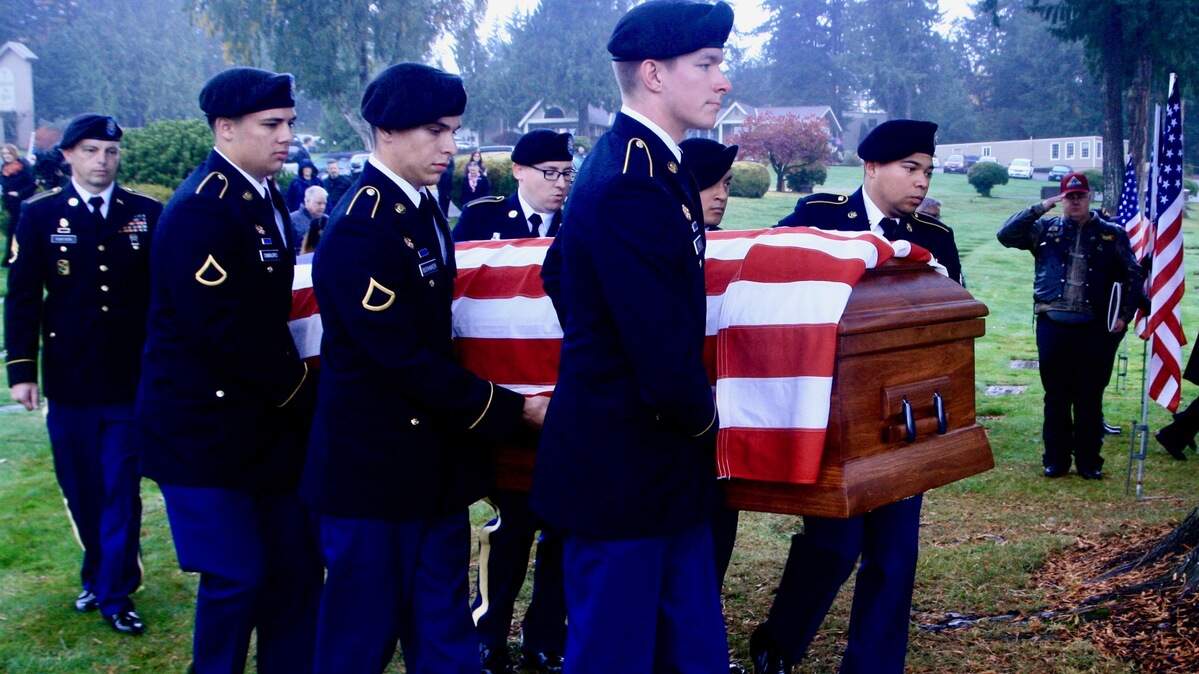
A World War II Army private missing in action for 75 years has been buried next to his sailor brother in Gig Harbor.
Pfc. Donald E. Mangan was carried last Tuesday by an honor guard from Joint Base Lewis-McChord to his new resting place in Haven of Rest Memorial Park. A rifle volley was fired and a bugler played “Taps” as the long-lost private was interred with full military honors.
Mangan, 26, was killed when his infantry platoon was ambushed near Wettlingen, Germany, in the weeks leading up to the Battle of the Bulge. He was originally from Elkton, S.D.
His remains, collected from a mass grave after the war, remained unidentified for decades, buried with others in the Luxembourg American Cemetery as “unknown.” Recent advances in technology allowed the remains to be identified.
His family chose Gig Harbor for the reburial because Private Mangan’s brother, WWII Navy veteran James E. Mangan, is already buried here.
“I couldn’t think of a better place to have him buried,” said Jim Mangan, who lives near Coeur d’Alene, Idaho. “Instead of being a distant relative, he becomes a close relative.”
Jim Mangan and his wife received the carefully folded flag from his uncle’s casket.
Lost in action
According to a Defense Department account, Donald Mangan was a member of Company C, 1st Battalion, 112th Infantry Regiment of the 28th Infantry division.
The unit had landed on the Normandy beaches, fought through France and helped liberate Paris. In September of 1944, they had advanced through Luxembourg into Germany, helping to attack the strongly fortified Siegfried Line.
On Sept. 17, 1944, Company C was ambushed by a German unit near the small town of Wettlingen in Rhineland-Palatinate, and suffered heavy casualties. Those killed were hastily buried in a mass grave.
After the war, thousands of unknown remains were collected across Northern Europe. Many 112th Infantry soldiers in the Wettlingen grave were identified through identification tags and personal affects, but Donald Mangan’s body was labeled as unidentifiable. He was buried in the Luxembourg American Cemetery as Unknown.
But five sets of unidentified remains were disinterred in 2017 at the behest of an Army historian, and re-examined using modern techniques.
The Defense POW/MIA Accounting Agency (DPAA) announced on July 30, 2019, that they had identified Donald Mangan’s remains. They used dental records, anthropological analysis, chest X-rays, and circumstantial evidence.
A call out of the blue
Jim Mangan, who served in the Marine Corps for 21 years and is now retired, said when he received the call in August that informed him of his uncle’s identification, he felt surprised.
“I felt privileged to be asked to make decisions on where he would be buried,” Jim Mangan said.
His father, James E. Mangan, served in the Navy for 21 years. Jim Mangan said he knew of his uncle but his family never talked much about the war.
“I knew that Donald existed,” Jim Mangan said. “My family didn’t talk very much about the warriors. My dad was 21 years in the Navy and participated in WWII but he almost never talked about it. The only thing I knew was that Donald was killed.”
More than 400,000 American soldiers, sailors, fliers and marines died during World War II, according to the Defense Department, and 72,652 are still unaccounted for.