
From bridge to bilge, the Shenandoah yields hidden treasures alongside lessons in history
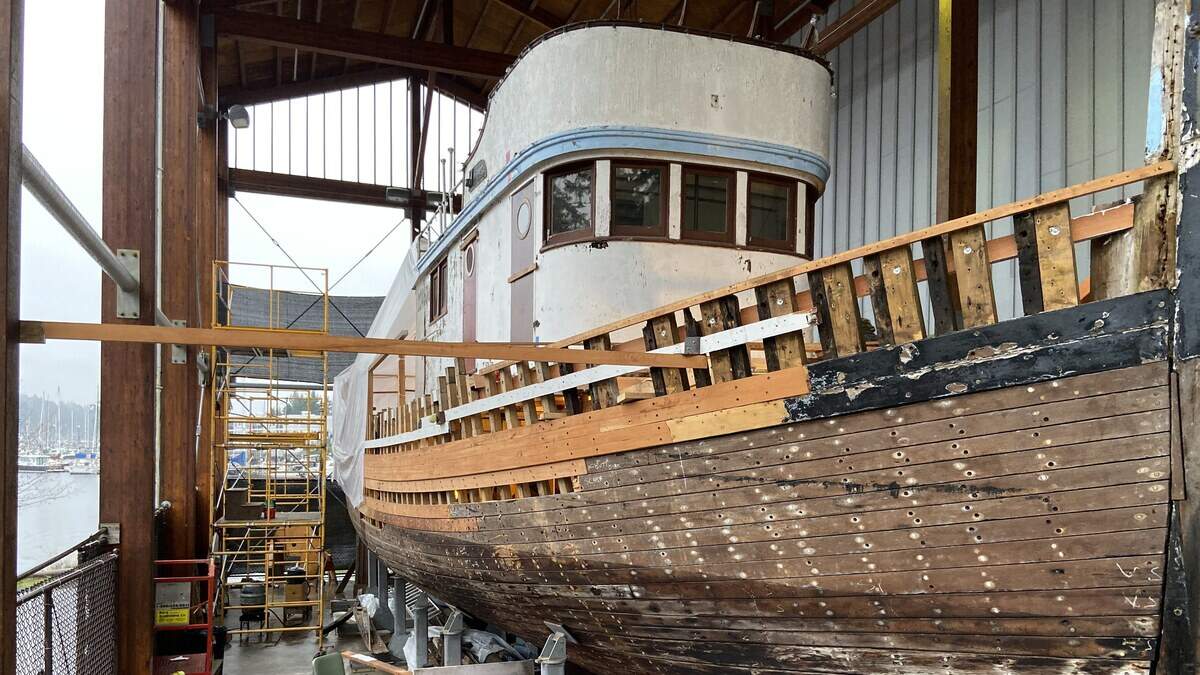
Piece by piece, the Harbor History Museum has discovered fascinating artifacts that resided deep within the Shenandoah, a 65-foot purse seiner built in 1925 that spent most of its career fishing the San Juan islands.
Museum workers and volunteers have been restoring the historic vessel, for decades a familiar sight on the Gig Harbor waterfront. As they’ve torn up rotten planks and dug through dry rot, they have come upon dozens of artifacts left behind by fishing crews over the years.
A John F. Kennedy matchbook. A perfectly preserved packet of cigarettes. A battered coffeepot. Crockery from the galley. A melamine ashtray. The ring tab from a pop can. A fading ring buoy.
With every discovery, museum workers learned more about the boat’s rich history in Gig Harbor, along the lives of her crew. Their discoveries are on display in an exhibit, “Treasures from the Shenandoah,” which will be open through September, 2020.
The Shenandoah was donated to the Harbor History Museum in 2000, and was previously owned by Antone Janovich, who fished on the boat from 1967 to 1998.
Antone Janovich’s brother, George Janovich, was the Pierce County Sheriff for many years. The museum discovered a “Re-elect George Janovich” sign used for a deck patch on the Shenandoah.
“As we pried a piece up we realized there was paint on one side. We realized it was a painted sign so we very carefully pried it up to preserve it as best as possible,” said Stephanie Lile, the director of the museum.
Local legend says during election season the Shenandoah could be seen displaying “Re-elect George Janovich” signs.
Sheriff Janovich made headlines in 1978 after being convicted for racketeering. He spent six years in prison.
Unknown creature
One of the discoveries aboard the Shenandoah was a small, curious anemone, green with small, rubbery spikes. The museum workers all wondered what this squishy-like creature could be.
After closer examination, it was discovered to be a Puffer Ball soft gel toy, something Robin Harrison, the operating and marketing manager, found quite amusing.
“I love that because it was from my childhood,” she said.
Lile said one question she receives constantly is how the Shenandoah was named. The short answer? It was named after an airship.
The USS Shenandoah, a Navy dirigible, was launched and toured the country in 1924. When it came to Washington, it was scheduled to dock at a Fort Lewis mooring mast. Due to high winds, the airship had to circle Puget Sound again and again, waiting for the winds to slow so it could safely dock.
“People closed business and let kids out of school so everybody could watch the amazing Shenandoah airship,” Lile said. “Ultimately she did dock at Fort Lewis and 10,000 showed up to watch.”
She said this event made a huge impression on the people around Puget Sound.
“When you go to name a boat, especially one that will launch a whole new cannery career, you want it to symbolize the latest, greatest technology,” Lile said.
The Shenandoah was destroyed in a storm over Ohio in 1925. The disaster effectively ended the Navy’s experiment with rigid airships.
The owl on the bridge
Many more treasures and discoveries can be viewed at the Treasures from the Shenandoah exhibit.
One of the crowd favorites, Lile said, is an inflatable owl, nicknamed “Hootie” by museum staff. It was mounted on the flying bridge to scare off seagulls.
The exhibit also details some of the life forms that have been attacking the wooden vessel, ranging from dry rot to fungus to a giant, two-foot-wide wasp nest found under planking.
There’s also a brass plate, found at a swap meet in California, that was originally in the pilot house, dating from the Shenandoah’s refitting at Gig Harbor’s Glein Boat yard in 1948.
Among the other discoveries the museum has made: Although it spent most of its career as a purse seiner, the Shenandoah was actually built as a cannery tender.
“The shipwrights working on the restoration thought the fish hold was a lot larger than usual for a purse seiner,” Lile said. “And then they discovered blocks under the decking that indicated the boat had once had a large tow bitt.”
A search of the archives turned up a short newspaper clipping indicating the Shenandoah had been build as a cannery tender. A photograph was found showing the vessel actually towing a fish barge in Alaska.
The restoration of the Shenandoah is a continuing project.
Back in April of 2019 the museum launched a capital campaign to raise $2 million in order to enclose the Shenandoah within the museum. They are currently $19,000 shy of their goal for the year, which was to raise $500,000.
The museum would like to raise $2 million by 2022. The Maritime Gallery, which will enclose the Shenandoah, is scheduled to open in 2025.
“We want to have it raised by 2022 so we can get the construction done and open everything by 2025, which will be the Shenandoah’s 100th birthday,” Lile said.
The museum’s goal is to both enclose the Shenandoah and make the boat fully accessible for visitors.
This story was originally published December 25, 2019 at 12:00 AM.