
Solar-lighted locator posts help 911 on Cushman Trail
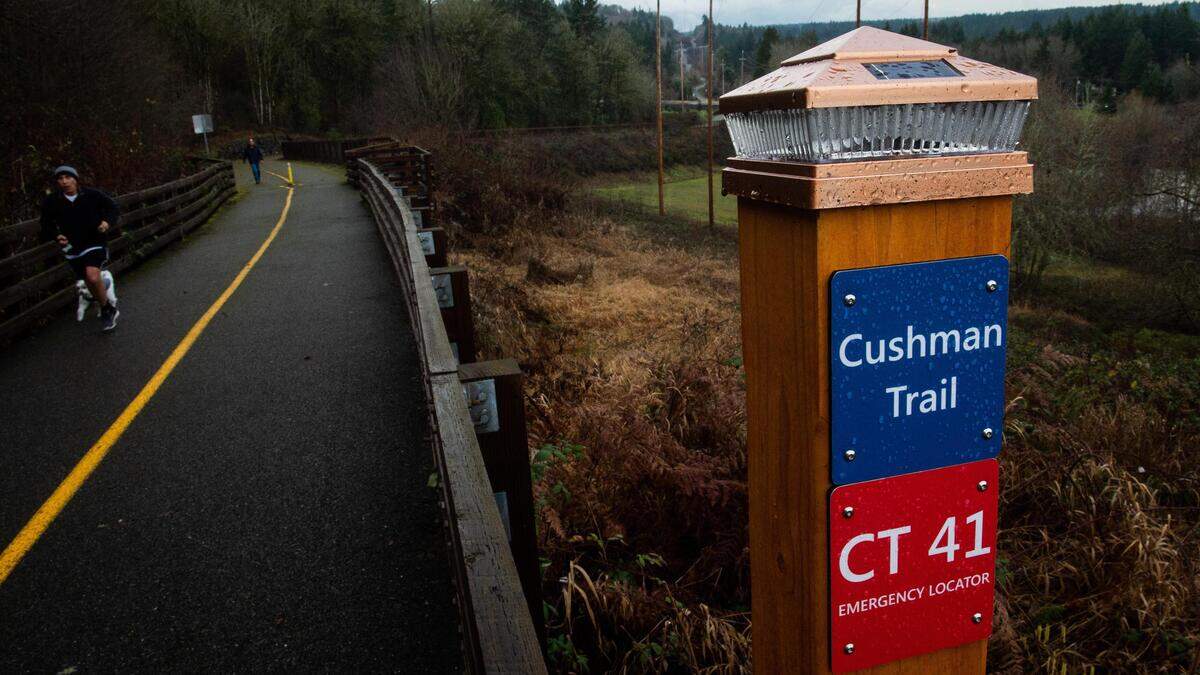
So you’re biking or jogging on the Cushman Trail, and you have an emergency.
It might be chest pains, or a sprained ankle, or that creepy guy that’s been following you for the last mile.
On a 6.2-mile path that weaves through wooded areas of Gig Harbor without many landmarks, how do you tell the 911 operator exactly where you are?
After several alarming incidents, including attacks on women joggers, the city of Gig Harbor, PenMet Parks and first responders have teamed up to provide a solution.
Twenty brightly-colored “locator posts,” lighted at night, have been installed every quarter-mile along the trail. They’re located on the side of the trail, and each has a number, such as “CT 23” and “CT 55.”
They’re odd numbers, and Nicole Jones-Vogel, the city’s parks manager, says that’s for a reason.
“They skip numbers with the intention that we plan to have them installed every eighth of a mile,” she said. “As we find more funding at the budget, eventually we’ll have 11, 12, 13, 14, every eighth of a mile.”
South Sound 911 already has these posts mapped out, giving dispatchers the ability to tell an officer where a caller is located on the trail, and the fastest route to that location.
“These posts will provide quicker response times for the police,” said Kelly Busey, the Gig Harbor police chief.
Each post has a solar-powered light, making them visible at night.
Incidents have occurred on Cushman Trail in the past. Two women, one in October of 2019 and another in 2014, were groped on the trail. One woman was with her children as the suspect approached and then grabbed her from behind before fleeing the scene. Neither man was never located.
Even with the installation of these posts, police still recommend running in pairs or groups, and always carrying a cell phone.
Each post cost $150 to install, and were paid for by the city’s general fund, along with PenMet Parks, who paid for the posts in the area of the trail outside the city limits. Jones-Vogel said the city hopes to adopt a trail program and work with sponsors in the community to finance the rest of the posts.
“If someone sponsors the first quarter-mile of the trail, it would help fund the eighth-mile marker and bring awareness to that section of the trail,” Jones-Vogel said.
The new markers are a huge improvement on what was available before, Busey said. He said there were only a few survey markers on the ground, along with some spray-paint markings at one point. Jones-Vogel added there were also short posts every half-mile, laid out by PenMet Parks.
Busey said expect these markers will be just as helpful for the fire department, which responds to medical emergencies, as they will be for police.
Jones-Vogel praises the multiple entities who worked together to install the posts.
“It’s a good example of agencies working together and having a successful project that adds the polish of the trails, consistency, and an additional layer of safety,” Jones-Vogel said.
Trails mean business for cities, state studies show. Read the Gateway story here.
This story was originally published January 15, 2020 at 12:00 AM.