
A scramble to retool at Peninsula schools, as the future arrives without knocking
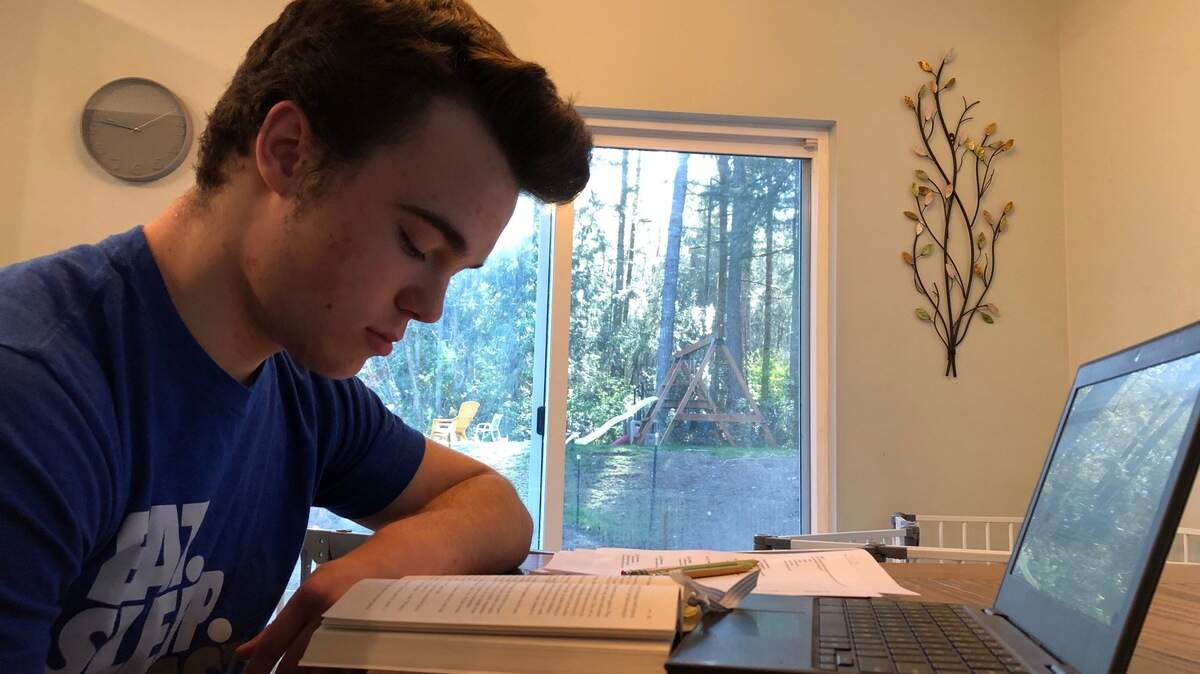
The lights are burning late in hundreds of kitchen-table offices across the Peninsula School District, as teachers and administrators struggle to come up with ways to teach more than 9,000 students at home for the rest of the year.
Interim Superintendent Dr. Art Jarvis is already talking about “the new education.”
“It’s a strange, and in some ways, a wonderful world we are watching evolve,” Jarvis told The Gateway in an interview last week, shortly after Gov. Jay Inslee ordered all schools closed through the end of the school year.
“We’re going to be doing things because of the pandemic that will take us farther into the future of education,” Jarvis said. “Now we get to extend and expand our capabilities beyond the walls of the buildings.”
Schools were closed March 13 for what was first expected to be a few weeks, until the coronavirus pandemic had passed. Now they will be closed until summer, and possibly longer.
“The guidance we are getting from the state right now is even, ‘Don’t count on opening in September,” Jarvis said.
“It makes your heart ache, because the kids are losing a lot of school, which is a big part of their lives. Their missing their friends, they’re missing that regular, organized contact that is so important to their development. And we can’t entirely replace that.”
Turning on a dime
In the early days of the closure, teachers concentrated mainly on reconnecting with their classes, sometimes one by one, by telephone or online.
“Teachers were having Zoom meetings just so their kids could see each other,” said John Hellwich, an assistant superintendent for K-12 curriculum. “The kids missed their teachers, they missed their classmates. So those first few weeks were mainly about checking in on them and thinking about their emotional needs.”
Now, teachers are faced with developing more long-term, structured learning plans.
“We can’t just lift our entire curriculum and place it online,” said Jarvis. “That’s not going to work.”
Instead, he said, teachers and administrators are working to identify basic needs for each grade, and provide “consistent, easy-to-find learning opportunities” for each age group.
“If you have a third-grader, for instance, we’ll help you find grade three material,” he said. “Eighth-graders, for instance, this time of year should be doing linear equations in math. We’ll point you toward that material, online or on paper.”
Since it’s spring, the weather is turning nice and “kids being kids,” he noted, it’s going to be a challenge keeping younger students, in particular, engaged and motivated.
“We’re not asking for six hours a day,” he said. “We’re asking for what’s reasonable for each age group.”
A district memo sent to parents last week suggests a sliding scale by age, beginning with 30 minutes a day for preschoolers and ranging up to three hours a day for high school students.
In some households, that’s going to be tricky, Jarvis acknowledged.
“One of the issues we’ve already heard from parents is, what do you do when there are multiple teachers, multiple kids, and multiple Zoom sessions?” he said.
Online access widespread
Generally, Peninsula students are well-prepared to learn online, Jarvis said. All students in grades 5-12 already had district-issued Chromebook laptops, and after the shutdown, the district distributed 2,000 more to pupils in grades K-4.
Internet access has turned out to be less of a problem than expected, he added. A survey of the Key Peninsula, where wireless service is sometimes spotty, showed only a few places where buses equipped with “hot spots” needed to be deployed.
Free drive-up internet connections are also available from the parking lots at 10 schools: Artondale, Evergreen, Minter Creek, Vaughan and Voyager elementary schools; Goodman, Harbor Ridge and Key Peninsula middle schools, and both high schools.
Several of the district’s standard curricula, including the widely used Envisions Math and Reading Wonders, already had online elements, said Hellwich, the K-12 assistant superintendent.
“These are the same materials the kids would be using if they were in the classrooms,” he noted. “So it’s not totally new to them.
That said, he added, “We’re not going to be able to replace school. It’s not like we’re just flipping the switch to online. This is really ‘emergency school.’ The expectations (for minutes of study per day) we sent out to parents are less than half the kids would have in the classroom.”
Expect gaps next year
Teachers and administrators understand there are going to be gaps in required skills when students return to school, Jarvis said.
“We are going to have to adapt to that reality,” he said. “If there are five basic concepts for a grade level, and the kids have learned three of them, well, that’s progress we can build on.”
Repeating a year is not an option, he said.
“We have not talked about repeating grades. It typically doesn’t work, anyway. On the state level, they may ask for compensatory time, for schools to run more days, more hours or have special sessions, and we’re looking at all those as possible.”
When students return next year, Hellwich said, “We are going to need to kind of assess where the kids are at, and proceed from there. But our teachers are good at doing that. So we will make that work.”
This is going to be the new reality for “a long time,” Jarvis noted.
“It’s new, and it’s stressful, and the teachers and staff are making just a valiant effort,” he said. “They’re isolated in their own homes, trying to teach while watching their own kids, and the dog is barking. They’re just wonderful troupers.”
He also hailed the districts food service workers, who have been distributing sack lunches every day in school parking lots.
“The lunch counts have gone up markedly, and they’ve met that challenge,” he said.
“When we first started doing lunches, the kids had to be present, so you would see cars pull up with four kids, all yelling and waving at the principal on the school steps, who is waving back. It was heartwarming.” The lunch rules have been relaxed since then, he added, and parents can now pick up lunches themselves.
He said teachers tell him of their own experiences with kids online.
“One teacher was finally able to get her whole class in a Zoom session, and kids were all waving at each other and so happy to see her, she started to cry. It just hit her how much they had missed her.”
Another teacher told of calling each of her first-graders on the phone, and “one little guy said, ‘I knew you’d call because you’d miss me!’”
Suggested minutes of study for each grade level are at psd401.net, update #10
For details on seniors and graduate, see story page A-
Some takeaways from our interview with Peninsula School District interim Superintendent Dr. Art Jarvis:
▪ Starting school early next year is probably not an option. In fact, parents should be prepared for a possible late start in fall.
▪ Repeating grades is not being considered.
▪ Seniors will graduate, with grades if they want them, or pass-fail as an option. There will be some kind of graduation celebration, but its exact form is still up in the air.
▪ An extended 2020-21 school year is an option, as are extra hours in the school day.
This story was originally published April 14, 2020 at 12:00 AM.