
Gig Harbor inventor’s device puts a spring back into step of injured first responders
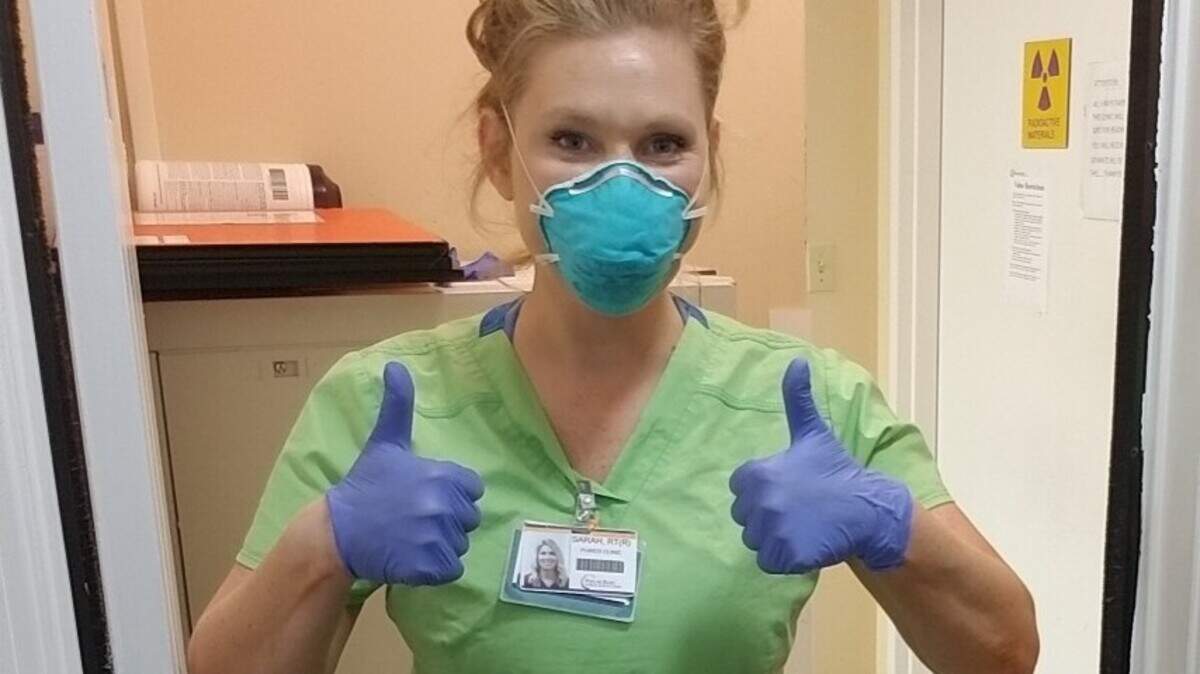
As medical workers and first responders battle the COVID-19 outbreak across the nation, many are being kept on the front lines by a device made in Gig Harbor.
The device, a form-fitting leg brace called an ExoSym, has allowed firefighters, nurses and doctors who have suffered serious leg injuries to stay in the fight.
“I couldn’t do it without them, there is no way around it,” said Sarah Metcalf, an X-ray technician whose legs were crushed in a car accident and now wears ExoSyms on both legs.
Metcalf works at Poplar Bluff Regional Medical Center in Missouri, which is seeing a lot of patients with coronavirus symptoms. Because of virus precautions, she often meets patients in the parking lot.
“I have absolutely pushed the ExoSyms to the limit,” she said. “Yesterday I had an 89-year-old lady with a broken hip, and I picked her up and laid her on a wheel chair. That’s the kind of stuff I do all the time, and I am able to do it, I am strong enough to do it. “
Her orthotics were made in Gig Harbor and personally fitted by its inventor, Ryan Blanck, at Hangar Clinic on Erickson Street.
This device is for patients who have suffered severe limb injuries, leaving a limb that could be salvaged, but would more than likely have no functional ability. ExoSym works similar to a prosthesis, but allows the patient to keep the limb rather than having it amputated.
The gizmo, whose technical name is a “dynamic exoskeletal orthorsis,” incorporates what Blanck calls a “dynamic strut” — essentially a spring — that stores energy and releases it with each step, acting as an artificial leg muscle. Some patients liken it to a small trampoline.
A call for photos
To recognize his front-line patients, Blanck put out a call on Facebook two weeks ago asking users to simply send a photo of themselves working. The response was overwhelming, he said.
Within 24 hours, he received more than 40 photos. Pictures and comments came from 911 dispatchers, nurses, medics, occupational therapists, firefighters, surgeons, anesthesiologists and more — including Metcalf, the Missouri X-ray technician.
“I was in a car accident when I was 19,” Metcalf explained in a telephone interview. “It resulted in severe trauma to both of my legs. I crushed both ankles and fractured my back in four places,”
“Recovery was rough ... I had a few good years, but arthritis caught up with me. It was a cycle of surgery and recovery, surgery and recovery. In 2016 I was seeking an elective amputation in my right leg.”
When someone told her about ExoSyms, she traveled to Gig Harbor for a fitting.
“I fell in love,” she said. “After so many failed attempts at gaining mobility, you lose hope. When someone told me about him, it was like ‘Okay, this will be another brace that won’t help.’ I was desperate so tried it.”
“The day I put them on I wanted to sit down and cry, it was so overwhelming,” she recalled. “The minute I put them on I felt like I had always had them; it was instant.”
It’s a story echoed by others.
Seattle firefighter
In 2013 Matt Runte, a Seattle Firefighter, was leaving his station on his motorcycle when a vehicle ran a red light, colliding with the firefighter.
Runte’s left foot was severely injured, resulting in a partial amputation.
“I am missing parts of my foot, and half of the function of my foot,” Runte said.
It took Runte months to recover from the injury, but he soon attempted to resume his normal job.
“The effort level of walking around on half a foot is quite a bit higher than normal. I would find myself pretty beat by the end of the day. I had a hard time keeping up,” Runte said.
Through a friend, Runte was introduced to Blanck and his ExoSym device. It had an instant impact.
“Once you get the device, I felt like it was a pretty steep curve,” Runte said. “Around 90 percent of my function was regained nearly instantly. There is a good amount of training that happened within a couple of weeks, but so much of the function is so fast.”
Now, besides a modified firefighter boot and a few other changes, Runte was able to return back to his normal routine.
“With the device, life is just normal,” Runte said.
Began with military
Blanck said the device, which he invented in 2009, was initially intended for active-duty soldiers. He said many were choosing to amputate their injured limb.
Often, limbs were damaged by IED blasts, RPG blasts or gunshot wounds, leaving a limb that could be salvaged, but would have no functional ability.
“Rather than every patient choosing amputation, what if there was a product that acted like a prosthesis?” Blanck said. “I wanted to create something that acts like that over a severely injured limb, that typically would be amputated. Maybe the patient could have a choice.”
After creating ExoSym, Blanck began helping hundreds of soldiers get back in the field.
In 2013 Blanck joined Hanger Clinic Specialty Center in Gig Harbor, bringing ExoSym to all civilians.
“The military was where this was all inspired,” Blanck said. “It is where my heart began with all of this, but to see years later the impact people are having beyond the military, it is equally as neat.
“To see people empowered and achieve their potential, with the help of ExoSym, it’s a pretty rewarding and humbling place to sit,” he added.
Still seeing patients
Blanck said this device costs around $9,000, which is a bit less expensive than the typical prosthetic. Each patient goes through a clinical regime to ensure that an ExoSym is the right fit for their situation.
During normal times, Hanger Clinic Specialty Center sees around ten patients walking, jumping, and training. Now, during a time of COVID-19, they are choosing to see only one patient at a time.
“We are still operating and seeing patients, but mostly local now,” Blanck said.
Back in Missouri, Sarah Metcalf is happy to be on the front lines.
“I love working in this field, I love X-rays. I love what I do and I want to keep doing it, and my ExoSyms help me,” she said.
“It’s made me want to be on the front line, and be okay with it because I can do it. It was a deal I made with God, whatever I can do to help I’m going to do it,” she said.
She gets a kick out the fact that her co-workers often call on her to help lift patients.
“If there is any need for assistance for a patient, they come to me, the girl with ExoSyms. There are a lot of able-bodied people but I am one of the strongest ones in the clinic, and I love that,” she said.
This story was originally published April 28, 2020 at 12:00 AM.