
A cry for justice finds an echo in Gig Harbor, as hundreds join a walk for solidarity
Can an affluent, nearly lily-white suburb make a difference in the roiling debate over racial justice?
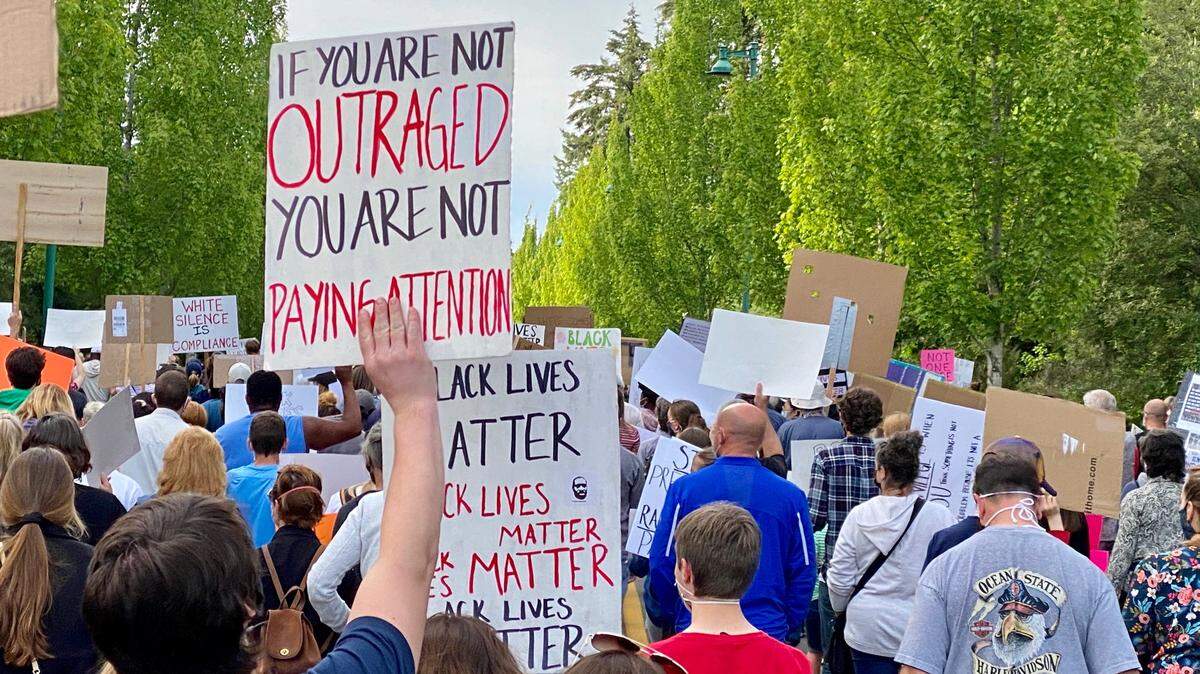
If that was the question, Gig Harbor gave its answer last Wednesday, when a significant part of the town’s population turned out for a Walk for Unity and Solidarity, flooding Harbor Hill Drive with a crowd estimated at between 700 and 1,000 people.
The mayor was there, and members of the City Council. Families came with their children. When they began to walk, the crowd, bearing signs and some wearing “Black Lives Matter” T-shirts, stretched for a quarter-mile along the tree-lined boulevard in the city’s north end.
The purpose of the June 10 march, its organizers said, was to call attention to the killing of George Floyd, a black man in Minneapolis who died after a police officer pressed a knee on his neck, and to express solidarity with black Americans everywhere.
Stand up and step in
“The status quo isn’t OK any more,” said Lisa Anderson, a 49-year-old freelance writer from Vaughn who organized the march in a flurry of tweets and posts on social media.
“I believe people were ready to come together here where we live in a predominantly white community to stand up and say publicly that we won’t tolerate racism,” she said.
When the march reached its end point at a roundabout, Maurice Hanks, 57, a black Fox Island resident who was for many years a renowned coach at Peninsula High School, climbed onto a concrete traffic barrier with a microphone.
“This is really serious,” he said, scanning the sea of white faces. “I’m talking to the white folks. I need you to listen very carefully. We are tired. We are very tired. I will be 57 years old on Friday, and this is still going on.”
Hanks talked about getting “the talk” from his mother at the age of eight, and the time, as a student at Mount Tahoma High School, he was accused of stealing a purse and handcuffed by an officer who told him, “Run, (n-word), so I can shoot you.”
“No, I’m good,” Hanks said he told the cop. He said he followed the rubric every black male knows: “I didn’t say anything. Smart kid. Look straight ahead. Yes sir, no sir.”
Spotting the spotter
Hanks was a star football player at Mt. Tahoma, and later at Central Washington University. He was an assistant coach at Peninsula for nine years. That didn’t always matter, he said.
“Ask me how many times I’ve been pulled over in the 27 years I’ve lived in Gig Harbor,” he said. “Once they said I was robbing a bank! Ask me how many times I’ve been followed in stores. So many times, I have taught my son and daughter how to spot the spotter that’s spotting you.”
“This happens all the time,” he said. “If I get a job, should I have to worry about being shot an killed? No! Just because I’m a different color, doesn’t mean I don’t belong.”
Again, he addressed directly the largely white crowd.
“Listen up,” he said. “We live in an affluent community. People do well here. Don’t go home and think it’s over. Talk to your neighbor. When you see it happen, call it out. We need you. We need you.”
“Now all you little guys, you young people,” said, shifting his gaze to the children in the crowd. “I’m so proud of you. You get it. This county was made because we are all different people, but when you put us all together, we are bad ass!”
That drew a cheer, and he continued, “If your parents, people around you, are saying stuff, call it out. Step up.”
“We’re tired,” he said once more. “All we want us a roof over our head, food in our belly and a few nickels in the bank. We want the same as you.”
‘We have to fix this’
“Omigosh, he was so powerful,” said City Council member Robyn Denson. “It was so important for us to hear. A lot of times, people in Gig Harbor think racism doesn’t exist here, but it does. There are incidents. It’s important to hear about that.
“As so many people have said, black people are tired,” Denson said. “It’s the rest of us who have to step up and say enough is enough. We have to fix this.”
Two other council members, Jennie Woock and Spenser Absersold, joined the walk, along with Mayor Kit Kuhn. Also present was U.S. Rep. Derek Kilmer, D-Gig Harbor, and two Democratic state legislature candidates, Joy Stanford and Carrie Hesch.
Anderson, the writer who organized the march, said she was stunned by the size of the turnout.
“I didn’t know what to expect,” she said. “I’ve never done anything like this before. I was completely out of my comfort zone.”
Anderson is a senior writer at World Vision, the Christian humanitarian organization, and she’s active in her local church and in Communities in Schools, Peninsula. So she started working her networks, scattering invitations on social media and by word of mouth.
“I wanted it to be a safe occasion, where kids could come and parents would feel safe bringing their children, so I called city hall to ask about a permit. Lo and behold, I got a call back from the chief of police and the city administrator, and we talked about ways to make it happen,” she recounted.
The next few days were “a roller coaster of yes and no,” she said. There were debates about the venue — she wanted downtown, but the mayor wanted a street that could be closed off easily — and a drama over insurance, which the mayor helped solve by recommending a carrier and paying half the cost personally.
Unsure about how a largely white effort would be received by the black community, she called Joy Stanford, an African-American who is running for the state Legislature, for advice.
“Joy said, ‘Yes, please, Lisa,’ “ Anderson recalled. “She told me, ‘We are so tired of having to do everything ourselves.’ “
RELATED STORY: Gig Harbor City Council condemns racism
This story was originally published June 17, 2020 at 12:00 AM.