
Overdue honor for Gig Harbor’s first people: A redwood guardian for Twa-wal-kut
Although it’s on the site of an ancient Native American village, there are few reminders of Gig Harbor’s indigenous heritage. The city is about to rectify that omission with a sculpture honoring its first peoples.
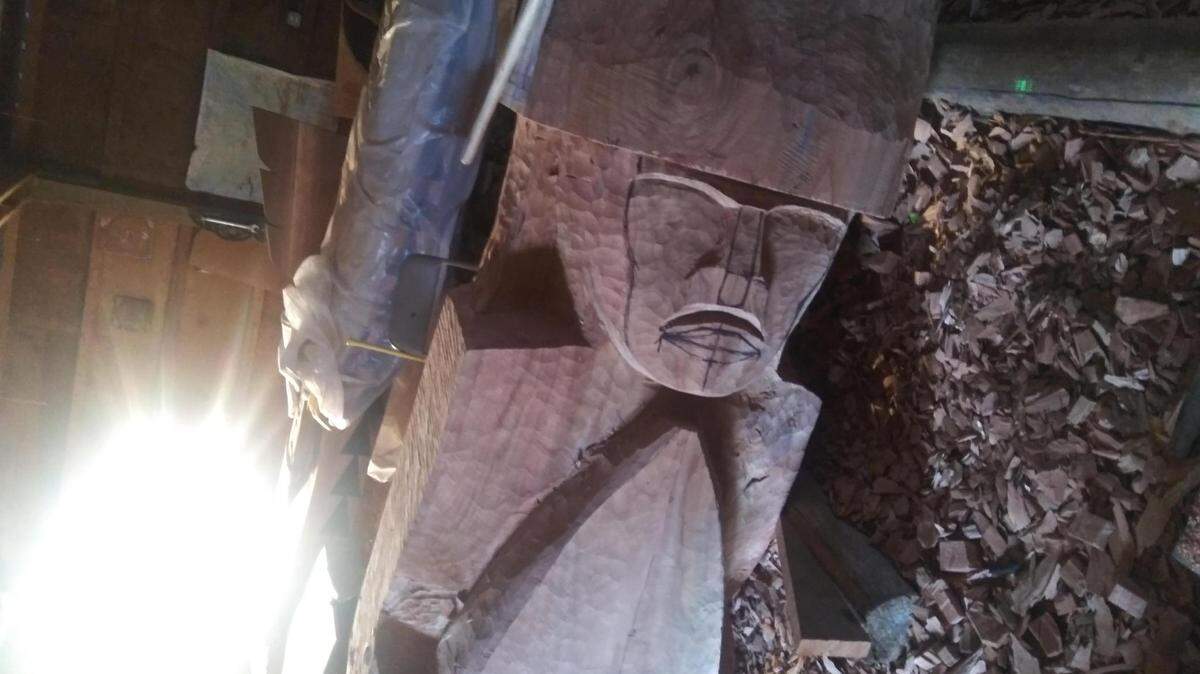
The Honoring Project, as it has been named, will feature an enormous redwood fisherman hauling in a great salmon. It will soon stand at Austin Estuary Park.
“There’s no street named after a Native American; there’s no major landmarks,” said Lita-Dawn Stanton, Gig Harbor’s former historic preservationist. “So, the sculpture is a wonderful way to honor the indigenous people.”
The sculpture was designed and is being crafted by Guy Capoeman, an indigenous sculptor whose workshop is on the Quinault Reservation on the state’s Northwest coast.
Honors fishermen
“Historically our people, we’ve always been fishermen,” said Capoeman. “So we decided to make a fisherman as the center of this piece.”
He is using hand and power tools to chisel out the basic shape from a Sequoia redwood log. Adze and knife marks will finish the figure in the traditional way. Then, the carving will be accented with painting in bright and various colors. When finished, the fisherman will be 15 feet tall and will hold an 11-foot salmon.
Capoeman has named the sculpture, “Our Fisherman, Our Guardian.”
It was originally to have been installed this month, but the coronavirus epidemic has pushed the date back until next year.
Capoeman has been sculpting Native American art all his life. The business is a family-run workshop that specializes in Coast Salish style art, according to his website, capoemanarts.com.
Capoeman said he understood that the area where the sculpture will stand was once a thriving fishing village.
“This signifies the importance of not only the fishery to us as the Native people, but the fishery to the whole region,” he said. “I hope it gives people a sense of place and a realization of what is our responsibility for the area and what legacy are we going to leave.”
The village of Twa-wal-kut
Austin Estuary Park is near where the sxwəbabš band of Indians once settled, at the mouth of what is now called Donkey Creek. (The name of the band is pronounced sk-WHUH-babsh)
The creek took its modern name from the donkey engine that was used by loggers to move timber downstream for transport to the mill, according to the city of Gig Harbor. The engine and mill were demolished in 2002.
According to the Harbor History Museum, the site where Donkey Creek empties into the harbor was a spawning ground of salmon. The village was called tuwawəϯqəϯ (pronounced twah-well-kax.)
It was founded before the 1800s by a band from the Puyallup Tribe. Tribal members would return regularly to tuwawəϯqəϯ during the times of salmon fishing, hunting, and gathering.
According to Dr. Linda Pitcher, a former professor of anthropology, the village consisted of six buildings: one longhouse, 100 feet in length, and five smaller houses, which were in the shape of 30-foot squares.
In a letter written by an early Gig Harbor settler, Louise Burnham, said there were about 50 people living in the village in the early 1900s.
The village would survive into the 20th century. But in her research, Pitcher said that due to the Homestead Act’s incentive to grant government lands to settlers, the village began to fade away. Under federal treaties, over three million acres of Indian-inhabited lands were ceded to the government.
Once the regional economy began to rapidly grow in the 1920s, it became increasingly hard for the indigenous Squababsh people to survive there, she said. The expanding timber industry decimated the salmon runs.
TCC Course led to action
The driving force behind the Honoring Project was Gary Williamson, a former elementary educator and principal.
“My wife and I have collected art from Alaska to Mexico for years and years and living in Gig Harbor for 62 years now, there’s not much history about Native culture around Gig Harbor,” said Williamson. “I’ve always wondered about that.”
After taking Pitcher’s class at Tacoma Community College about Native culture in the Puget Sound area, Williamson formed a committee to find a way to recognize the people who first lived in the Gig Harbor area.
The mayor of Gig Harbor, Kit Kuhn, said the city responded enthusiastically four years ago when it was approached with the idea.
“I fully support this. The Native Americans were the true settlers of America,” said Kuhn.
By last year, Williamson and his team collected the $150,000 needed to carry out the project.
According to Nicole Jones-Vogel, who until last week was parks manager for the City of Gig Harbor, the city contributed $55,000, the Puyallup Tribe of Indians contributed $75,000, and the Gig Harbor Kiwanis Foundation contributed $25,000.
The committee called for design submissions from practicing Native American artists, and experts at the Puyallup Tribe judged the submissions. Capoeman was the winning artist.
Robyn Denson, who was president of the park board when the sculpture was commissioned, said, “the Parks Commission was very supportive of this art piece, as was council.”
A motion in support of the project was passed unanimously by the Parks Commission on May 8, 2019.
“All of the members of the parks commission just thought this was an amazing idea,” Denson said. since the Harbor History Museum is also right there. It’s not just any kind of art.”
Coronavirus delay
Williamson hoped to conduct the installation ceremony at Austin Estuary Park this summer, where Native nations from all over the Pacific Northwest gather together during their annual tribal canoe journeys.
But due to the coronavirus pandemic, the idea of gathering hundreds of people together became unrealistic.
“We wanted to have the presentation while the Indians were coming by and that’s not happening anymore, so now we are looking toward probably early next year,” said Williamson.
Since the sculpture is planned to be placed within 200 feet of the water, Williamson also said that he and his team are working with the Department of Ecology. They do not yet have the final permits yet to place the art work exactly where they want it.
According to the proposal request, the proposed location of the artwork is within the “look-out” area of Austin Estuary Park. The sculpture will stand at the furthermost point of land on the shoreline, and will be visible throughout the harbor.
“I’m excited and I’m hoping that this helps bring all the people together from the local tribes,” said Capoeman. “And all the residents of the area can come together and really recognize the people that lived in this area.”
There will be interpretive signs at the base of the sculpture to educate visitors, and its proximity to the Harbor History Museum will allow visitors to get more information about Gig Harbor’s maritime history.
“Between permits and COVID, many things had to change.,” said Mayor Kuhn. “Most things had to change in everyone’s life. But we will persevere and work through this and look forward to having this installed.”
Nathan Hyun is a summer intern reporter at The News Tribune. He’s a 2018 graduate of Curtis High School and a junior at the University of Southern California. Reach him at nathanael.hyun@thenewstribune.com
This story was originally published July 14, 2020 at 12:00 AM.