The Peninsula school board voted unanimously in a meeting Thursday to support a resolution affirming that the district does not teach ‘critical race theory,’ but promised it will continue to “teach a complete and accurate history that is inclusive and without bias.”
The board also approved a second resolution stating that the district will continue to provide comprehensive sex education. It was also passed unanimously.
The resolutions were read by school board president David Olson, who had been heckled last week at a forum of the group Parents & Citizens for School Choice when he defended the importance of diversity and inclusion in the district. Olson told the group there would be a resolution on the topic at the July 22 school board meeting, and invited them to attend.
School board President David Olson addresses a meeting of Parents & Citizens for School Choice. Courtesy
Wording ambiguous
The wording of the resolution was bland and somewhat ambiguous, but a key passage seemed to indicate the district would not restrict any curriculum in response to the campaign against CRT, which the district has always insisted is not taught anyway. The resolution also mentioned Senate Bill 5044, recently passed legislation which mandates equity and inclusiveness training for staff and teachers, and which critics feared was aimed at students.
“There will be no additional or modified student curriculum, including Critical Race Theory, or instruction in response to Senate Bill 5044, as it does not mention or require additional instruction for students. The District will continue to teach a complete and accurate history that is inclusive and without bias.”
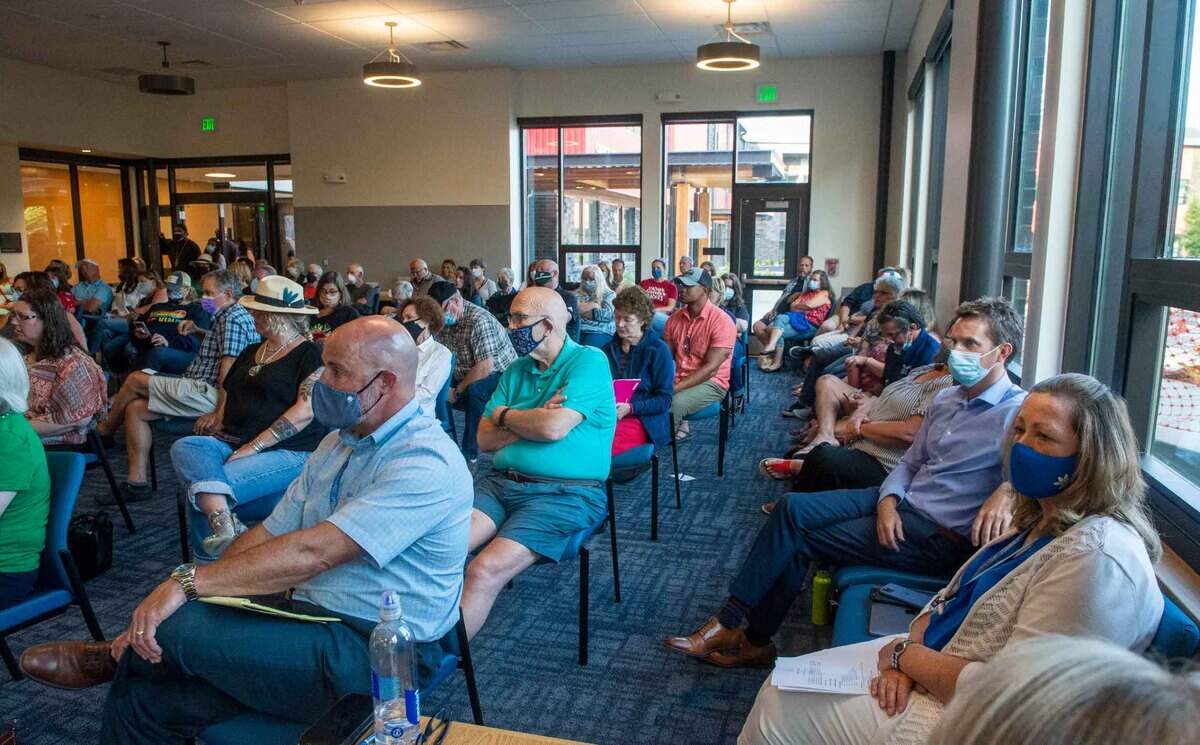
Discussion of CRT however, dominated the lengthy public comment period, which stretched for nearly an hour. The large crowd in the community room of Swift Water Elementary was polite and attentive, and frequently applauded speakers with whom they agreed.
Some in attendance were confused about what exactly the resolution would do in regards to current efforts to support diversity and inclusion.
‘Why this, why now?’
Joy Stanford, a former Democratic candidate for state Legislature, spoke as a member of the Diversity, Equity and Inclusion Committee for the district. She asked what would happen to the committee and the work she felt was important to continue.
“Why this resolution and why now?” Stanford said. “There is something behind this resolution that hasn’t been said, and I want the answer to that question.”
Stanford said as a parent of a student of color, she was concerned the board was sending the message that students of color don’t matter and that there wasn’t enough emphasis being given to diversity.
“My son went through this school district nine years without one teacher of color,” Stanford said.
Lisa Marcus, a professor of English at Pacific Lutheran University, said she felt that the board was being pressured by political groups to “censor” the teaching of history.
“I ask that the board not cave to these special interest groups,” Marcus said. “We don’t want to be silenced and railroaded by those who have fallen for a manufactured campaign.”
Analogy to teaching the Holocaust
Marcus is also chair of Holocaust and Genocide Studies Program at PLU, which she said gave her insights about the importance of reckoning with the darker parts of history.
“What if they decided that studying the holocaust would make the current generation feel guilty?” Marcus said. “What if instead of ‘never again’, they decided to say ‘never talk about it again?’”
Tim Gates, a former student in the district, said that having worked in corporate America for 31 years, he felt that learning about diversity is important to prepare today’s youth for the future.
“There is not one company in America that doesn’t focus on this and look to continue to expand our perspectives,” Gates said. “The most important thing I want to say is that these are not radical ideas. These are very simple ideas to understand and our students are demanding them.”
“I trust our teachers to handle this content, and you should too,” Gates said.
Objections to lack of discussion
The structure of the board meeting that put a vote upon the resolutions before the public had a chance to comment is not one that is seen in all districts. In the neighboring South Kitsap school district, a resolution opposing CRT was voted down after a lengthy public comment took place before action was taken.
An overflow crowd attended a meeting Thursday evening July 22, 2021 in the community room of Swift Water Elementary where the Peninsula school board voted on resolutions about ‘critical race theory’ and sexual education. Drew Perine The News Tribune
Ben Pinneo, a teacher in the district, said he felt the resolution about CRT was voted on before proper discussion could take place. He expressed concern that he had only learned about it from the reporting in The Gateway about the forum Olson attended.
Pinneo also raised criticisms of a comment at the forum that curriculum about indigenous communities in Washington involve students learning a lot about “basket weaving.”
“There was a very offensive comment,” Pinneo said.
He said the board needed to send a message of kindness to communities.
“I want to focus on love and empathy for our BIPOC community,” Pinneos said, using an acryonm for Black, indigenous and people of color.
Jessica Kowalski said she is a former student and teacher in the district and was concerned the resolution would ignore a large part of history.
“I’m just continually disappointed. Frankly, it’s why I separated from the district,” Kowalski said.
Kowalski also raised issue with the board voting on the resolution before they could hear from the community.
“This was not a great process,” Kowalski said. “What is the point of us speaking if you’ve already made up your mind?”
Jill Neumeister, a Gig Harbor business owner and parent of a former Peninsula student, echoed that complaint.
“I am just stunned. I can’t believe that this was voted on without comment,” Neumeister said.
Neuimeister said that opposition to teaching of accurate racial history in the district was being driven by people who were motivated by “bigoted grievances.”
“You fake CRT flag wavers, it won’t work,” she said.
Carol Rivera, president of the Peninsula Education Association, the teachers’ union, said that it is important to care for every student.
“We believe that our children are unique and diverse,” Rivera said. “We all have a shared responsibility to create and foster an inclusive environment that puts students on trajectory for success.”
‘Things we need to talk about’
Melody Derrick, a parent, said it was her first time speaking at a school board meeting and that she supported the Senate Bill 5044 while having some concerns about the board resolution.
Derrick said she has worked in construction, which she said has shown her the importance of diversity and equity training.
“As a parent, I think these are great ideas,” Derrick said. “These are values and programs that need to be taught. Your students are going to run into them. It doesn’t matter where you work or what’s going on.”
Derrick also pointed to the Tulsa Race Massacre, an event where a mob of white residents attacked Black residents and destroyed homes and businesses in Tulsa in 1921, as an example of something students should learn about.
“These might be challenging ideas to talk about,” Derrick said. “But those are things we need to talk about.”
Karen Anderson said she had been a history teacher for forty years and had also taught CRT at the university level. “My concern is that critical race theory was banned without being defined,” Anderson said.
Anderson did praise the district for pledging to ensure they would teach history accurately.
She said CRT is typically condemned for “making white people feel bad,” but that’s not what it’s about.
“We look at the past and what we owe it is an honest telling,” Andersons said.
Response from board
Superintendent Bahr did acknowledge the public comments in a brief, general statement towards the conclusion of the meeting.
“I heard a real commitment to and appreciation of excellence of the academic program as well as the whole child in the Peninsula school district,” Bahr said. “So I want to thank the educators that spoke today and how impassioned they were and the civility with which they shared information.”
Bahr did not respond specifically to the concerns raised about the resolution being voted on before public comment or offer an explanation on how the resolution could impact current inclusivity efforts.
School board member Chuck West said that there were “a lot of emotions that people read into these resolutions that weren’t there” and said the actions only existed to clarify misinformation in the district.
Other board members said there was a disconnect between the public reception to the resolutions and the intention that was had in passing them. They said they would try to bridge those gaps by reaching out to those that spoke during public comment.
This story was originally published July 23, 2021 at 5:30 AM.
Chase Hutchinson was a reporter and film critic at The News Tribune. He covered arts, culture, sports, and news from 2016 to 2021.You can find his most recent writing and work at www.hutchreviewsstuff.com