
Rosie was a riveter; Millie ran a crane. Gig Harbor woman, 102, helped win WWII
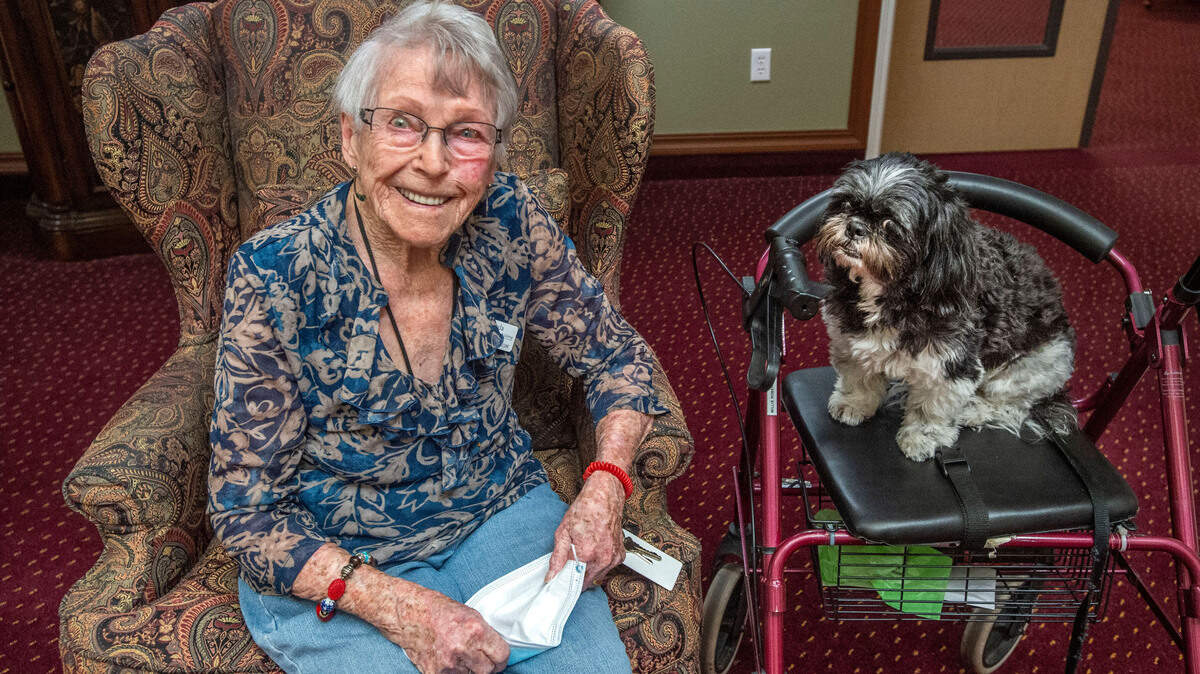
You’ve heard about Rosie the Riveter. Now meet Millie the crane operator.
Millie Robertson of Gig Harbor, who turned 102 this month, may be one of the last survivors of the army of women who swelled the work force of the Bremerton Navy Yard during World War II. She ran a crane — and a big one.
“There were three kinds of cranes in my shop. I took the highest one because it paid a few cents more,” she recalled in an interview last week. “To get into it, you had to climb a ladder. Some of the girls didn’t like the high crane, because you’re like a spider crawling up the wall.”
Robertson was 24, a young wife with a small child, when she went to work in the machine shop in 1943. The shipyard was bustling then, its drydocks full of ships damaged in the Pacific War. The cavernous machine shop received large pieces like gun mounts and turrets, and Millie’s crane lifted them.
It was a frenetic time for what was then known as the Puget Sound Navy Yard, the major repair point for ships damaged at Pearl Harbor, Midway and other battles in the Pacific. The yard had just finished four of the five “ghost battleships” — refloated and refurbished after Pearl Harbor — and was still working on the fifth, the USS West Virginia. Dozens of smaller vessels, from cruisers to destroyers, were also being repaired, refitted or modernized.
Much of this work was being done by women — more than 8,000 of them at the height of the war, according to the Puget Sound Navy Museum.
“About a quarter of the workforce was women,” said Megan Churchwell, curator of the Bremerton museum. “For many, this was their first job outside the home. They served in a wide variety of occupations at the shipyard, from office and administrative roles to industrial roles such as welders, mechanics, and crane operators.”
“At the shipyard, they worked in 24 Shops,” an account by the museum reads. “The supply shops, the Shipfitters Shop, the Rigger Shop and Central Tool had between 400 and 500 women on their payrolls. The Electric, Sheetmetal, Public Works Maintenance, Machine, Director, Pipe and Copper, and Paint Shops employed more than 100 women each.”
Cockroaches in the kitchen
Millie Robertson at first worked in the pipefitter’s shop, and then ran “a machine that made some kind of metal part,” she remembered. “But I didn’t like that. I got a piece of metal in my eye, and besides, the wheel turning over and over put me to sleep.”
She applied to be a crane operator, but was told no jobs were open. So she quit.
“A couple of weeks later, they told me that they had a crane operator job open, and I took it,” she said.
At the time, Bremerton was bursting at the seams, with 34,000 men and women working at the shipyard alone. Housing was so hard to come by, many workers commuted from Seattle by ferry. The Black Ball line ran six boats making 35 trips a day, according to an article by Daryl C. McClary on historylink.org, an encyclopedia of Washington state history.
Millie and her then-husband, George Wiley, arrived at the height of the boom.
“It was so hard to find a place to live, we rented an apartment sight-unseen,” she recalled. “The first night, I got up and found the drainboard in the kitchen all covered with cockroaches.” Later on, the couple got space in government housing put up for the war workers. They divorced later in the war.
Even mother got a job
“It was a trying time,” Robertson said. Among other worries, she had a brother in the Navy and another in the Marines. Both survived the war, but it was a close call.
“My younger brother was in a ship that got torpedoed, and for a whole month we couldn’t learn what had happened to him. We finally learned he was in a rest camp.”
Millie and her siblings grew up around Shelton, where their father was a logger and later worked on a sheep ranch at Mud Bay. It was a hardscrabble life during the Depression, she said.
“We didn’t have much,” she recalled. “Once a month, I had to go stand in line to get the government handouts of cheese and margarine — it was the kind you had to add the yellow color to — and I was so embarrassed, as a teenager, to stand in that food line.”
When the war came, she said, it changed everything.
“Even my mother got a job at the shipyard, working in the sail loft, where they sewed canvas,” she said.
Churchwell, the museum curator, said it’s hard to pin down the exact shop Millie Robertson worked in, although it may have been the largest machine shop, built in the 1930s, which did have several large cranes.
“Several of the largest buildings at the shipyard do have cranes in them, since there is so much heavy lifting to be done when working on ship parts,” Churchwell said.
Busy hands — and feet
Running the crane took both hands and feet, Robertson said. In the high cabin was a small forest of levers which controlled the boom and the cables suspended from it. Foot pedals propelled the crane up and down the track.
“You had to be awfully careful,” she recalled. “With so many people around the track, you could run over somebody if you didn’t take care.”
Like Rosie, the fictional riveter, she developed unexpected muscles.
“You’d go zipping down the track and have to stomp on the brake to stop,” she said. “So that made one leg more muscular than the other.”
All three of the crane operators in the machine shop were women, she said, but they hardly ever took any guff from the men.
“Although, if you didn’t like a particular rigger, you could give the crane a little shake,” she said with a twinkle. Riggers were the workers on the ground who attached the parts to be lifted.
Rats and spilled coffee beans
Millie’s skill with the crane came in useful in other ways, too.
“The ships we worked on had to be unloaded of their supplies, and there were boxes and boxes of toilet paper and bags and bags of coffee, which we couldn’t get because of rationing. It made the girls grumble.”
“So one day I had a pallet of these huge 50-pound bags of coffee beans, and one of the girls said, ‘Millie, why don’t you see if you can make a little hole in one of those bags?’” she recalled. “Well, I wiggled it around just right, and sure enough, a seam came loose and coffee poured out of the bag. And people came from everywhere to scoop up those beans.”
The machine shop was big, old and drafty, she recalls, and there was a problem with rats.
“I remember a guy who used to come around at night,” she said. “He was a rat-catcher, because the shop was full of rats. He had a bag over his shoulder, full of dead rats.”
She doesn’t remember the names of any of the ships she helped repair, but historian McClary says the yard repaired 26 battleships — some more than once — 18 aircraft carriers, 13 cruisers, and 79 destroyers during the war. Among them, during Robertson’s tenure, were the battleships USS Pennsylvania, USS Tennessee, the carrier USS Enterprise, USS Lexington and USS Yorktown.
In 1944, President Franklin D. Roosevelt arrived on the destroyer USS Cummings and, from Drydock 2, thanked the workers for their contribution to the war, according to records at the FDR Presidential Library.
Retirement with Chloe
Robertson is modest about her own contribution.
“Lots of women did much more important things during the war,” she said. “When I lived on Vashon Island, I used to play mahjong with a woman who was a pilot.”
After the war, the shipyard contracted, the men came back for their old jobs, “and I went and got married again,” Robertson said. She and her new husband, Russ Robertson, lived 30 years on Vashon Island, then briefly in Arizona, where he died.
“I had two families and raised six children between them,” she said. She moved to Gig Harbor five years ago to be near two of her surviving children, James Robertson, who lives in Olalla, and Susan Smart, who lives near Shelton.
These days, Millie resides at Peninsula Retirement Community, where she spends her time with her little dog, Chloe. She celebrated her 102nd birthday on Sept. 14.
“I get up in the morning, take Chloe for a walk, come back and take a nap, take Chloe for another walk in the afternoon, and that’s my day,” she said, laughing. “I never thought I would live so long, but here I am.”