
Gig Harbor revises code to allow homeless shelters; here’s where they’d be allowed
The Gig Harbor City Council passed an emergency ordinance Monday revising the city code to align with a new state law that requires cities to accommodate emergency shelters for homeless persons.
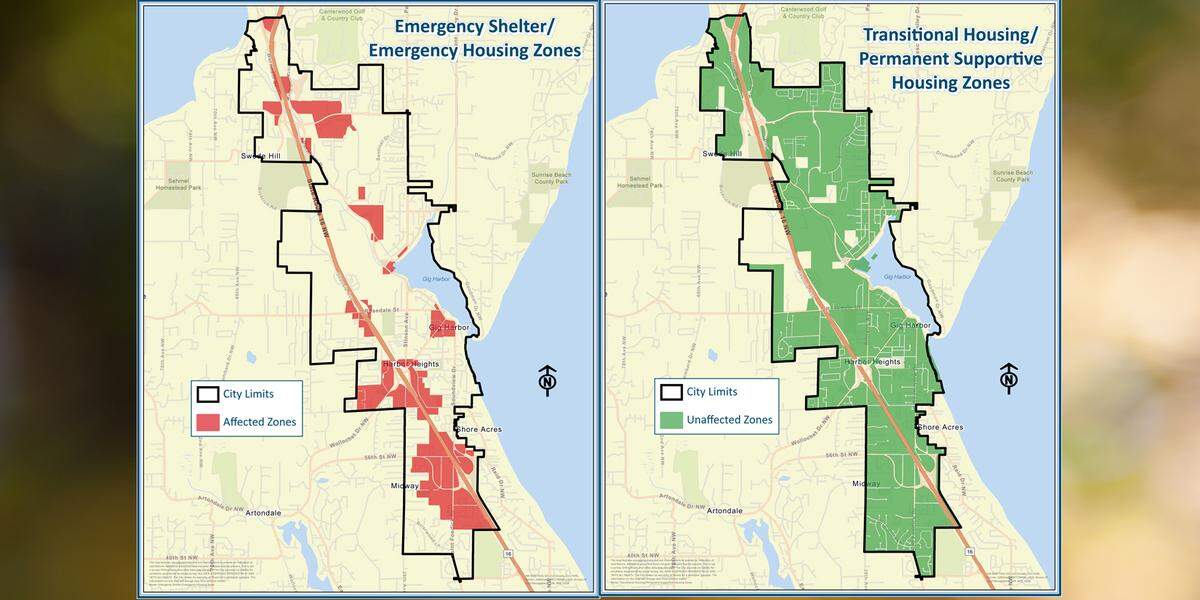
The revision would allow homeless shelters in any Gig Harbor zone that also allows hotels or motels, and longer-term transitional housing in any zone that allows residential housing.
The state law, HB-1220, was a reaction to the attempts by some cities to ban or severely restrict homeless shelters. It forbids cities to prohibit indoor shelters in any zones where hotels are allowed, or to prohibit “transitional or permanent supportive housing” in residential areas.
Interim City Administrator Tony Piasecki explained that revising the code will give the city a measure of control over issues like spacing and overcrowding; leaving it unchanged would mean looser state standards would prevail.
Under state preemption alone, “you could have two shelters right next door to each other, there would be no maximum number of occupants, for example,” Piasecki said.
The ordinance would allow only one continuously operating emergency shelter in the city at a time, and sets occupancy limits at 10 families or 40 people, whichever are fewer.
The ordinance defines emergency housing as “temporary indoor accommodations for individuals or families who are homeless or at imminent risk of becoming homeless that is intended to address the basic health, food, clothing, and personal hygiene needs of individuals or families.”
It also sets limits on “permanent supportive or transitional housing,” in residential neighborhoods, requiring that such dwellings be at least a half mile apart and follow the same basic building and safety codes as ordinary residential housing.
The measure was adopted as an emergency ordinance because of a Sept. 30 state deadline. A public hearing will be scheduled at the Oct. 11 City Council meeting.
Members said they had little choice.
“This is just a prime example of us losing local control,” said Councilmember Jim Franich. “This is top-down government telling us what to do.”
“The short of it is, if we pass this tonight, we will have as much control as possible; if we don’t, the state will be in charge,” said Councilmember Le Rodenberg.
The ordinance passed 6 to 1, with Councilmember Spencer Abersold dissenting.