
How a fallen redwood became a symbol that will soon sit on the Gig Harbor waterfront
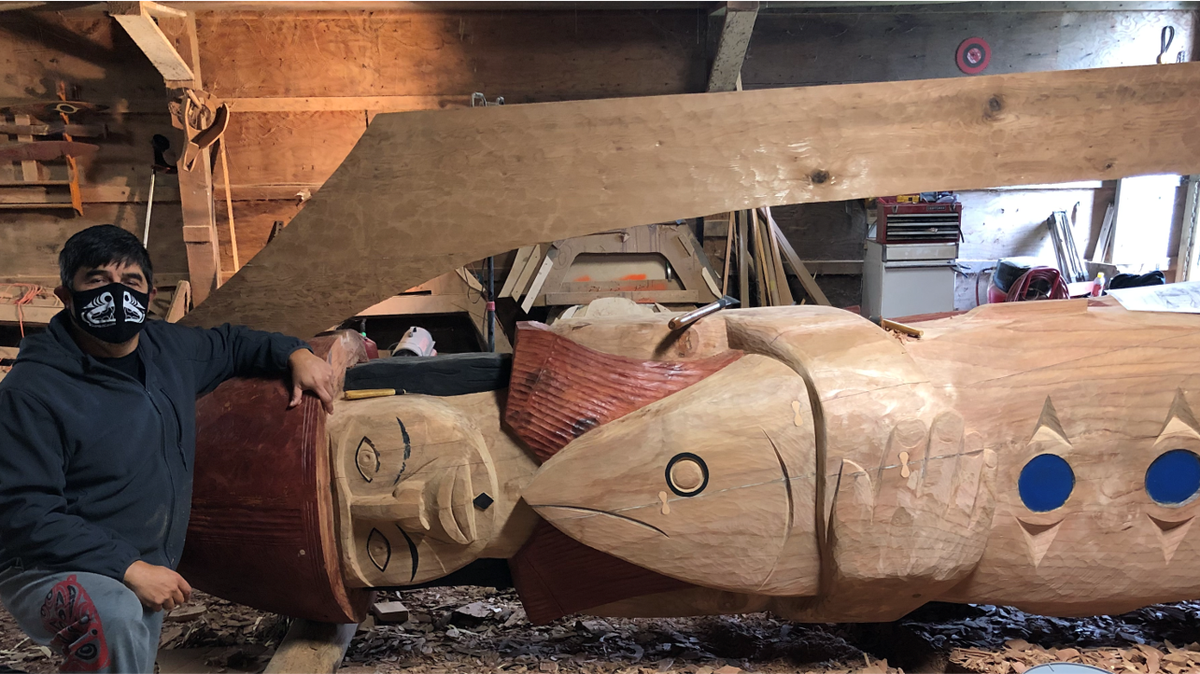
Quinault carver Guy Capoeman knew he had found something special when a friend led him to a deadfall Redwood in the woods near Shelton.
Capoeman was looking for a large log to carve into a symbol of the sx̌ʷəbabš, or Swift Water people, who had lived on the Gig Harbor waterfront for centuries.
This snag of Redwood, fallen of its own accord, was the right size, in the right place at the right time.
“Finding the log, finding a place to work — everything just sort of fell in place,” Capoeman told the Gig Harbor City Council by video from his Quinault workshop last week. “It was beautiful wood, just wonderful wood to carve.”
Shaped over the last year with traditional tools, the Redwood snag has become a sculpture called “Our Fisherman, Our Guardian,” which is expected to be installed soon at Austin Park at the head of the bay.
The 14-foot-tall sculpture is of a fisherman in a traditional conical hat, tightly clasping to his breast a newly-caught salmon.
“I really wanted to do something to symbolize the salmon struggle we’ve gone through,” Capoeman explained. “That’s the biggest struggle we face today — that we have a resource left to fish — specially with global warming and all the things that are happening in the ocean today.
“I wanted that centerpiece to show our relationship with the salmon, that’s why we hold onto it with our heart and soul,” he said.
The City Council spent the first hour of its regular meeting on Oct. 11 celebrating Indigenous Peoples’ Day, with guests including Capoeman, Puyallup Tribal Councilwoman Anna Bean and other tribal officials. The occasion also served to mark the warming of relations between the city and the tribe, the original inhabitants of the harbor.
Bean celebrated the renaming of the Donkey Creek estuary, which will now be called txʷaalqəł, or “Place where game exists,” in the Lutshootseed language.
“It may seem like a little thing to some folks, but it is deeply impactful to the members of the Puyallup tribal community,” she said.
Jennifer Keating, the tribe’s land planner, grew up in Gig Harbor and still lives in the city. She said she is encouraged by gestures like the renaming of the estuary, the planting of historical markers at the village site, and the naming of Swift Water Elementary school, among other efforts to recognize the original inhabitants.
“We have come so far from when I was a kid,” she said. “We were actually removed from the classroom to learn our tribal history, which basically told the rest of the class, ‘their history isn’t worth learning.’”
Capoeman told the council that he discovered while researching his family that “one of our grannies actually lived at txʷaalqəł during one period of her life.” Her name was Sally, he said, and she married a man on Squaxin Island who was “the grandfather to my grandfather.”
He learned that about the same time he saw the call for submissions for the Gig Harbor Honoring Project, he said, and “I heard a voice in my head that said, ‘Do some artwork and submit it.’”
Capoeman is a well-known Northwest artist who specializes in large carvings, especially the 32-foot long ocean-going canoes that are emblematic of the coastal Salish peoples. His design was chosen from among seven finalists for the Gig Harbor commission. (In March, Capoeman was elected president of the Quinault Indian Nation on the state’s northwest coast.)
At this point, the finished sculpture is in a Gig Harbor city storage facility, awaiting installation. It will sit right at the tide line on the estuary, facing the water. City Public Works Director Jeff Langhelm said the city is still negotiating the requirements of various state agencies for permits, including the need to avoid disturbing archaeological remains. Besides the village, the estuary was also the site of an early lumber mill.
The discovery of the redwood snag came with a little historical bonus, explained Tina Shoemaker of Gig Harbor Kiwanis, which contributed $25,000 through the Kiwanis Foundation toward the Honoring Project.
“Redwood is not native to the Pacific Northwest,” she said. “But it turns out this one was planted from seeds brought from California by a homesteader 100 years ago.”
Capoeman said the enthusiasm of the local community for the project “really warms my heart.”
“It really is a testament to the dedication and commitment you have to our ancestors and our way of life,” he said. “When I refer to ‘us,’ I mean all of us, as mankind. We all live here together now and share these lands and sacred sites.”
Correction: An earlier version of this story misstated the amount contributed by Gig Harbor Kiwanis toward the Honoring Project. The Kiwanis Foundation donated $100,000, of which $25,000 was provided by Kiwanis and $75,000 by the Puyallup Tribe.
This story was originally published October 18, 2021 at 5:00 AM.