This pre-K class finds worms, pines cones and ‘exploration in play’ in outdoor classroom
The Peninsula School District has launched an early learning program that has some of its youngest students eager to find worms and mini pine cones.
In November, the district started taking classes outdoors as part of the transitional kindergarten program at Voyager Elementary and Evergreen Elementary.
The district started offering its transitional kindergarten program in January 2022 as a way for children ages 4 and 5 to get ready for kindergarten. It’s offered at five elementary schools in the district.
The other three schools follow a fully indoor curriculum. Each transitional kindergarten class has 18 students, assistant superintendent John Hellwich told the Gateway.
“Voyager is a great site for outdoor transitional kindergarten,” said Lisa Reaugh, director of special programs for the Peninsula School District. “They have quite a bit of land around this facility and have Kopachuck State Park right across the street.”
“There’s so much room for them to explore when we go into the state park,” paraeducator Jessica Miller told the Gateway Tuesday, Jan. 10.

‘Exploration in play’
“Outdoor transitional kindergarten is very much intentional time and reason to be outside,” Reaugh told the Gateway. “They have a lot of exploration in play, and a curriculum on the things that they’re seeing outside.”
The program curriculum is created by PSD’s outdoor traditional kindergarten teachers, Reaugh said.
The students have shown growth with outdoor stamina, teacher Melissa Northstrom told the Gateway Jan. 10.
“At the beginning of the year they weren’t as willing to get dirty, to stay out, because they were cold,” Northstrom said. “They wanted to do a quick walk and back. But now they stay out longer. They explore and aren’t so worried about getting dirty.”
They spend an hour of their school day outside.
Most days consist of the kids exploring and navigating nature. They’re looking at the bark on the trees, examining plants, and noticing differences in the environment when the seasons change.
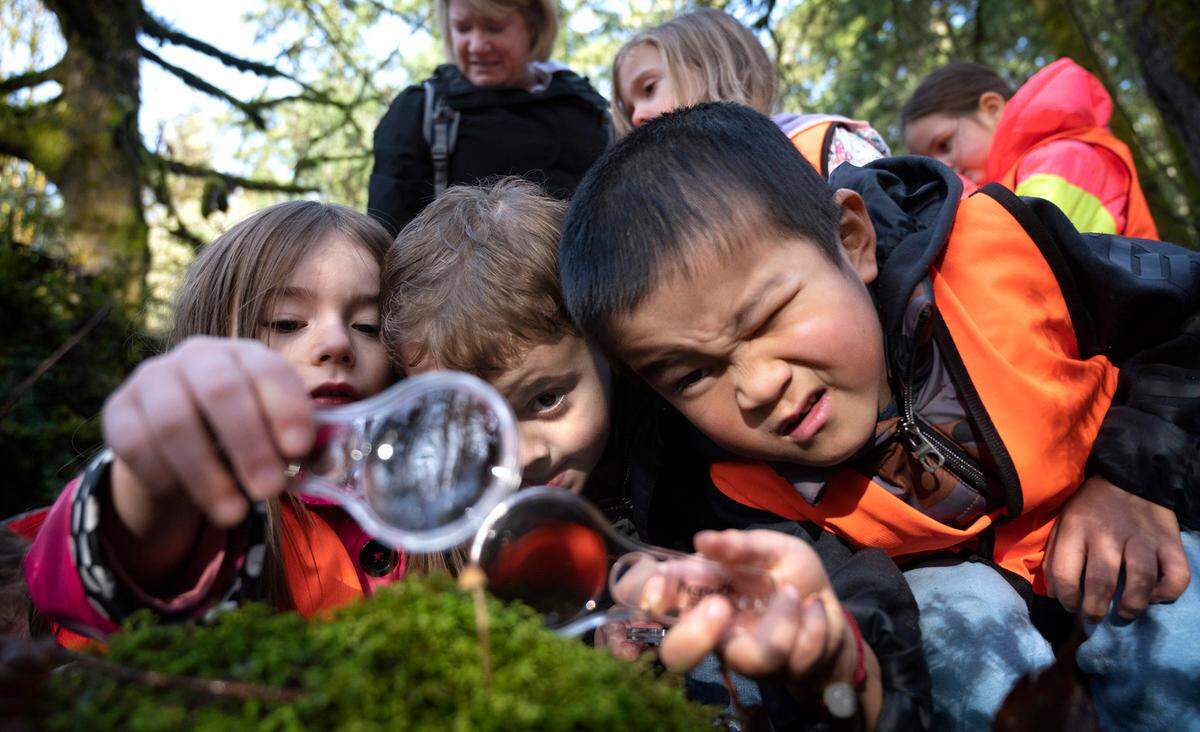
On Jan. 10 the class at Voyager received new magnifying glasses for the students to take on their hike in Kopachuck State Park.
“Our brand new tools have a special purpose, to observe and discover new things on the trail,” Northstrom told her class.
She encouraged students to use them to look closely at moss, mushrooms or woodpecker holes.
“I found a spider web,” student Veronica Black said, pointing at a tree.
Ezra Croff, another student, rushed over to take a closer look and reported there were no spiders in it at the moment.
Shortly after a group of students gathered around a worm.
Student Lorelai Herling was excited to find mini pine cones.
“They’re watching a tree evolve throughout the year,” Reaugh said. “And then they’re sketching, labeling and following its growth and change.”
While walking the trails, Northstrom asked the class if they remembered the name of the tree.
The class chanted: “Douglas fir.”
“Wow, it’s huge,” student Max Stiles said.
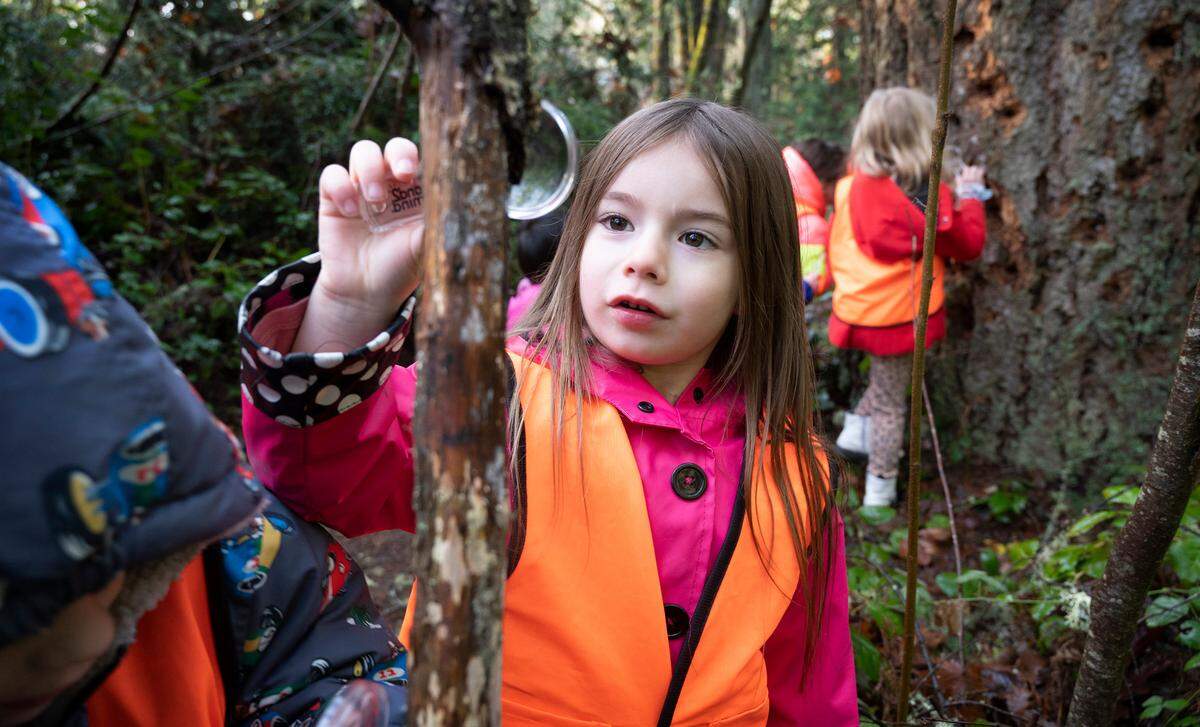
Outdoor learning still gives students experiences to help them prepare for kindergarten, Reaugh said.
“Nature-based learning can really impact social and emotional learning,” Reaugh said. “They’re still learning how to self regulate, interact with peers, taking care of their lunch, sitting in a circle. They get to all of that with an added component of exploration.”
“This has given Duke the opportunity to spend time with peers for the first time in his life,” said Lacey Galligan, whose son is in the program.
Northstrom is thoughtful with the decision for the day’s outdoor agenda.
“If I’m noticing their stamina is not quite there or we just don’t feel like they can take that long walk in the park, we’ll just go to the TK garden area that we’ve created,” Northstrom said.
Similar to the traditional transitional kindergarten, to be considered for outdoor transitional kindergarten a student needs to be 4 or 5, starting kindergarten the following school year, and must show a need. For example, that they haven’t spent time in a classroom before, speak a language other than English at home, or are having social challenges. A screening process is completed to evaluate whether or not transitional kindergarten is the right fit for that student.
“This is another opportunity to close the gap of students not having learning opportunities before kindergarten,” Reaugh said. “Some are learning to navigate their own independence for the first time.”
Duke comes home and tells his mom all about his exploring.
“He has shown growth in making connections with peers and adults at Voyager,” his mom said. “His independence has been fostered by being able to be outside of the home and explore new environments. When he comes home he is willing to help with chores and do everything independently.”
‘A Scandinavian approach’
Last year, Peninsula Superintendent Krestin Bahr and school board president Natalie Wimberley participated in a conference in Norway.
They connected with educators in Gig Harbor’s sister city, Bodø, and learned about their outdoor classes.
“Outdoor classes are very much a Scandinavian approach,” Reaugh told the Gateway.
When Bahr and Wimberley returned from the conference, they brought the idea of outdoor education to Reaugh.
“It was really an opportunity for us to look at how we do education,” Reaugh said. “It’s unique and a shift from the traditional education we’re used to.”
There aren’t currently plans for future outdoor programs for other grades.
“This is a new program PSD is introducing and the success of this year will likely determine any future changes,” Danielle Chastaine, Digital Media Communications Coordinator for the district, told the Gateway.
Funding
Earlier this year the district received the Reimagine Education Project Grant for $35,000 from the Washington State Office of Superintendent of Public Instruction.
That grant helped the district get supplies and materials the kids need to be outside.
“All students can choose to bring their own items, but we do not want anybody to not have what they need,” Reaugh said.
Each student has access to boots, outdoor pants, coats and gloves.
In December, the district received an additional $35,000 grant from United States Department of Agriculture for outdoor learning. The district hopes to use it to add additional structures to the outdoor learning sites.
“Having some sort of covered structure to provide some shelter is what we’re hoping to do,” Reaugh said. “Having something that is covered allows students to grab a clipboard and do some work while staying dry.”
The two sites are not identical and offer different things for students to do.
“The outdoor learning site at Voyager includes a smaller space that has a mud kitchen, a ‘fairy garden,’ planter boxes and some donated items from families,” Chastaine told the Gateway.
Parents are excited about the additional outdoor opportunities.
“We’ve seen a lot of really cool things happen just in a short amount of time,” Reaugh said. “Parents come and drop off rocks or play structures the kids can play with. It’s awesome to have the support from the community.”
“The Evergreen outdoor learning environment is still under construction, but will include covered areas, a rain garden featuring native plants, large boulders for students to climb on, stumps for children to climb and jump on, and (covered) learning spaces for outdoor classes,” Chastaine said.
“I am thrilled the district has invested in early learning opportunities,” Galligan said. “It is especially amazing that transitional kindergarten gets to have an emphasis on time spent outside. ... they definitely are keeping up with research on early development and the importance of outdoor play.”