
40 acres of local salmon habitat was saved. You’ll be able to explore its primitive trails
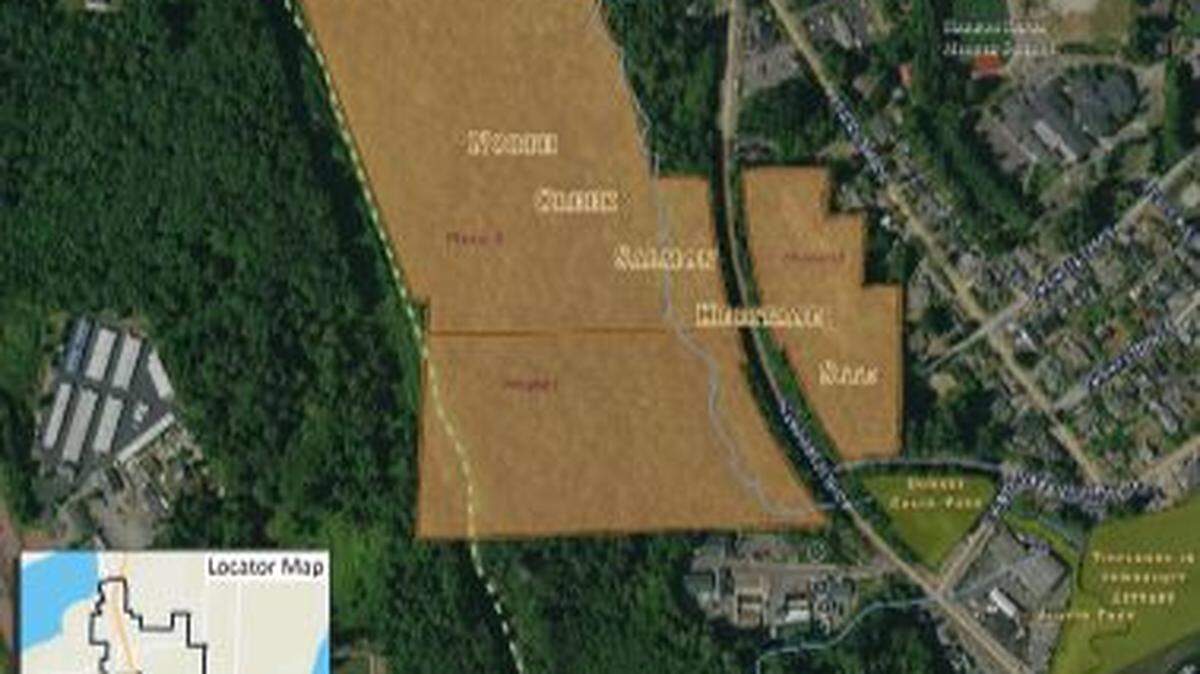
The City of Gig Harbor is celebrating the milestone conservation of 40.52 acres. Throughout the course of 2022, the city collaboratively worked to purchase Phases I-III of the North Creek Salmon Heritage Site, conserving the land in perpetuity.
North Creek Salmon Heritage Site’s name derives from the important salmon-bearing creek that runs across all three phases of land, as well as recognizing the ancestral homelands of the sxʷəbabč peoples, the original residents of the Gig Harbor area.
The name showcases what the city is protecting and also hints at what the public will be able to enjoy in the future. The site will eventually be open to the public, offering primitive trails, access to the Cushman Trail (a project slated to begin in 2024), salmon viewing opportunities, and signage celebrating the land’s heritage.
Land conservation can take many forms, depending on the owner, but collaboration is key to protect any parcel, starting with funding. But to understand the collaboration behind this land conservation effort, we first need to understand what each phase looks like.
Phase I
This parcel totals 11.5 acres and is located just north of the city’s wastewater treatment plant, across the street from Donkey Creek Park. North Creek runs under Harborview Drive onto this parcel. Notably, Phase I is also where the main village site of the sxʷəbabč peoples is located.
The city closed on Phase I in mid 2022 for $500,000. Funding came from the Puyallup Tribe ($50,000), local funds, and a reimbursement amount to be determined from Pierce County Conservation Futures.
Phase II
Located farther up North Creek and adjacent to Phase I, six parcels make for a total of 23.87 acres on Phase II. The Gig Harbor Land Conservation Fund (GHLCF) notes that this land already contains a beautiful trail, lovingly nicknamed “Lushootseed Loop.”
Jennifer Haro, parks manager with the City of Gig Harbor, said the city plans on a connection from the Cushman Trail to Harborview via Phase I and/or Phase II. This connection project is an exciting aspect of Phase II that will offer trail-goers a direct connection to historic downtown Gig Harbor.
The city closed on Phase II on Oct. 31, 2022 for $4.2 million. Haro said the city expects to be reimbursed at least $500,000 from Pierce County Conservation Futures.
Phase III
A year ago, this 5.15 acre parcel was the site of a proposed 18-home development, complete with a new road. GHLCF notes that based on how the site was vested, stormwater runoff would have been damaging to North Creek, affecting the salmon and salmonid species that call the creek home. Development would have also meant the loss of a substantial wildlife corridor in the area.
The city purchased Phase III on Sept. 1, 2022 for $1 million. After its purchase, the city partnered with Great Peninsula Conservancy (GPC) for a conservation easement on the parcel. “Great Peninsula Conservancy will hold and defend the conservation easement in perpetuity to ensure that the wildlife habitat and community greenspace are protected,” said Ali Querin, conservation project manager at GPC.
Funding for Phase III came from GHLCF ($50,000) and local funds. The un-groundbreaking ceremony took place on Jan. 14, 2023 at Donkey Creek Park.
Pierce County Conservation Futures
Funding for land conservation can come from many sources and often requires teamwork from several entities. The result benefits residents and visitors alike.
And whether Pierce County residents realize it or not, they have contributed to land conservation. The Pierce County Conservation Futures program is funded through property tax revenue. State law permits a levy of up to 6.25 cents per $1,000 assessed property value. In 2021, Pierce County charged 3.55 cents per $1,000 assessed property value, equating to nearly $4.89 million in revenue that was used to fund conservation projects.
“This tax funds preservation grants for different types of land — open spaces, wetlands, wildlife habitat, timber and agricultural lands — for the enjoyment of the public and our future generations,” said Kimberly Freeman, resource stewardship superintendent of Pierce County.
Our tax dollars via Conservation Futures have supported the creation of Narrows Park, Sehmel Homestead Park, and Gateway Park. And now, this same funding is helping to conserve the North Creek Salmon Heritage Site.
Conservation Futures takes grant applications in odd numbered years, meaning applications for funding will be opening again this spring. While these applications are generally submitted by the county, local cities, nonprofits and park districts, individuals with land they would like to conserve can also be involved. The first step would be reaching out to one of these entities to start the conversation.
These applications are then reviewed by a technical advisory committee to determine eligibility, then by a volunteer citizen advisory board, which recommends selection, rankings and protections to be put in place.
“The citizens advisory board volunteers come from all different walks of life and they’re not all necessarily conservationists,” Freeman said. “Many of them just want to get involved with their community.”
From there, the County Council takes public action on these recommendations, which determines the final ranking order and terms of acquisition for funding the selected projects.
After the projects are submitted into the budget, they are purchased for future conservation and public benefit.
Notably, conservation can also include preserving farmland in perpetuity. Kaukiki Farm on the Key Peninsula is a great example of this type of conservation. The owners worked with GPC (who, in turn, applied for Conservation Futures and the Washington Wildlife and Recreation Program’s Farmland Preservation funding, to ensure their land is conserved for agricultural purposes).
“Kaukiki Farm is a win-win for balancing conservation of agricultural land and wildlife habitat while also protecting a rural area,” Querin said.
While the funding process for land conservation has many steps, it ensures equitable selection and grants for land conservation. And it wouldn’t be possible without the dedication to our environment by many different entities, volunteers, and even Pierce County taxpayers.
At the end of the day, residents and visitors alike win by having outdoor spaces — now including North Creek Salmon Heritage Site – to enjoy in perpetuity.

Carly Vester has been writing an environmental column for The Peninsula Gateway since 2019. Her storytelling focuses on the intersection of people and the outdoors — from adventures across the west, to our environment and the rich history surrounding it. Her documentary films have screened internationally and her writing has been published locally and regionally.