WA retailers lose $3 billion to theft each year. Here’s what Gig Harbor does to stop it
There are people who come to Gig Harbor to settle. Others come to sail. And some come to steal.
Shoplifters come from “all over,” Gig Harbor Police Chief Kelly Busey told The News Tribune. He listed off a long list of cities: Port Angeles, Bellingham, Portland, Yakima, Spokane, Tacoma. The Police Department did a statistical analysis of where their criminals come from and couldn’t detect a pattern, he said.
The department started a program in the fall of 2021 to help curb retail theft, called the “Business Check” program. Three years later, it appears to be working, he said, though its success is difficult to quantify because of the nature of how it works: An employee who notes suspicious activity inside or near a store can call 911 and request a “business check.” An officer will show up, pending availability, in hopes of deterring would-be criminals from acting once they see police nearby.
If no crime occurs, no police report is written, so there isn’t exact data to indicate how many crimes such business checks may have prevented.
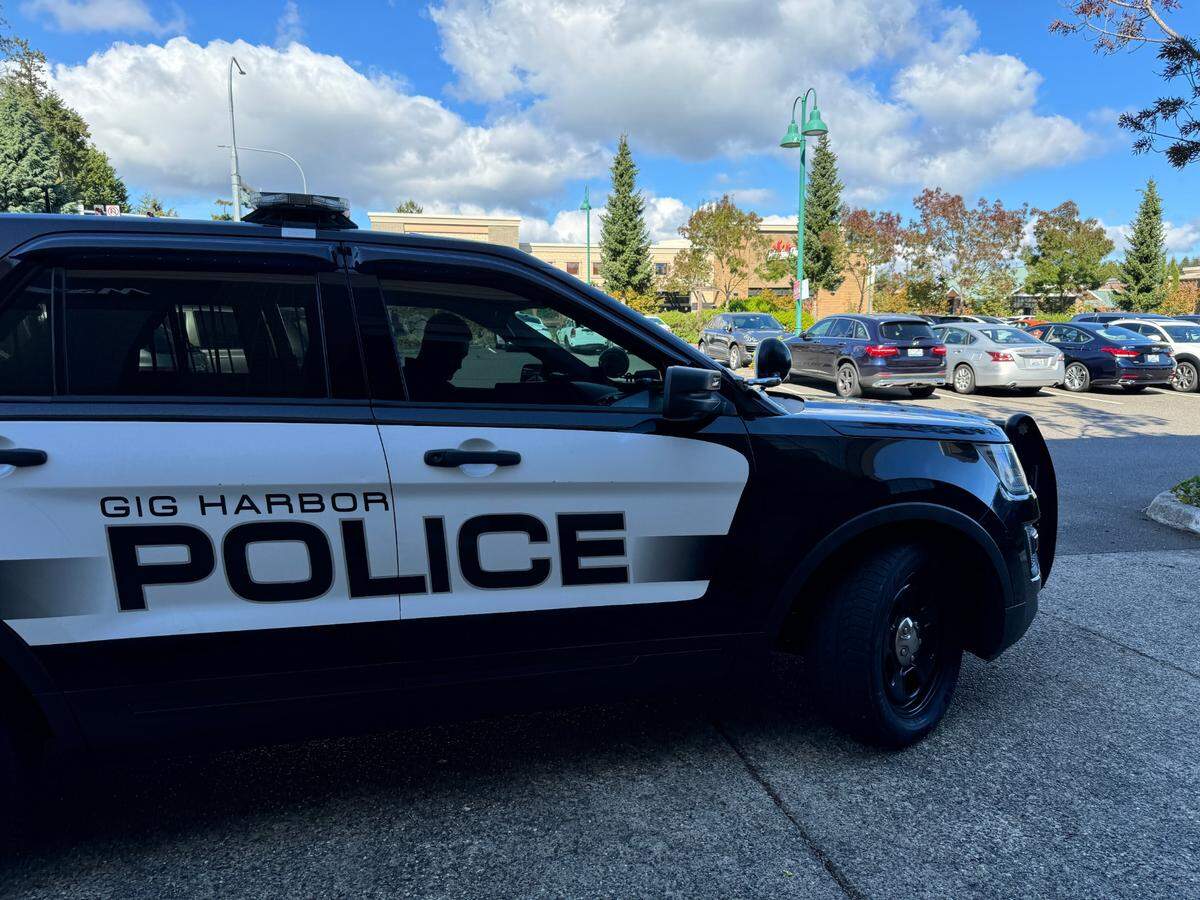
The News Tribune rode along with a Gig Harbor police officer recently to learn how police look for suspicious activity, reviewed examples of police reports from business checks in cases where an alleged crime did occur, and found out how the program works.
Shoplifting in Gig Harbor
Gig Harbor’s 2023 crime rates fell close to the middle of Pierce County police jurisdictions, according to data from the Washington Association of Sheriffs and Police Chiefs. At an overall crime rate of 58.6 crimes per 1,000 people, it ranked eighth among the 19 Pierce County jurisdictions included in the Crime in Washington 2023 Report.
Among the crimes committed in Gig Harbor that year, larceny-theft offenses came out on top at 26.8 incidents per 1,000 people, according to the report. Larceny-theft includes shoplifting as well as other kinds of theft, and refers to “the unlawful taking, carrying, leading, or riding away of property from the possession of another,” according to the report. The next highest crime rate in Gig Harbor was 5.6 per 1,000 for motor vehicle theft.
Data from the Gig Harbor Police Department also showed that the stores hit hardest by shoplifters are major retail chains. The top five stores in Gig Harbor with the most shoplifting calls from Jan. 1, 2023, to Sept. 16, 2024, were Albertsons, Target, Famous Footwear, Safeway and Rite Aid.
Busey provided an excerpt from a police report dated Sept. 17 that illustrates how a business check works. An officer responded to a business check request at about 8:11 a.m. to the Albertsons at 11330 51st Ave. in Gig Harbor, where he learned that a man wearing a fisherman’s hat was acting suspicious while pushing a cart of several cases of Tide Pods — a commonly stolen item — and two cases of beer.
“He abandoned the cart in the store after observing us in the business,” the officer wrote in the report.
Per an employee request, the officer told the man that the business would like him trespassed, which the man acknowledged before leaving the parking lot, the report said.
According to reports from the Washington Association of Sheriffs and Police Chiefs, the reported number of larceny-theft offenses in Gig Harbor dropped to 350 in 2023, the lowest annual number among incidents reported from 2019 to 2023.
During an annual crime report at the Sept. 9 City Council meeting, Busey offered several reasons he believes retail theft — calculated as part of larceny-theft offenses — went down from 2022 to 2023. First, under-reporting among retail establishments because of changes to corporate policy may have decreased shoplifting calls, he said. Retail theft emphasis patrols, which are periodic operations to concentrate arrests over a short period of time, and business checks may have also contributed, he said. And loosening jail booking restrictions after the COVID-19 pandemic has made it easier for officers to take suspected shoplifters to jail “on day one” and prevent repeat offenses, he told the council.
Store policies can make stopping shoplifters difficult
Busey told The News Tribune that the department invented the Business Check program in part because they felt loss prevention policies for some larger, corporately-owned stores were too weak.
“Most employees can’t confront shoplifters, which isn’t bad,” Busey said. “We don’t necessarily want confrontations. That’s how people get hurt, right? But we found too that most employees couldn’t even call 911 to report the shoplifting.”
Nationally, retail theft contributed to a 1.6% “shrink rate” across retailers in fiscal year 2022, according to a survey report from the National Retail Federation. Shrink, or shrinkage, measures the inventory businesses lose to theft both by employees and non-employees, administrative or operational errors, and other causes, according to the National Retail Federation. Taken as a percentage of their total earnings in 2022, retailers lost $112 billion, and external theft accounted for 36% of this total, the survey found.
Violence in retail stores has also increased, drawing more retailers to support a “hands-off” approach to shoplifters, the release said; 41% of respondents to a retailer survey said “no employees are authorized to stop or apprehend shoplifters,” a jump from 38% the previous year.
“Like many in the industry, we are seeing a higher level of brazen shoplifting and organized retail crime,” Rite Aid spokesperson Michelle McEnroe told The News Tribune via email Oct. 17. “We are taking an active role in helping law enforcement in their pursuit of shoplifters, as well as continuing our efforts to educate community leaders on the impact of retail theft and advocate for solutions.”
Busey said he thought the reason for such policies might be fear of litigation or negative publicity, if the store nails the wrong person. So the police department decided to make an arrangement with their dispatch center. South Sound 911 handles emergency dispatch services for jurisdictions across Pierce County.
If an employee calls 911 for a “business check,” the dispatcher won’t ask them questions beyond the employee’s name and the business name and location, according to a letter explaining the program that Busey said was distributed to various merchants. If officers are available, they’ll respond to that location knowing that something suspicious may be going on – but won’t know who they’re looking for or what the situation is.
“We presume it’s probably a shoplifter, but we’re not sure,” Busey said. “But just us being there reassures the employees. Generally, if the suspect is still at that location, they’ll leave without stealing anything and the crime has been averted.”
Their goal is to prevent crime from happening in the first place, rather than respond after the fact, he said.
Busey said some businesses have prohibited their employees from even requesting business checks. That’s disappointing, he said.
“It’s really a non-invasive way of addressing a potential crime,” he said. “We’re not profiling anybody. We’re not falsely accusing anybody. We don’t even know what we’re looking for.”
He declined to share the specific businesses that have stopped using the program, but said the department knows about them because employees at those stores have said they can no longer call when talking to officers doing routine checks.
A national problem
Mike Johnson, senior vice president of policy and government affairs for the Washington Retail Association, told The News Tribune that they applaud Gig Harbor’s Business Check program. But not every jurisdiction has the law enforcement, prosecutors and jail space to crack down on retail theft in the same way, he said.
He also emphasized that retailers’ biggest issue is organized retail theft, not petty shoplifting. Organized retail theft is when criminals turn a profit by selling stolen merchandise. They often use that income to fund other criminal activities, like human trafficking, illegal drug use and prostitution, he said.
“That’s what is killing us financially,” he said.
Each year, the Washington state retail industry loses about $3 billion to theft, and organized retail crime is a significant part of that, according to Johnson.
Busey said that business checks help prevent both organized retail theft and petty shoplifting. Sometimes police see cars serving as “lookouts” in the parking lot while the shoplift is occurring, which Busey said tends to be associated with organized groups.
This story was originally published October 28, 2024 at 5:00 AM.