Beloved Pierce County swim club at risk as pool rental fee more than triples, coaches say
Erika Jackman says she’s from a “family of swimmers.”
A swimmer herself, she previously served on the board for a Seattle nonprofit aquatics club. Her three daughters began swimming with Harbor Aquatics Club in the Gig Harbor area after they moved from West Seattle in 2022.
This aquatics program feels different to her.
“I generally like swim people,” Jackman told The News Tribune. “. . . But they’re special here.”
She credits the coaches and assistant coaches with creating a supportive environment for their swimmers. Her 8-year-old daughter, Tess, agrees: She and her friends “love this swim team,” she told The News Tribune during practice Nov. 26.
Jackman was one of six parents who spoke at the Nov. 12 Peninsula School District board meeting about the positive impact that Harbor Aquatics Club has had on their children. The coach-owned LLC will soon need to pay $210/hour to rent the Peninsula High School pool, over triple their current rate of $60/hour. District spokesperson Danielle Chastaine told The News Tribune this is a necessary correction, as the club had been paying the rate for nonprofits previously while not technically being part of that category.
Coaches and co-owners of Harbor Aquatics Club, Hillary Jensen-Bergren and Jianna Link, say that paying the increased rate will be a heavy lift for their swimming program, which consistently holds practices at Peninsula High School’s pool and sometimes Gig Harbor High School’s pool.
“I don’t know how any small business could afford a rate of $210 an hour,” Jensen-Bergren told The News Tribune in a video call Nov. 25. “I mean, at that rate, virtually every dollar that comes in would just be going to the rental itself.”
If Harbor Aquatics Club is required to pay $210/hour to rent one of the district’s pools, they won’t be able to pay for their coaches, equipment or other activities that would enrich the team and allow them to grow, Jensen-Bergren said. They say they can only afford up to $80/hour.
Jensen-Bergren and Link also said it could force them to stop renting from Peninsula School District entirely, and raise membership fees significantly, though they would try to make other adjustments first. That would make their team less accessible, something they want to avoid, Jensen-Bergren said.
It costs $21/year to register for year-round membership in Harbor Aquatics Club, according to their website. There are additional monthly dues which range from $90 to $175/month and vary by swimming group, with more advanced groups paying higher dues. Swimmers are also expected to register with USA Swimming, which has its own annual registration fee of about $87/year.
The district told the swim club in August of the rate change and granted them an extension until March, according to the coaches. Link said that they have been told the district may revisit the issue then, but they don’t have any guarantee. The two coaches asked the school board at the Nov. 12 meeting to consider amending their current rental fee schedule to include a cheaper option for small businesses to rent school facilities long-term.
Jensen-Bergren and Link co-founded Harbor Aquatics Club in October 2021 after coaching Narrows Swim Club together before the COVID-19 pandemic. Narrows Swim Club was a competitive Gig Harbor-based swim team that began offering a conditioning program in 2016, according to News Tribune archives. The team did not return after the pandemic.
Link said they decided to open their own club after getting numerous calls and emails from parents of kids asking when swim team would be starting up again. Some parents told them their kids were also struggling with their mental health without the opportunity for physical exercise and time with friends.
“We’re kind of famous for our quick decisions,” Link said. “And it was really kind of a quick decision in October of 2021 when we were like, ‘Man, people really need this. These kids are really missing swimming.’”
The aquatics club started operating with a business license and registration with USA Swimming less than two months later.
They started with 30 participating kids, according to Jensen-Bergren. Now, they have about 150 kids across all of their programs at any given time, with the actual number fluctuating when kids join during their short summer swim program or take a break for high school athletics, for example. The number of kids they can serve is directly related to how many hours they can rent the pool from the district, she said.
How does the district set its facility rental fees?
Chastaine, the Peninsula School District spokesperson, said the district superintendent works with her team to propose the fee schedule, and the school board approves it. The current fee schedule was approved in November 2023 and is reviewed every other year, so the next review will probably happen in 2025, according to Chastaine.
The district’s Policy 4260 outlines rules around public use of school facilities, including that district-sponsored activities are first in line to use them. The district also divides groups wishing to rent school facilities into three categories: “school or child-related groups or other government agencies,” “nonprofit groups” and “commercial enterprises.” The last category includes “profit-making organizations and business-related enterprises.”
The district prefers commercial groups to use commercial or private facilities, but they may rent facilities “for non-regular use at the prevailing rate charged by commercial facilities in the area,” according to the policy.
The current fee schedule breaks down the group classifications further. Level A includes nonprofit community youth organizations and social activity providers, such as PenMet Parks, Harbor Soccer Club and Boy Scouts. They pay the cheapest rate to rent district facilities. Level B includes nonprofit adult parks and recreation programs in the district, and Level C includes all other nonprofit and public organizations. Level D is where Harbor Aquatics Club falls — commercial, private or profit-making groups. They pay the most expensive rate.
Previously, the district was mistakenly charging Harbor Aquatics Club the $60/hour rate for nonprofits instead of the for-profit group rate of $210/hour, according to Chastaine. She wasn’t sure how that error occurred but said they’re making the correction now as part of the work they’re doing with their new athletic director to make sure they’re following their own policy and “doing things the proper way.” Director of Athletics and Activities Wendy Malich was hired this past spring, according to the district’s Facebook page.
“We’re trying to offer these resources and these facilities so that our youth can benefit from them,” Chastaine said. “. . . (Nonprofits) do not do the work they do for profit, they do the work they do to better their community.”
To set each rate, Chastaine said the district looks at what the costs are to maintain the facilities and provide staffing when they’re in use. The state constitution prohibits local governments and municipal corporations, including tax-funded school districts, from “gifting public funds” to private parties. That means that the school district must charge private groups at least as much as is necessary to cover maintenance expenses, according to Chastaine.
“Whatever we’re paying to maintain our facilities, we’re making sure that the fees we charge match that . . . we’re also not setting fees in a way that we profit from these programs,” she said.
Pool maintenance is expensive. The cost of summer maintenance, which the district usually completes on one of their two high school pools, alternating each year, is in the ballpark of $40,000, Chastaine told The News Tribune. This year, the district found a leak in the Peninsula High School pool and the additional repairs plus the cost of regular maintenance was about $80,000. She said the process of regular maintenance includes cleaning the pool, sealing any cracks, making sure safety standards are up-to-date and draining and refilling the pool with the proper chemicals.
She said she couldn’t share the full annual cost of maintenance for their pools because the pools are not on their own electric meters, which makes it difficult to figure out how much electricity the pools use separately from the school buildings they’re part of.
The district also looks at the rental fee rates in other districts to guide their decisions, she said.
The News Tribune reviewed pool rental fees for several Western Washington school districts, limited to those that posted their fee schedules online. The Central Kitsap School District charges $55/hour for commercial rentals of their pool, and rentals with lifeguards for 61-90 people are $115/hour. The South Kitsap School District charges $130/hour for a rental with 76-100 people. The Clover Park School District charges commercial and for-profit groups $200/hour to rent an entire pool facility. Tacoma Public Schools charges private/commercial groups $140/hour with a $14 charge for utilities. The Puyallup School District charges $197/hour for a maximum of 100 people, and also offers a long-term rental option of $83/hour on weekdays and $125/hour on Sundays and holidays.
Why isn’t Harbor Aquatics Club a nonprofit?
Asked if Harbor Aquatics Club makes a profit or breaks even, Jensen-Bergren said that she and Link make enough money to cover their expenses and pay themselves a small amount. Making a profit isn’t their primary focus, but they see it as a path to making their program more sustainable in serving the community, she said.
Remaining a small business instead of converting to a nonprofit allows them to keep “full control over how (their) organization serves the community,” according to Jensen-Bergren. A nonprofit is required to have a board governing the organization, and she and Link wouldn’t be able to serve on that board as paid coaches. That could impact their ability to fully control their practice structure, the coaches they hire, the wages they pay their coaches and how they handle crisis situations, she said.
That level of control is important to them, especially when they need to act quickly, she said. When the Peninsula High School pool was shut down for unexpected maintenance in the fall, she and Link were able to take action, sometimes within hours, to find other places to hold practice. They didn’t have to have a special meeting with a board to make those decisions.
The other difficulty with a board is that the members who serve on it may not know as much about competitive swimming as the coaches, according to Link, who previously coached for a team that was run by a nonprofit board. As a parent herself, she said she also understands that board members may be tempted to think of their own kids rather than the good of the team as a whole.
“That can become very difficult because as we know, there are a lot of kids on the swim team, and not all of them benefit from the same decision,” Link told The News Tribune.
She and Jensen-Bergren are able to make decisions understanding how each one will impact the team, their coaches and the swimmers in both their pre-competitive and highly competitive groups, she said.
Pool availability in the Gig Harbor area
There aren’t any truly public pools in the Gig Harbor area, according to a study commissioned by PenMet Parks to evaluate the feasibility of building a public aquatics facility in their service area. It found that the Gig Harbor area has five pools total. Three require some kind of membership: the YMCA, a country club and a swim club. The remaining two are high school pools with limited public access.
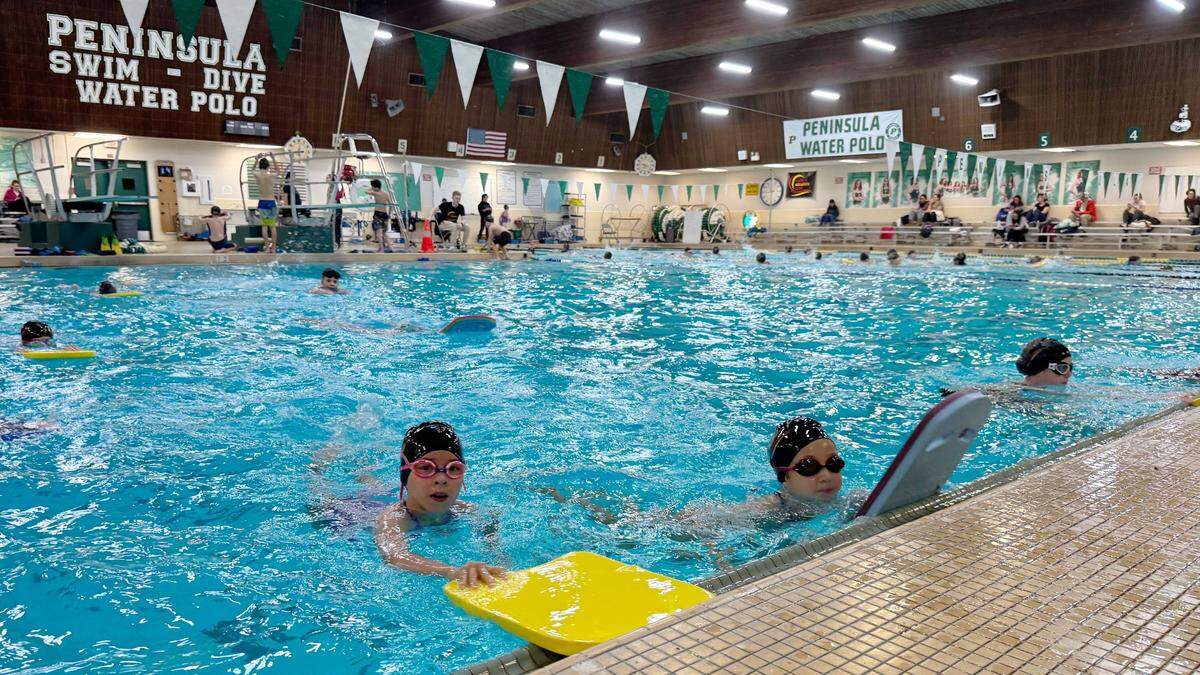
That limits the options for Harbor Aquatics Club, which doesn’t have its own facility. The club rents Peninsula High School’s indoor pool at 14105 Purdy Dr. NW for about 14 hours a week, according to Link: three hours each day Monday through Thursday, and two hours on Friday.
They also sometimes rent Gig Harbor High School’s pool for the same rate. Link said they prefer Peninsula’s pool because of its L-shape, which provides additional pool space for beginner swimmers outside of the regular six lanes.
While they’ve sometimes run practices at Canterwood Country Club’s outdoor pool, it’s too cold for the winter months, especially for younger kids who are still learning to swim and don’t know how to move as much in the water to keep warm, according to Link. The club has also used a few lanes at the YMCA in emergencies but can’t rely on space there, either.
“We have exhausted all the options in Gig Harbor,” Link said.
The two coaches said their dream is to build a pool of their own where they can offer swim lessons, lap swim, water aerobics, and continued swim team activities. They don’t yet have the funds for that, but Link said they’ve reached out to pool companies, realtors and banks to start looking at options.
Jensen-Bergren and Link aren’t alone in their vision for a new local aquatics facility. Two Gig Harbor moms, Heather Maher and Sarah Stancikas, began campaigning for a public pool in 2021 and co-founded a group called Swim Safe Gig Harbor, according to News Tribune archives. They emphasized the safety component of teaching kids how to swim in a city surrounded by water. A community pool could accommodate the demand for swim lessons in the Gig Harbor area, Maher told The News Tribune in 2021.
Jackman, the Gig Harbor-area mom of three involved in Harbor Aquatics Club, told The News Tribune she wants to be part of a solution to the issue of pool access.
The district cut their Aquatics Manager position because of budget constraints for the 2023-2024 school year. After that change, there was some confusion around who to contact with concerns with district pool conditions, such as chlorine levels or the temperature of the water, Jackman said. She thinks communication between the district and groups looking to rent the pools could be improved.
She emphasized that she and her family are grateful for all that the district does. They chose to move to Gig Harbor because of the school district, she said, and she wants to help the district work on creative solutions to manage their pools without negatively impacting small businesses like Harbor Aquatics Club.
With Narrows Swim Club no longer active, Harbor Aquatics Club is one of few options left for swimmers on the Gig Harbor side of the Tacoma Narrows Bridge.
“Swim lessons and access to pools is such an important thing right now,” Jackman said. “There’s a couple generations of kids right now that really don’t know how to swim . . . it would just be a tragedy for Gig Harbor to lose a swim team again.”