The Fish Bowl outgrew Roy Anderson Field. What would it take to build a new stadium?
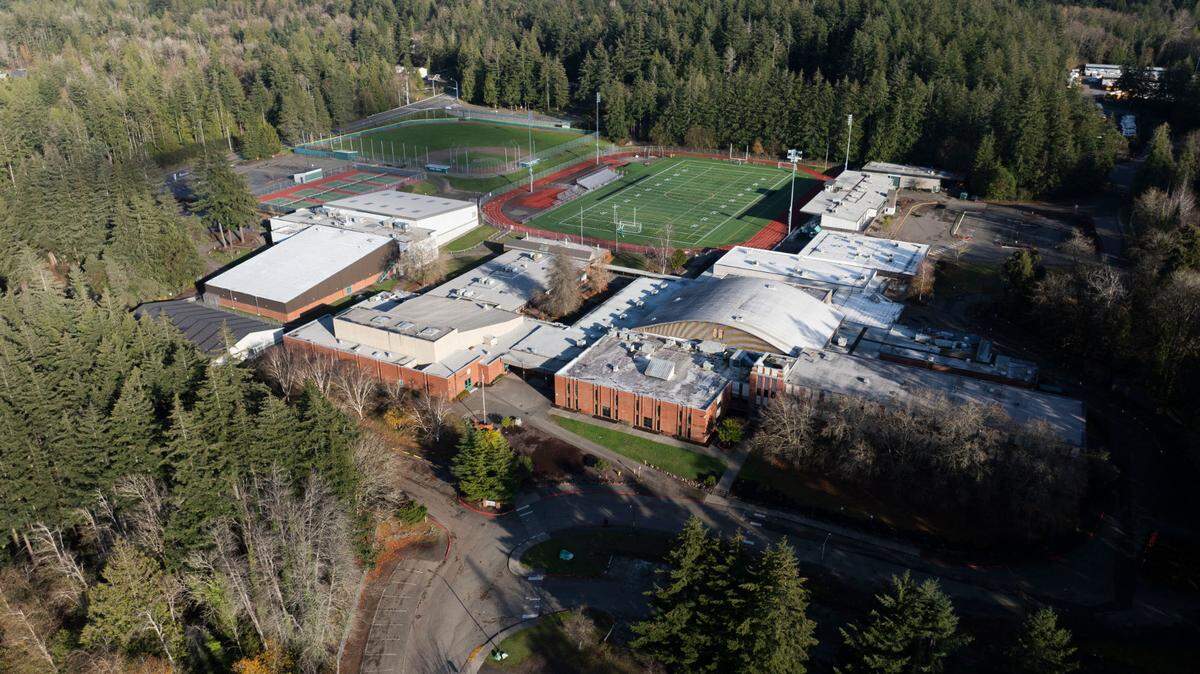
The rubbery smell of a red track and a synthetic turf field. Bleachers covered to protect fans from the rain. Plenty of parking, restrooms and seats for 5,000 roaring fans.
“That’s kind of the gold standard,” Peninsula School District school board member Jennifer Butler said about Mount Tahoma Stadium, which opened in 2004. “I mean, beautiful, beautiful stadium.”
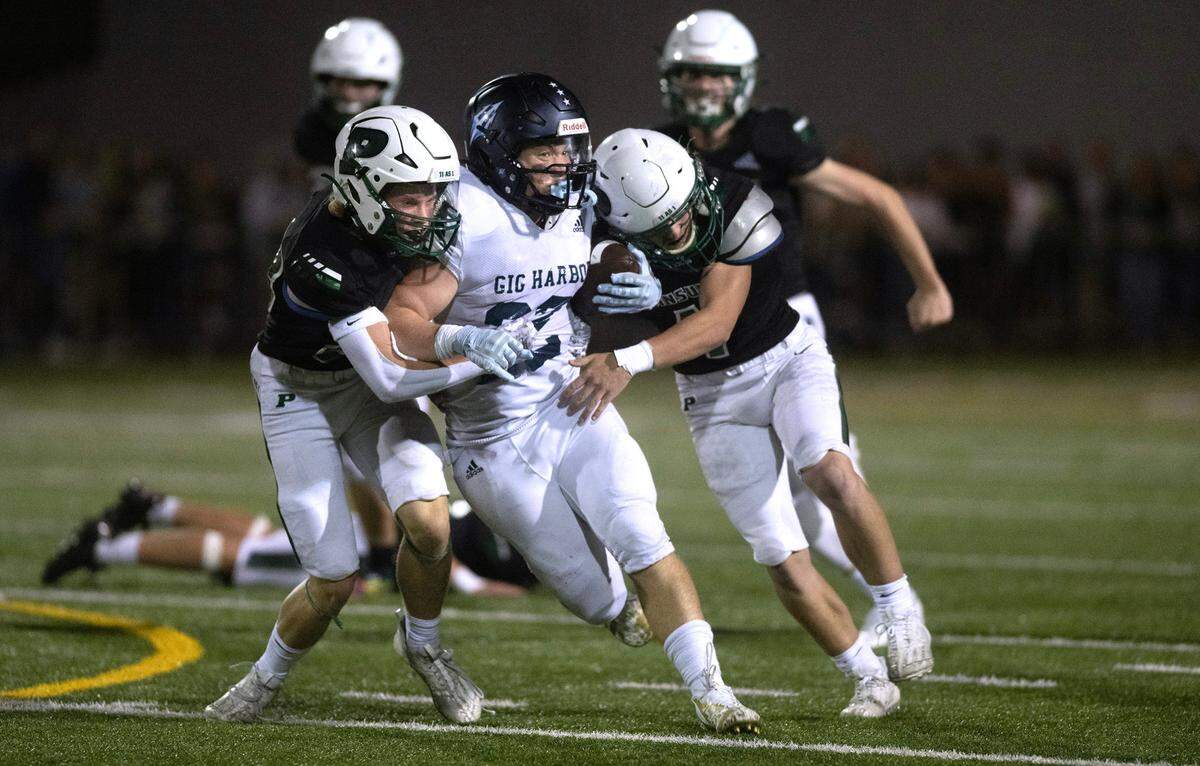
The district moved their annual Fish Bowl football game to the stadium in Tacoma last year, following struggles with crowds and security during the 2023 rivalry game. The game has historically been played at Roy Anderson Field at Peninsula High School.
At a meeting Sept. 10, Peninsula School District board president Natalie Wimberley hinted that new facilities, including a new stadium, could be a possibility.
“I think the event at Mount Tahoma was very well-run and so well-received by the community, and the wish is that we see something like that here,” she said in her comments near the end of the meeting. “. . . it’s probably time to have a conversation about what that means to get new buildings, to get new stadiums, to get facilities and bring it up to date, because our students deserve that.”
She also mentioned the district’s discussion of a land purchase agreement. The News Tribune reported that the district acquired about 20 acres of land in Purdy on Nov. 22 but hasn’t announced specific plans for it.
Could the district build a new stadium for future Fish Bowl games anytime soon? The district hasn’t released any public plans to build one, or to ask taxpayers to help fund one.
The News Tribune sat down with Butler, a professional architect who also serves as the board representative on the district’s Long Range Facilities Advisory Board, to ask what such a project would take.
A long process
How does the district decide to build something new? Can someone just come up with an idea and bring it to the district’s Long Range Facilities Advisory Board for review and further research?
Not quite. The district is required to update their capital facilities long-range plan annually, Butler said. That means the district has professional assessments done on all of their facilities each year to check how they’re doing in terms of their material condition, enrollment (for schools) and other aspects.
“Nothing kind of pops up out of the blue,” she said.
The Long Range Facilities Advisory Board provides a cross-section of the community to help review the district’s capital facilities plan. The school board approved this recruitment of community members via a resolution in February 2024, and applications were due in March, The News Tribune reported. Butler said a selection committee including the district’s capital facilities director and chief financial officer aimed to recruit a diverse group of parents, youth sports representatives, teachers, athletic directors, retirees and business owners to ensure a variety of voices were included on the advisory board.
Not only will the advisory board look at the current state of district facilities, but they’ll also spend time imagining what they could be.
Butler said the advisory board will take “field trips” to other schools to check out other “learning environments.” That’s important because most citizens and taxpayers haven’t been inside schools that their own students don’t attend. Even in their own students’ schools, they’re typically heading straight for the auditorium, stadium or gym and not exploring other parts of the facilities.
Those field trips aren’t scheduled yet, but Butler said they’ll happen this year. Most likely, the advisory board members will visit schools in this part of the state since they’re looking for schools in comparable construction markets. For example, building a school in Spokane is less expensive than building one in Puget Sound, so they won’t physically visit Spokane — though they’ll still look at some of the features that schools in other areas have, she said.
Butler said she doesn’t think the advisory board will do a stadium-only field trip, but that they’ll “certainly” see stadiums during their visits to different high schools.
The advisory board’s next step would be to present a list of recommendations to the school board, sharing what they see as the most important needs to be addressed in the district’s facilities. The district has to consider which of those priorities they can take on, factoring in considerations like cost, timeline and impact on students from the construction process, according to Butler.
The school board will discuss the list of recommendations, and could then pass a resolution to decide when to bring a construction bond to voters for approval.
A bond is the mechanism through which school districts pay for capital projects. It’s different from a levy, which is a short-term property tax school districts can propose to pay for educational programs and services not covered by the state.
Bonds aren’t taxes — they’re loans that the school district takes out from investors, and are repaid with property tax collections over time. While voters have to approve both for them to go into effect, bonds have a higher threshold, needing a 60% supermajority to pass. Levies require a simple majority.
It’s not clear how long the process could take from researching facilities to actually building a stadium. Asked for an idea of the time frame, Butler said via a text message Jan. 24 that “there are too many variables to predict.” She added that community support and partnerships with the City of Gig Harbor and Pierce County will be important for any future project to succeed.
For many districts in the state, it’s not easy to reach that 60%.
State Sen. Deb Krishnadasan of Gig Harbor recently sponsored a bill in Olympia that would lower the requirement to pass a school bond from 60% to 55%, according to a release on the Senate Democrats website. The release said that only 33% of school bond measures in the state passed in February 2021.
Changing the requirement requires a constitutional amendment. If the bill passes, voters would need to approve the amendment in the next general election in November 2025.
Lawmakers have introduced similar legislation in the past, including a bill that didn’t make it out of committee last year.
What’s stopping a new stadium?
Stadiums aren’t just big, they draw a lot of people. That means they have significant parking requirements and can strain traffic infrastructure, according to Butler.
A lot of new designs now try to locate stadiums in areas with existing parking lots, to help share that burden, she told The News Tribune.
Another challenge is finding the land for it. Large parcels of land are difficult to find in the area, and the way the district is geographically dispersed, the majority of students live on the Gig Harbor side as opposed to the Key Peninsula, Butler said.
“If you’ve ever driven across to the Key Peninsula, that Purdy Spit is a real traffic choke point,” she said. “So just we have a lot of unique traffic and geography and population distribution conditions that make a joint use stadium location something that we really have to carefully consider.”
A joint use stadium means that it would belong to both Gig Harbor and Peninsula high schools, since Gig Harbor doesn’t have its own stadium, she told The News Tribune. The advisory board would have to consider whether they’d want that, or if they’d want two projects: renovating the aging Roy Anderson Field and building a new stadium for Gig Harbor High.
(The district has a third high school, Henderson Bay, which doesn’t have its own athletics program.)
The original football field at Peninsula High opened with the school in 1947 and got a significant makeover with “bulldozers, shovels and trucks” in 1953, according to archives from The News Tribune and The Peninsula Gateway. Other improvements to Roy Anderson Field in recent years include fresh turf in 2017, The News Tribune reported, and new bleachers in 2012, according to The Kitsap Sun.
Butler said it’s “more standard” for each high school to have its own stadium, though that’s not the case in all districts: Shoreline School District’s joint use Shoreline Stadium is one example.
The district recently acquired 20.42 acres of land in Purdy. Butler previously told The News Tribune that the district would like “all options on the table” when asked if a new stadium could be built there.
The cost of a new stadium is another major challenge.
Butler said she doesn’t know offhand what the cost of building a new stadium would be, but she does know that passing a bond of that size could be difficult.
The district passed a $198.55 million bond in 2019 mainly to address their overcrowded elementary schools, The News Tribune reported. Butler said that was the first time the district was able to pass a bond in almost 20 years.
The new Memorial Stadium at Federal Way High School cost $23 million to build, the Daily Journal of Commerce reported in 2023.
Baseball team affected by the move to Mount Tahoma
A new stadium in the district could impact more than just football teams.
The Peninsula High School baseball team has been selling concessions at the Fish Bowl game for at least eight years, according to Lisa Jahn, president of the team’s booster club. During last September’s Fish Bowl game, the district denied the booster club’s request to sell at Mount Tahoma.
“Not having that this year, it really cost us,” Jahn said in a phone call Nov. 22.
She joined the booster club four years ago, and her son is now a senior on the team. Selling concessions “has always been (their) biggest fundraiser,” she said.
The team usually makes between $8,000 to $11,000 from selling concessions at Fish Bowl games when Peninsula High is the home team. They make significantly less when Peninsula High is the visiting team, usually earning around $2,000 to $4,000 selling swag, beverages, candy and uncooked items.
The agreement at Roy Anderson Field was that the home team gets to use the concession stand, and the visiting team can sell cold, uncooked items under a tent on the visitor side during Fish Bowl, according to Jahn. The team also sold parking spots for $20/spot near Purdy Veterinary Hospital for past Fish Bowl games, bringing in roughly another $1,020 in both home and away years, she said.
The PHS Seahawks were the away team at the September 2024 Fish Bowl, according to the team’s game schedule.
Jahn said in a second phone call Thursday that the team hasn’t yet recouped their losses from losing the ability to sell concessions at that game. She hopes that they’ll be able to get close to the $3,000 to $4,000 they would have made through other fundraising, but the season is only two months and the window to get the players involved in fundraising is short.
Their other fundraising efforts include doing takeovers at local restaurants, running camps for local Little Leagues and — new this school year — selling sign space to local businesses to put their logo and information on fences around Peninsula High School. They’ve only sold two spaces so far, she told The News Tribune Jan. 23.
Fundraising has been increasingly difficult in the last few years as the team faces competition from the district’s many other schools and programs turning to parents for donations, she said.
The district helps pay for some expenses, but the team relies on their booster funds to buy items like hats, equipment and swag, according to Jahn.
Despite the loss of concessions, the move to Mount Tahoma seemed like a good thing, Peninsula High junior and varsity baseball player John Browand told The News Tribune. He attended the 2024 Fish Bowl and said it seemed everyone was able to connect with the game “without being smashed or stepped on.” It felt less claustrophobic, and “parking was way better,” he said. He expressed more of his opinions in a piece for Key Peninsula News in October.
Mount Tahoma Stadium seats 5,000 people and has covered stands on both sides of the field, locker rooms for both teams and adequate parking and restrooms, according to a district news release Feb. 22.
Jahn said the ideal would be to have a new stadium to bring the Fish Bowl back to the Gig Harbor area.
“It’s going to lose the history and that sense of community when it’s out of town,” she said.
A field for the community
School board member Butler told The News Tribune that the stadium also comes up in the context of local youth sports. The need for more lit, turf fields has been an issue in the Gig Harbor area for years, The News Tribune reported.
Gig Harbor-based Harbor Soccer Club hosts a regional tournament called the Tyee Cup each August. There were 177 teams that played in the 2023 tournament — 142 of them from other soccer clubs — and over 10,000 people visited the Gig Harbor area for the weekend, according to a Facebook post from the Gig Harbor Peninsula Youth Sports Coalition.
The club has had to host some of their games in Tacoma in recent years because there aren’t enough fields in the Gig Harbor area to meet the demand, and they’re considering whether they’ll have to move the full tournament across the Narrows Bridge in the future, according to the post.
“To solve this problem, we need additional lit turf fields to provide adequate space for hosting the current teams, with the ability to grow registration numbers in the future,” the post said. “Having more fields will also encourage better economic outcomes for our local retailers, coffee shops, and restaurants, with all venues on this side of the bridge (not to mention tax revenue for the city).”
A new district stadium, if built, could serve other community groups like Harbor Soccer Club as well as district athletes, Butler said.
Editor’s note: This story has been updated with information about when Roy Anderson Field opened and its recent improvements.
This story was originally published January 27, 2025 at 2:26 PM.