
Is this Pierce County school district’s free speech policy unusually strict?
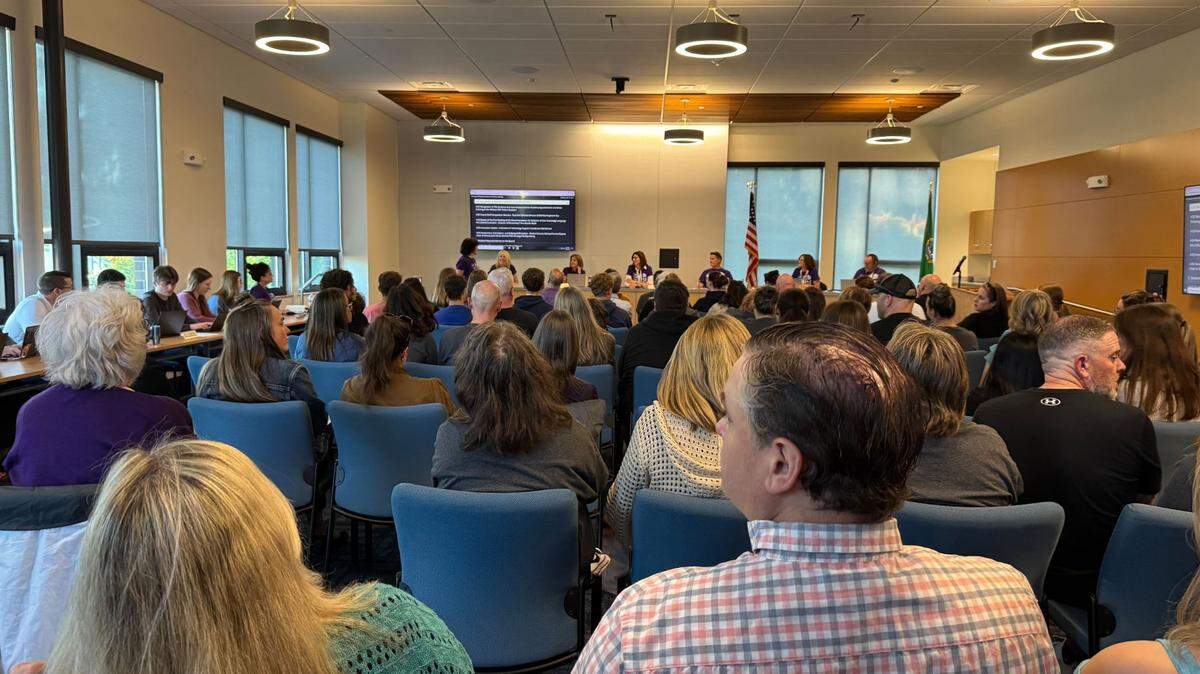
A new policy regulating teachers’ free speech, including outside of school, came under scrutiny during public comment at a recent board meeting in the Peninsula School District.
At the April 22 PSD board meeting, Minter Creek Elementary Parent-Teacher Association secretary Heather Bruhn said the staff expression policy adopted six months ago “has created a culture of fear” in the district, adding that the PTA had spoken to teachers who felt silenced from speaking about upcoming principal and assistant principal changes across many of its schools out of fear of losing their jobs.
“Staff should not have to choose between job security and their voice,” Bruhn said at the meeting. “This fear is stifling honest conversation around the topic of principal rotation and undermines the collaborative environment we all strive to maintain.”
In October 2024, the PSD School Board of Directors adopted Policy 5254. Titled “Staff Expression,” the policy broadly limits “employee expression that has an adverse impact on district operations” at the board’s discretion, declaring that such behavior may lead to disciplinary action up to termination.
The policy also states that “employees who use social media platforms are encouraged to remember that the school community may not be able to separate employees as private citizens from their role within the district.”
The News Tribune researched similar policies across Washington state to see how the Peninsula policy compares.
Christine Geary, director of policy and legal services with the Washington State School Directors’ Association, told The News Tribune in a phone call that WSSDA creates model policies for local school boards to adopt or adjust as they see fit. WSSDA has no regulatory authority and does not require districts to take on certain policies, Geary said, adding that the models offer law-based and legally-defensible templates for policies school districts can use as necessary.
“‘Staff Expression’ 5254 is considered an optional policy,” Geary said. “It’s there because districts had a need for it, we were contacted, and so we created this policy. Districts are not required to take it in any way.”
Geary also shared a copy of the WSSDA “Staff Expression” model policy — which was published in April 2023 — with The Tribune, which showed PSD’s Policy 5254 is adopted verbatim from that document.
The News Tribune reached out to each elected PSD school board member, Superintendent Krestin Bahr, and PSD spokesperson Jake Voss for comment; Voss responded. Voss told The News Tribune in an email that Policy 5254 is fully supported and adopted by the PSD board. Voss also provided The Tribune with a list of 29 other school districts that had also adopted the WSSDA model policy as of September 2024, and said via email that the policy is commonly adopted across school boards in Washington state and not unique to PSD.
An April 2023 issue of WSSDA’s Policy & Legal News also explains: “The overall goal of 5254 – Staff Expression is to provide staff with notice of district expectations regarding staff speech.... The new policy and procedure focus on employee speech that occurs as a result of the employee’s employment with the school district.”
The policy also aims to ground preexisting school district policies as a reference point, WSSDA wrote.
“By incorporating existing model policy and procedure by reference, we avoid needing an exhaustive list of permitted and nonpermitted speech, and ensure that implementing this policy will not conflict with your preexisting policies and procedures,” WSSDA wrote in the article.
Katie Hannig, a spokesperson for the Washington Office of Superintendent of Public Instruction, told The Tribune in an email that, although OSPI does not have a specific requirement or guideline for school boards to adopt expression policies, PSD’s staff expression policy appears consistent with WSSDA’s model staff expression policy.
In the email, Hannig shared an OSPI bulletin sent out to school district leadership in September 2024.
The bulletin reminds that “if the school district can show that the speech could adversely affect the school’s ability to function or the teacher’s effectiveness, the First Amendment may not provide protection regardless of when or where the speech took place.” Further, it states that staff’s private speech may not be protected under the First Amendment if it pertains to “students, schools, or other work-related matters, or engage(s) in conduct that might be considered impairing them as an educator” or “creates a hostile environment at school.”
Julie Popper, a spokesperson for the Washington Education Association — the largest union representing public school employees in the state — told The News Tribune in an email that Pierce County’s school districts typically have guidelines on staff expression but that it “rarely goes as far as the Peninsula one does.”
In Pierce County, the Tacoma School District’s policy on social media and electronic communication, which was last revised in 2015, states that “District employees are reminded that they remain subject to all District Policies and Regulations” while using private social media accounts — including their employee conduct policy — but does not mention an “adverse impact on district operations” as a reason for disciplinary action.
Pierce County’s Clover Park School District adopted their 2023 staff expression policy verbatim from the WSSDA model; like PSD’s policy, it states that “the school community may not be able to separate employees as private citizens from their role within the district” and “expression on social media platforms that interferes with the district’s operations … may be subject to discipline up to and including termination.”
To the north in Snohomish County, Lakewood School District’s staff expression policy was also adopted in 2023 nearly verbatim from the WSSDA model, stating: “employee expression that has an adverse impact on district operations and/or negatively impacts an employee’s ability to perform their job for the district may still result in disciplinary action up to and including termination.”
The Puyallup School District’s freedom of expression policy, which was last revised in 2021, has a similar standard. It says that: “Speech that creates a real or foreseeable disruption of district operations, or a violation of the district’s non-discrimination policy, is subject to restriction.”
Popper also pointed The News Tribune to the Washington American Civil Liberties Union’s guidelines for Washington teachers’ free speech rights. The ACLU writes that speech inside the classroom is considered as communication on behalf of the district and is not entitled to First Amendment protection. Further, the ACLU states that “certain types of speech outside the school might also not be protected if the school can show that (a teacher’s) speech created a substantial adverse impact on school functioning or that (their) speech was made in accordance with (their) job duties.”
“In general, if you use social media in your private capacity to express your beliefs on a matter of public concern, you may be protected,” the ACLU writes about teachers’ free speech rights. “However, if you use social media to comment about students, school or other work-related matters … the First Amendment may not protect you.”
The Peninsula School Board voted unanimously to adopt the staff expression policy during the Oct. 15 board meeting, other than board member Lori Glover, who was not at the Oct. 15 meeting. The policy drew criticism from teachers and residents during public comment.
Jonathan Bill, a retired Peninsula High School teacher, said at the meeting that the policy should be able to separate teachers’ work and their lives as private citizens.
“We have rights as individual citizens — this takes me right back to the moral turpitude clauses that they had young female teachers sign in the 19th century as a condition of employment, and we’ve come full circle of that,” he said to the board.
Ben Pinneo, a Peninsula High School teacher, said at the meeting that the policy appeared to be a vague, catch-all policy that could unnecessarily penalize PSD staff for private activities such as attending LGBT events, political rallies or drinking alcoholic beverages at local sports games. Pinneo also questioned who would have the power to interpret and decide what constitutes an “adverse impact on district operations” as mentioned in the policy.
“Language in this policy is so broad, so vague, that it could be used to bully, threaten and intimidate PSD staff,” he said at the meeting.
PSD spokesperson Voss did not directly respond to The News Tribune’s emailed question on April 30 about whether any staff members have been disciplined for violating the policy since it was adopted in October.
When asked via email whether any teachers across Washington state had been disciplined as a result of Policy 5254, WEA spokesperson Popper told The News Tribune on April 30 that she would look into the matter, but believes the issue was more prevalent during remote learning from 2020 to 2021.
This story was originally published May 1, 2025 at 1:44 PM.