Welcome to ‘The Nest.’ Pierce County nonprofit turns garage into community hub
AI-generated summary reviewed by our newsroom.
- Pierce County co-op transformed a 1,600 sq. ft. garage into a community hub.
- The Nest hosts classes, socials, and garden work for more than 365 members.
- Mutual-aid system trades volunteered hours for services without monetary cost.
Jess Almeida knew she couldn’t do it alone.
The daughter of an antique shop owner, Almeida inherited a large collection of items from her father after his death — boxes upon boxes that sat in her garage, collecting dust. An ex-boyfriend who used to live with her left behind his stuff, too. In all, the garage “basically housed about 20 years of my life,” she said.
She would lie in bed and think about how she wanted to turn it into a community space for creatives, being a potter herself, but the task seemed both impossible and emotionally painful, rummaging through items from her past.
When a few women from the Gig Harbor Women’s Co-op came over to help her clean her home pottery studio, she wasn’t planning to show them the garage. But she changed her mind.
“Oh, you can’t do this by yourself,” Almeida recalled one woman saying after they walked inside.
“And it was just that release, that confirmation that I can’t do this by myself,” Almeida said. “It was way too much.”
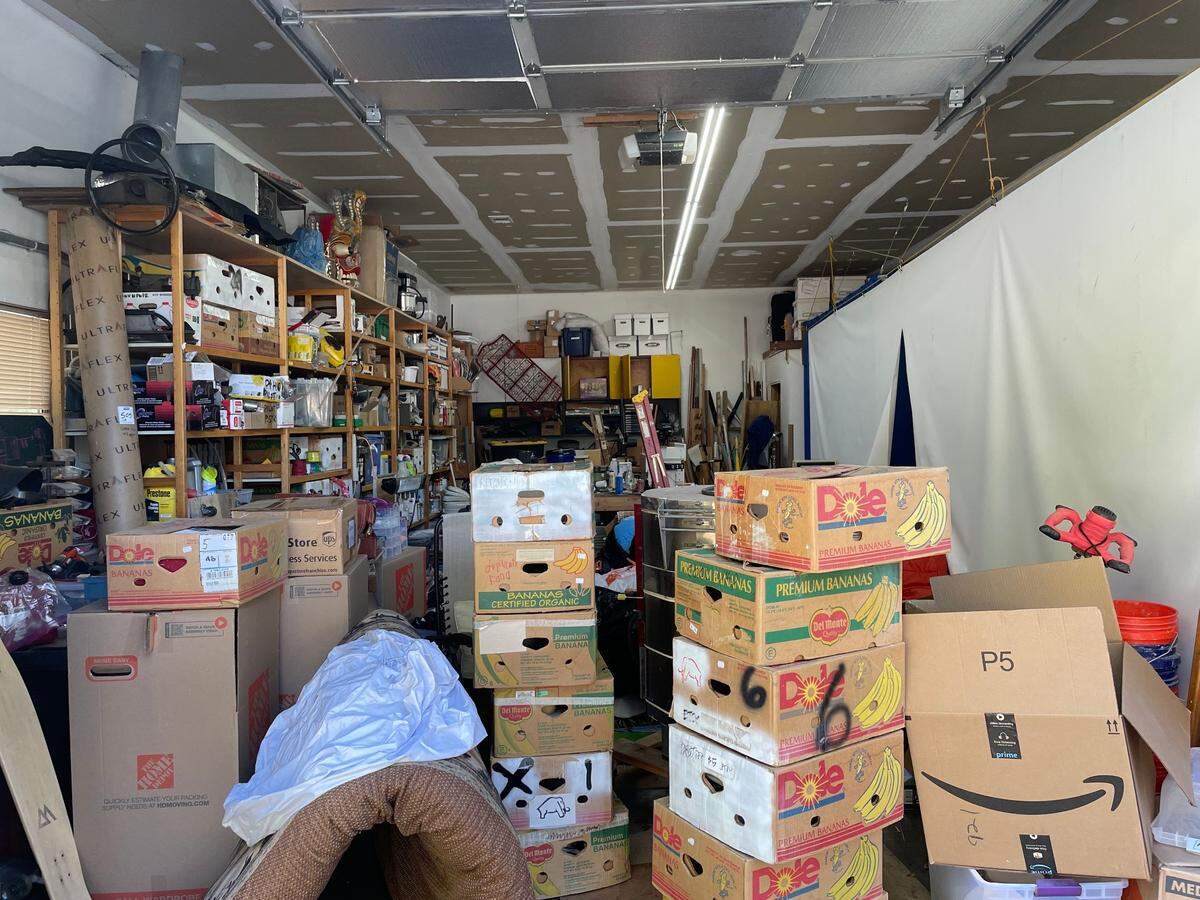
Beginning around September 2024, Almeida and some 20 other women went through her garage, clearing things out, selling as much as they could and taking other things to the dump. They also cleared part of her yard to plant a community garden. In all, the volunteers put in over 1,000 hours of work, she said.
Now, Almeida’s 1600-square-foot garage at 3906 160th St. NW is called The Nest, a dedicated community space she’s leasing to the Gig Harbor Women’s Co-op for $12 each year. The co-op provides the insurance and maintenance. The Nest held its grand opening June 22 and will host a variety of meetings, workshops and socials for co-op members and participants. It’s the nonprofit’s first physical space.
With its concrete floor, colorful wall art and refrigerator in the corner, along with four pottery kilns, a kids’ play area with a sofa, and a small office in the back, the space feels casual, inviting, and, well, a bit messy.
Speaking about the kids’ play area, which has a chalkboard-like surface on the floor and partway up the walls that kids can draw on, O’Block said adults should be able to be creative and messy in the rest of the space, too.
“ ... we’re not about perfection,” Jillian O’Block, the co-op’s founder, CEO and president, said. “That’s our big thing. We do not want things to be perfect. We want people to feel free to create in here and to let go of that sense of perfection that women have placed on them(selves).”
O’Block founded the group as the Gig Harbor Cleaning Co-op in September 2023, the co-op website says. As a mom, she felt overwhelmed taking care of her four kids while managing the house and work. She wanted to help other moms who were also struggling and formed the co-op to help moms in the Peninsula School District assist each other with cleaning.
The group, which O’Block said originally included 17 women, soon began to grow. More women expressed interest in joining, including those who weren’t moms, and they also began exchanging services besides cleaning, the website says. The organization achieved nonprofit 501(c)(3) status in May 2024.
Alicia Grubbs, the co-op’s chief community officer, told The News Tribune they estimate they now have about 365 fully-onboarded members. Many more engage with the co-op through their private Facebook group, which had some 1,400 members as of July 3. Kim Anderson, the co-op’s executive vice president, said the ages of women who participate in the co-op range from 18 to 99 years old.
The Nest is ‘a safe space’
On one wall of The Nest, a calendar of events shows what The Nest has lined up for July. The list includes an ice cream social on July 13, a quilting session for troops on July 17 and a mah jong game night on July 21. They’re also planning to have pottery making and painting at The Nest, O’Block said.
Anderson said they’re working on organizing a tool library at The Nest where people can share machinery like a lawn mower or a pressure washer. Outside, people can come work in the community garden, which the co-op started from seed and already has Brussels sprouts, onions, tomatoes, chard, flowers, herbs, celery, strawberries, cucumbers and squash, O’Block said.
Diana Olsen, the co-op’s public relations manager, said the co-op previously had meetings in places like coffee shops or people’s houses. Though members will still meet out in the community, she said The Nest provides “a safe space” and opens up opportunities for people like herself, as she rents a small apartment that makes it difficult to invite people over.
The Nest is “a safe space,” Olsen said. “Nobody has to open up their home, nobody has to worry about are the dishes done. It’s a place that everybody can meet.”
The Gig Harbor area isn’t lacking for community-oriented groups and organizations, between the school district, parks districts, local Rotary club, Kiwanis club, the food bank and others. Co-op leaders said their group is unique for both their system of giving and receiving help and their holistic approach to supporting women.
Anderson, the executive vice president, described what they do to support women as like “a stopgap preventative.”
She gave an example: One co-op member was going though a difficult divorce and had to leave her home with virtually nothing. Co-op members came alongside her to help with child care, errands, meals and other needs while she went back to school so she could find a job, Anderson said.
“It’s that safety net that keeps people from falling into the abyss, right,” Anderson said. “Just a little helping hand.”
Though the co-op doesn’t provide crisis relief, they do refer people to other nonprofits that can provide that, O’Block said.
Exchanging services
Members exchange services through a time banking system, leaders told The News Tribune. Anderson said they want to “combat the notion that everything is monetized in the world.” The way it works is simple: If you volunteer an hour to babysit another member’s kids, clean their garage, paint a room in their house, or do some other task, you get an hour of time credited to you. That time counts for one hour of help you can receive from someone else.
Every person’s time is valued equally, and that also makes it easier to ask for help, O’Block said.
“Asking for help — it should not come from a place of ‘I’ve hit rock bottom, and now I need to ask for help,’” she said. “Asking for help should just be a normal thing that we do.”
“So it’s not about like, ‘I’m poor and I don’t have the money to pay somebody to do this. I need all these people to come do it for free.’ That’s not what this is. This is about (how) every single one of us needs help with something, and we don’t have to pay people to do it. We can help each other. And when we help each other, that creates very lasting relationships with people.”
Everything in the co-op is offered for free, leaders told The News Tribune. There are no membership fees, and no cost to participate in activities.
Anderson said the funding for their operating costs, which add up to a couple thousand dollars a month, come from donations they’ve raised through grassroots campaigns like GoFundMe pages and events like their grand opening, where they held a raffle. They’re currently applying for grants and looking for additional donors, she said.
To join the co-op as an onboarded member and participate in its time bank system, you’re required to attend a one-hour orientation and undergo a background check. More information is available on the co-op website at gigharborwc.org.
You don’t have to be a member to start attending events or join the private Facebook group. The group is open to all women who live or work in Gig Harbor and the surrounding areas, per the website.