Will controversial salmon hatchery be cut from Pierce County culvert project?
Fixing culverts — pipes or tunnels that allow streams of water to pass under a road, highway or railway — is expected to cost the city of Gig Harbor millions.
Culverts are known fish barriers in much of Washington state. When built or designed improperly, these pipes can block or hinder fish from swimming through streams on their way to spawning grounds and other habitat. Restoring these passageways can mean removing or redesigning culverts to allow fish to cross without issues.
As the city seeks to remove a culvert near Donkey Creek Park, staff are recommending a way to shorten the project timeline and cut costs.
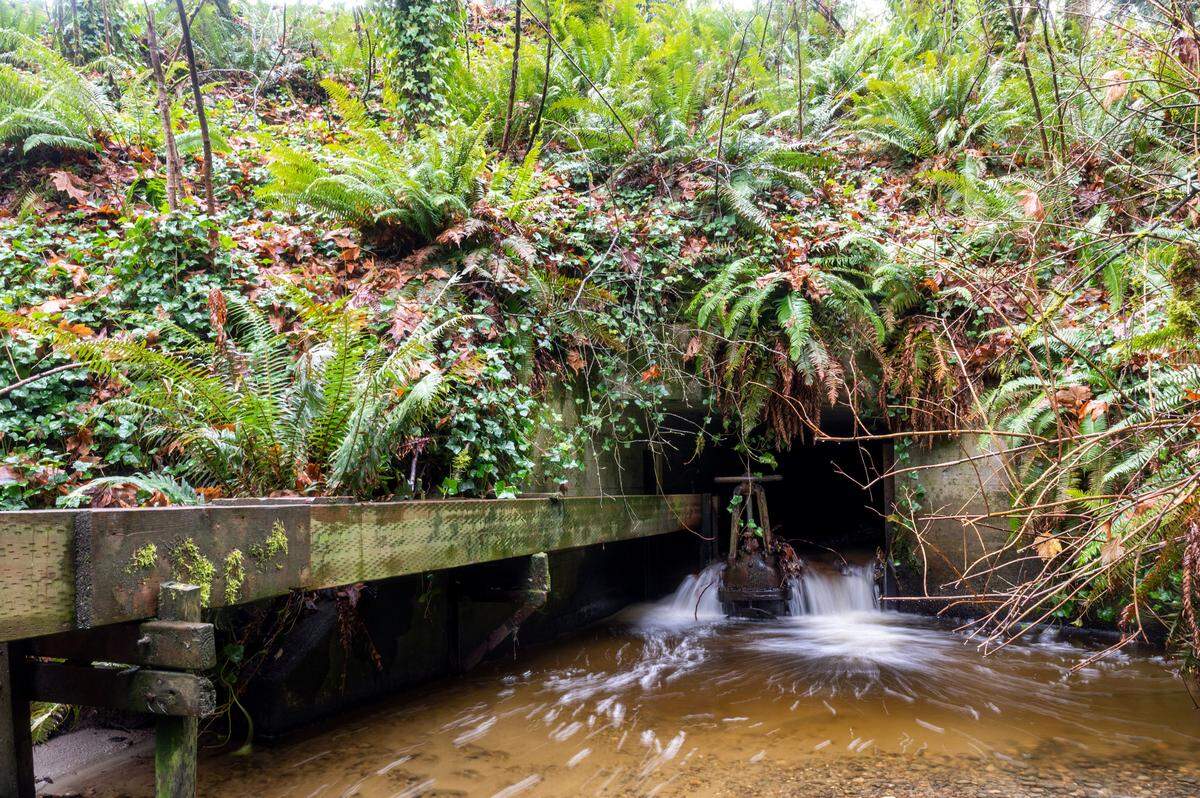
The North Creek culvert crosses North Creek (often known as Donkey Creek) underneath Harborview Drive. It’s one of three culverts in the creek the city has identified for removal, according to a city webpage about the project. The city removed one of these culverts around 2012 and built an 80-foot pedestrian bridge on North Harborview Drive, The News Tribune reported.
Removing the North Creek culvert is tricky because it’s connected to a fish hatchery. This hatchery, made up of a series of plastic barrels, was installed in 1971 by the Gig Harbor Commercial Fishermen’s Civic Club and allows baby salmon to hatch from their eggs in a protected environment before they’re released into the creek. In a study session last October, the Gig Harbor City Council directed staff to look further into alternatives for the hatchery if the culvert is removed.
Gig Harbor Public Works Director Jeff Langhelm and Senior Engineer Steven Demmer provided an update to the council at a study session May 14. City staff recommend removing the North Creek culvert but postponing a decision on potential options for the hatchery. This will ensure the city remains eligible for grant funding and avoids permitting delays, according to the city’s agenda bill.
Tom Lovrovich, a board member for the Commercial Fishermen’s Civic Club, told The News Tribune in a phone call before the May 14 meeting that the club would like to see the incubators continued and that the update is “putting everything in jeopardy.” He has been helping incubate fish there since he was a kid.
“The community benefits from it and people love to see fish return to the stream,” he said.
Lovrovich also questioned whether removing the culvert would bring back the number of salmon that people expect. There’s a lot of runoff from upstream development into the stream, and he said he doesn’t think the creek is an “ideal spawning ground for wild salmon.”
The city’s National Pollutant Discharge Elimination System coordinator, Michael Abboud, told The News Tribune in an email that there are several factors that make it likely fish will return to North Creek after the culvert is removed. The stream has a history of supporting coho, chum, steelhead and sea run cutthroat, and removing the culvert will allow fish to access protected habitat, he wrote.
“After removal, the newly accessible habitat is considered high quality for rearing and spawning due to streambed characteristics, dense vegetation, and topography,” he wrote.
Background on North Creek culvert replacement project
The city of Gig Harbor began looking to remove the culvert in North Creek in 2021. The culvert is a concrete tunnel that’s 146 feet long, covered by some 22 feet of soil, according to a feasibility study prepared in 2023.
Water pours through the tunnel and requires fish to jump about a foot to make it into the culvert, then swim about 60 to 70 feet upstream to make it to the other side, The News Tribune reported.
The hatchery is made up of Remote Site Incubators, or RSIs. The culvert diverts water to a settlement pond where sediment is washed out, then into the plastic barrels where the salmon eggs are hatched, as explained in a video from Harbor WildWatch. The Gig Harbor Commercial Civic Fishermen’s Club has a water right to divert 0.25 cubic feet of water per second to the incubators, Gig Harbor Senior Engineer Demmer said at the May 14 study session.
In the past, the Fishermen’s Civic Club received about 1 million eggs a year from Minter Creek Fish Hatchery for the incubators. But outbreaks of a virus called infectious haematopoietic necrosis (IHN) have set back their efforts in recent years.
In 2018, the club was told that the Minter Creek Fish Hatchery wouldn’t be able to provide eggs for three years because of the disease, according to Rahna Lovrovich, wife of Tom Lovrovich and another longtime supporter of the incubators. The club received another set of eggs in 2022 but an IHN outbreak in the fall of 2023 led to another three-year quarantine, she wrote in an email. They hope to get eggs as soon as later this year.
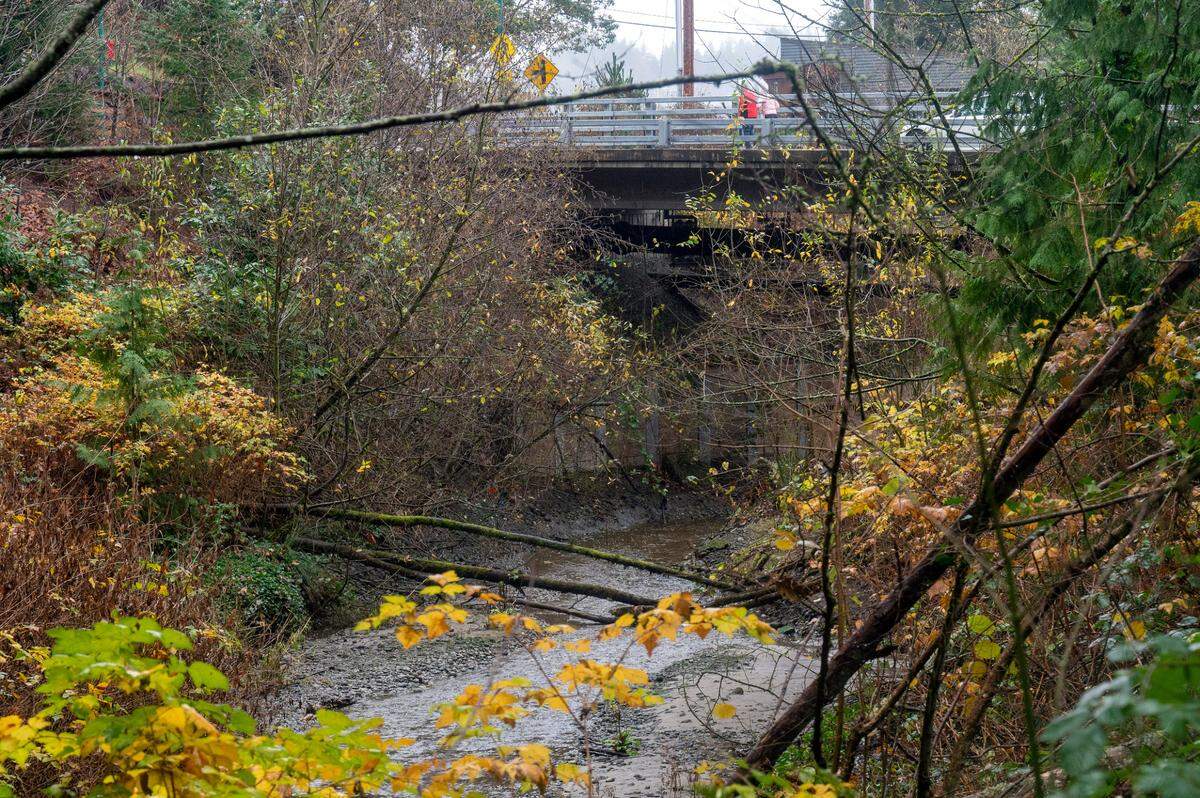
Rahna Lovrovich told The News Tribune she’s concerned that removing the culvert won’t be worth the cost to the city because of other barriers upstream.
The city is aware of the other barriers, Gig Harbor Public Works Director Langhelm wrote in an email.
“The city removed one of the barriers along Donkey Creek with the recently completed culvert replacement project along Burnham Drive,” he wrote. “Also, the expanse of the city’s conservation properties provide high quality habitat that will be valuable to future fish propagation until such time that other barriers are removed.”
After removing the North Creek culvert, the city plans to build a concrete bridge, 140 feet long, allowing the creek to flow freely underneath. The city will also do stream restoration work and extend an existing trail through Donkey Creek Park, Demmer said.
Design and permitting is costing the city about $1.65 million, according to the Gig Harbor Capital Improvement Projects website. That includes $1.3 million from the city’s Storm Capital fund and $350,000 from a grant. The city anticipates spending an additional $9 million on construction, with about half of that coming from city funds. Full funding for the project will likely depend on grant support, Demmer told the council.
The state has done significant work to fix state-owned culverts, after Washington tribes with treaty-protected fishing rights sued the state to restore salmon habitat blocked by culverts in 2001, The News Tribune reported. The U.S. Supreme Court later ruled the state needed to address the most serious fish barriers by 2030.
Cities are not yet required by law to fix their own culverts, Public Works Director Langhelm told the city council.
But that may not always be the case, the Association of Washington Cities wrote in a post on their website in 2018. “There’s wide belief that the resolution of this (court) case could ultimately point the way for the treatment of city- and county-owned culverts,” the AWC wrote.
City discusses postponing decision on hatchery
City staff met with the Commercial Fishermen’s Civic Club last November, and discussed possible alternatives to the RSIs, Demmer said in his presentation to the city council May 14. One idea was to create an “acclimation pond” in the city’s conservation area near the creek, to give salmon a place to get used to the water in the creek before being released. Another idea was to install a new RSI at the creek, smaller than the existing one.
Demmer said in his presentation that pursuing either the acclimation pond or a new RSI could add months to the project timeline, disqualify the project from some state and federal permits and require an additional $1 million to $2 million on top of project costs.
Instead, city staff recommend that the city separate the RSI project from the culvert project for now, he said.
The majority of council members supported that recommendation at the study session May 14, though several expressed appreciation for the commercial fishermen and wanted to continue the discussion about RSIs in the future.
“I think this is a really tough conversation,” council member Emily Stone said at the meeting. “There’s a lot of history and legacy, and I really appreciate council member (Le) Rodenberg’s comments and advocacy for trying to find a path.”
She added that if the majority of the council wants to move forward with separating the culvert and RSI projects, she’d like the city to be “deliberate and proactive about trying to find a path for feasibility for the RSIs.”
Council member Rodenberg questioned the consultant’s report during the council’s discussion and whether the commercial fishermen had had enough input about the RSI considerations. He advocated for the city to pause the culvert project entirely, given that the city isn’t required to remove it.
“I suggest that we don’t do the project at all,” he said. “We save the $9 million, we don’t use the staff time. The $9 million could be devoted to other things that are more important in the city than a fish culvert, which, incidentally, does not block those fish. Anybody who’s been down there at a high tide can see these fish going right through that culvert.”
Now that they have the support of the council majority, city staff will proceed with the culvert project and postpone a decision on alternatives for the hatchery, Public Works Director Langhelm said to The News Tribune after the study session. Staff plan to propose a feasibility study to look into RSI options during the 2027-2028 budget cycle, subject to approval by the mayor and city council.
In the meantime, the city and its consultant will continue working on design, permitting and grant applications for the culvert project, Langhelm wrote in an email Tuesday.
Two of those grants are pending. The city applied for a $4 million grant from the Federal Highway Administration in 2024, according to the city’s website. Abboud, the city’s National Pollutant Discharge Elimination System coordinator, wrote in an email that the decisions from the 2024 cycle were never published and that the Federal Highway Administration plans to combine the 2024 cycle with the 2026 cycle that ends this fall.
“The city will likely need to reapply,” he wrote. “Unsure when to expect a decision.”
The city also applied for a grant from the Washington Recreation and Conservation Office, subject to funding in the state Legislature’s 2027-2029 biennial budget. If awarded, those funds will be available July 1, 2027, Abboud wrote. A city resolution says the grant was for $2.5 million.
This story was originally published May 20, 2026 at 5:00 AM.