
After losing husband to cancer, Gig Harbor resident O'Hare found strength through dragon boat
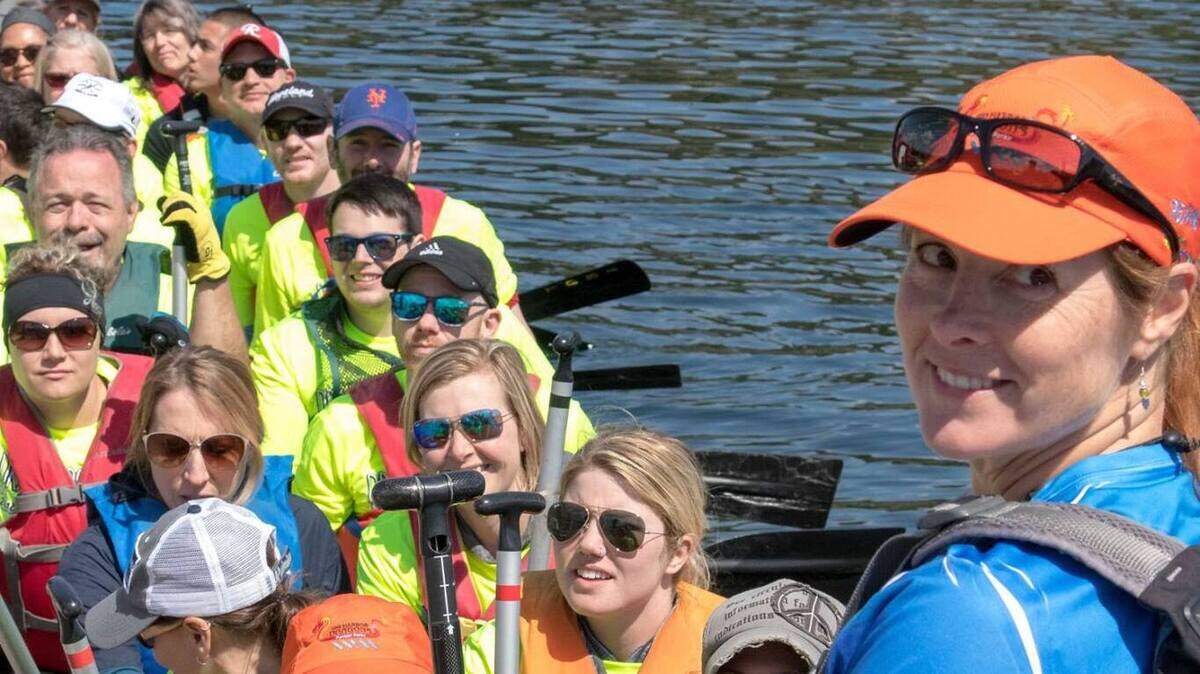
Jen O’Hare’s husband, Jeff, had just died after a lengthy battle with cancer when one of her friends asked her if she wanted to paddle a dragon boat at the Gig Harbor Paddlers Cup.
It had only been five days since Jeff had passed in April 2017. O’Hare didn’t feel like she had the energy to paddle, much less leave the house, or socialize.
“I was so incredibly sad,” she said. “I didn’t know if I could handle the energy of being around all the time. I just wanted quiet. I hadn’t had quiet in a long time. In a way, I was intimidated by the noise and the people.”
But she went.
“The moment my paddle hit the water, I started to feel more hopeful and alive than I had in months,” O’Hare said.
So the Gig Harbor resident stayed on the water all day.
“It was so energizing to me,” O’Hare said. “Pretty much on the spot, I joined the dragon boat team.”
Now, she paddles with the Gig Harbor Dragon Boat team four days a week. She’s one of the team’s coaches. She travels with the team and is on the Washington Masters competitive team, which draws paddlers from Seattle, Whidbey Island and the greater Puget Sound area.
She purchased a dragon boat and donated it to the team. And at the annual Paddlers Cup at Skansie Park, O’Hare has shared her experience and honored cancer survivors, those who have passed away from cancer and cancer caretakers.
A LONG BATTLE
O’Hare met Jeff, a former U.S. Marine, working at a technology startup in Chicago. It was not love at first sight.
“I thought he was an ass,” O’Hare said, with a laugh.
But once they started working together more, things changed.
“I realized we had a great connection,” she said.
They moved to Denver, Colorado and got married in 2004. Then they moved to Omaha, Nebraska. Then Las Vegas. Then San Francisco. And finally, Gig Harbor, in 2013.
Jeff was diagnosed with head and neck cancer in 2006, but the cancer went into remission.
“We thought we were kind of in the clear,” O’Hare said.
But nine years later, Jeff received another diagnosis: Prostate cancer.
“You never want to hear the words, ‘You have cancer,’” O’Hare said. “You definitely don’t want to hear them twice.”
The cancer quickly got worse.
“Jeff went from being able to walk, to using a walker, to using a wheelchair,” O’Hare said.
One day, Jeff received some bad scan results.
“I was so angry,” O’Hare said. “I was crying. He took my hand and said, ‘You cannot fix this, stop trying,’ He was right.”
At a certain point, they knew Jeff was terminal. He died April 4, 2017.
RECOGNIZING CAREGIVERS
Cancer took her husband’s life, and it took an emotional and mental toll on O’Hare.
Caring for Jeff while he was sick. Driving him to Seattle for treatment. Advocating for his care. Minimizing his pain. Making sure he was getting enough nutrition. Cooking his meals. Planning his funeral with him.
“The word 'hard' doesn’t even begin to describe it,” O’Hare said. “You feel very helpless. You’re seeing your loved one go through something you can’t control.”
O’Hare, who owns Tiamat Leadership, a business consulting company which offers action-based learning programs designed to help strengthen leaders and create more effective workplaces, recently finished her master’s degree in organizational behavior. Her thesis was focused on spousal caregivers.
“We’re not addressing the mental, emotional and spiritual needs of the cancer caregiver,” O’Hare said.
She compared it to the dragon boat team. Trusting your teammates is essential to having a successful boat.
“There has to be synchronicity,” O’Hare said. “I just felt that caregivers are symbols of strength.”
O’Hare used the Paddlers Cup this year, in April, to recognize people affected by cancer.
Those people entered a “Paddle Tunnel,” where people in attendance held out their paddles, and those affected by cancer walked through the tunnel. In the future, O’Hare wants to fill two boats of survivors and caregivers — sitting as bench mates.
“I just stood up and addressed the whole community about how we were celebrating cancer survivors and caretakers,” O’Hare said. “It was really important to me to address all the families in our community who are trying to navigate the daily demands of the disease. It’s a very challenging process. I wanted to acknowledge what they’re doing to get through every day.”
O’Hare has gotten calls from various people in the community who are going through similar situations. Just in the past month, she met with a woman whose husband has pancreatic cancer. Mostly, she just listened.
O’Hare has been through plenty recently. The dragon boat team has helped her manage everything. She reflected back on the first time she tried it, five days after her husband had died.
“I remember laughing, smiling,” O’Hare said. “I remember feeling those moments of hope.”