How do your property taxes compare across Pierce County? 2nd-lowest city seeks increase
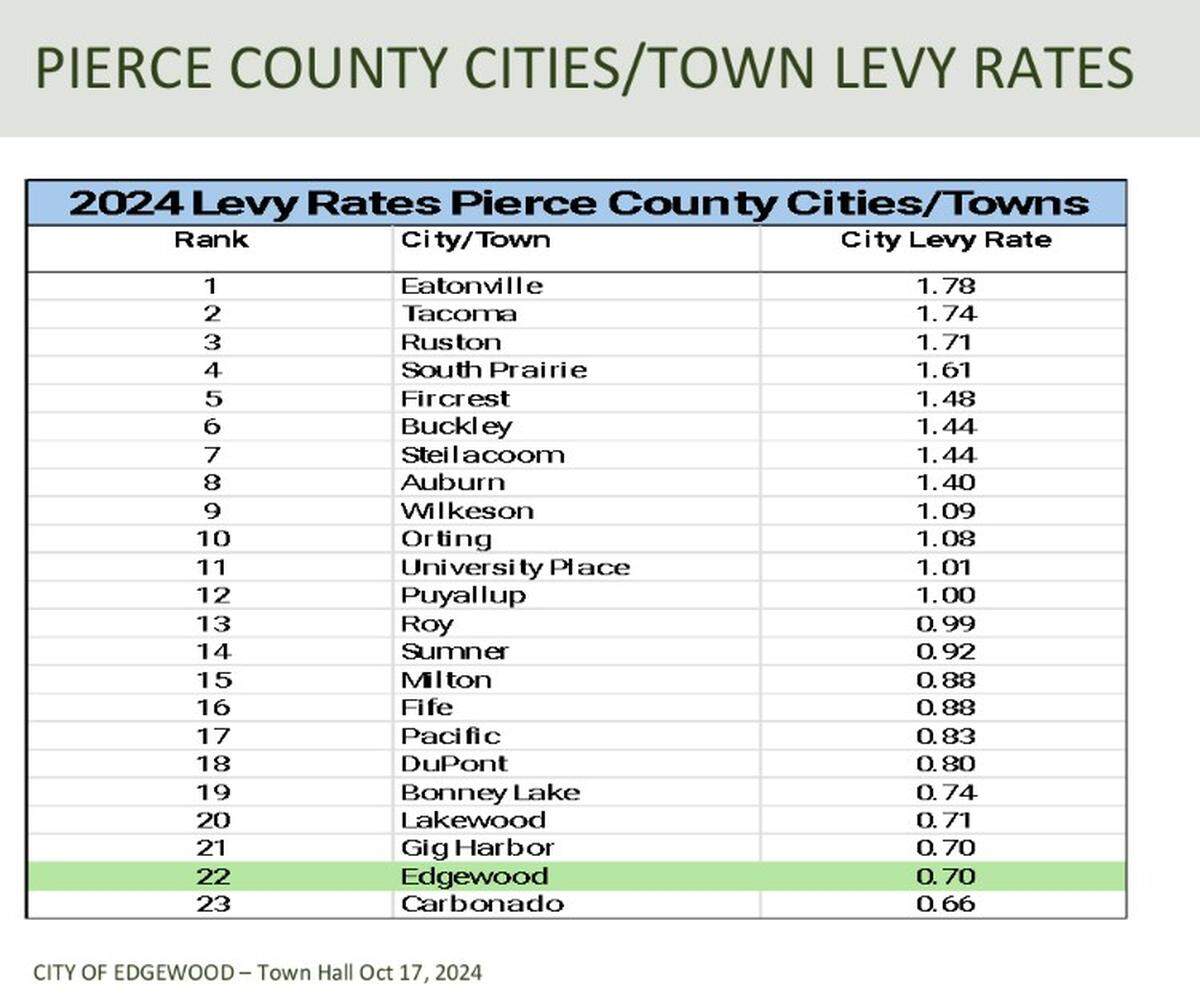
Of the 23 cities and towns in Pierce County, only Carbonado has a lower property tax rate than Edgewood.
“We collect the lowest rate of almost anyone in the county,” Mayor Dave Olson told The News Tribune. “We’re just behind the curve, and it’s kind of our turn to address it.”
If residents pass a levy lid lift on the ballot Nov. 5, Edgewood’s city-related property taxes would increase from $0.70 to $1.28 per $1,000 of assessed property value, which would be the ninth highest in the county.
For a $625,000 home in Edgewood, that’s an increase of about $30 a month, the mayor said.
The levy lid lift would be the first in the city’s 28-year history. It needs a simple majority to pass.
“The cities are allowed to increase it by 1 percent every year without a vote of the citizens, and that’s what most city councils do,” Olson said. “… Inflation is much greater than one percent.”
Like other local cities, Edgewood is facing a deficit.
“We have about $9 million in annual revenue and about $10 million in expenses this year and next,” he said.
Wages and benefits of city employees are going up.
“Medical benefits are going up by double digits every year, and we are a growing city, and our needs continue to expand and we’re just trying to keep up.”
Meanwhile, revenue from development, such as fees and permits, is down.
“That’s primarily because of interest rates,” he said. “We don’t currently have a lot of development.”
$3.7 million for law enforcement
About $3.7 million of the city’s budget goes to the city’s police department.
Egdewood and University Place are the two cities that contract with Pierce County to provide sherrif’s deputies as officers.
The city has 11 officers now. If the levy passes, they plan to have 12. If it fails, they’ll go down to 10. That cut would save $500,000, which covers salaries, benefits, equipment, training and patrol vehicles, among other costs.
“That’s just a nervous cut as far as public safety for our city,” the mayor said. “That’s never a popular one. I’d hate to have to cut public safety like that.”
Having 12 officers would allow the city to have two officers on duty 24/7, he said. The 11th officer the city brought on in June gives them the ability to patch together two-officer coverage much of the time, but vacations, training, sick days, furlough and other interruptions mean that it’s not a foolproof schedule. They need a 12th officer to reliably have two officers working at all times.
Asked if Edgewood considered a public safety sales tax to help fund those officers, the mayor said they did. But Edgewood brings in far less sales tax than Gig Harbor, he said, which recently passed such a measure.
The impact would be nominal, he said.
He said one thing the city has done to limit its expenses is a hiring freeze of sorts this year, and that some city employees are essentially doing two jobs. There are five vacant positions.
For example, the public works director is also handling the responsibilities of the city engineer.
Hiring a city engineer, the mayor said, would be one of the priorities if the levy lid lift passes.
Edgewood is growing
The city hosted a town hall Oct. 17 to “open up the hood” on the Edgewood finances, the mayor told the crowd.
The city has 14,000 residents and it’s growing. It’s an increasingly desirable place to live, the mayor said. It takes half the time to get to Seattle from Edgewood as it does from South Hill, he pointed out.
“I’m still a newbie,” resident Mark Zuerlein, 70, joked during the meeting.
He’s only lived in Edgewood for 20 years, he said.
As the assessed value of his property has gone up, his taxes that used to be $2,000 have gone up to $6,000, he said.
Olson pointed out that only a fraction of that goes to the city. School districts, fire agencies and other government entities collect much more.
Zuerlein told The News Tribune he likes that this measure is different than one from the city that failed last year, which would have brought a larger increase in property taxes.
“I still don’t know if I’ll support it or not, but the city has to get money somehow,” he told The News Tribune after the meeting.
One resident wanted to know if the apartments along Meridian account for much of the police department’s work in the city, and whether those residents pay their fair share.
The mayor said the owners of those apartment complexes do pay a big property tax bill.
As for how many of the police department’s calls are to respond to the apartments, Police Chief Jason Youngman said it’s not so many. Some places do see more calls to apartment complexes, he said, but that’s not the case in Edgewood.
What really takes a lot of officers’ time, he said, is all the bad driving through the city. A wreck on Meridian can occupy an officer for 90 minutes, he said. Someone suspected of driving under the influence can take up to four to six hours, he said, while an officer waits for a blood draw.
Property crime, which an extra officer would help deter, he said, is also up there.
Property tax exemptions
Karen Snyder, 69, said after the meeting that she appreciated seeing the numbers and understanding the limited share of her property taxes that goes to the city, compared to other government entities.
“They’ve got to do something,” she said about the budget. “I think we need to help the city out.”
Her husband, 75-year-old Jerry Snyder, joked after the meeting: “It’s an honor to be considered the city’s ATM.”
He’s lived in Edgewood since 2015. He raised the point during the meeting that many seniors in the city are living on a fixed income, and that the tax increase could be a burden to those residents.
The mayor told the crowd that there’s a property tax exemption seminar at 2 p.m. Nov. 14 at City Hall.
Those who are 61 and older and make $64,000 or less a year, among others, should qualify for some sort of exemption, he said.