Puyallup drivers aren’t happy with their streets. Here’s what the city is doing about it
Sales tax in Puyallup will increase next year if the City Council approves a move that would change how it pays for its streets.
The council will vote Nov. 12 whether to create a transportation benefit district — an independent taxing district that would raise sales tax by 0.1 percent, or $1 on every $1,000 spent.
That would bring Puyallup’s overall sales tax to 10.2 percent, and the council would decide after 10 years whether to renew the tax.
The News Tribune asked city engineer Hans Hunger about the work the tax would fund and about other significant road projects residents can expect next year and beyond.
Rather than funding large capital projects that are better suited for grants, he said, the roughly $3 million a year the tax would bring in would largely help with street operations and maintenance.
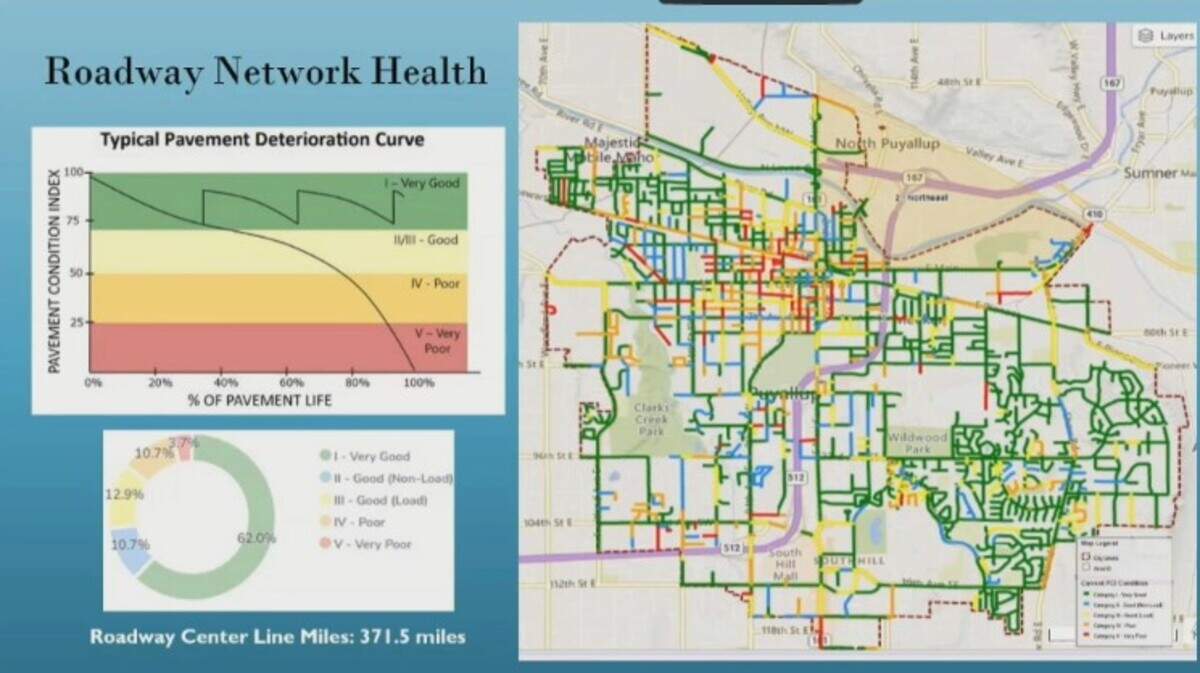
That includes work such as chip sealing, traffic-signal repair and replacement, asphalt overlays (think grinding down a few inches of asphalt and repaving, to preserve the life of the road), and cutting back vegetation that obstructs a driver’s line of sight.
The transportation benefit district, he said, is “getting us a designated source of funding for our road system, especially for maintenance.”
Residents would also see Americans with Disabilities Act improvements across the city, such as fixing uneven sidewalks and making sure sidewalk ramps are ADA accessible, he said.
The TBD would have to compile an annual report to show where the money went for the year, he said. That way residents could track how the funding is spent.
If the council votes to create the TBD this month, the sales-tax increase would take effect in April. The city’s proposed budget accounts for that funding, which would help balance the city’s roughly $312 million budget for the biennium.
Puyallup is facing about a $4 million biennial deficit. Like other local cities, Puyallup has seen wages, benefits and other costs increase while revenue from sales tax and development has slowed.
“Over the past four years, our costs have gone up 24 percent and revenues have gone up 2 percent,” City Manager Steve Kirkelie told The News Tribune.
Most cities in the county have a transportation benefit district already, he said.
“We do not have a dedicated fund for streets, yet streets are incredibly important to our community,” he said. “And our community, our residents, have told us that this is important.”
‘We are lacking sidewalks and other infrastructure’
The tax wouldn’t mean more funding overall for street maintenance, but it would offset the cost of some of that work, so that the city doesn’t have to rely on the general fund alone to pay for it. The city budgets between $4 million and $4.5 million per biennium for street maintenance. That’s still the case in the proposed budget. The difference is that now it won’t all come from the general fund.
At a time when cities are facing difficult budget decisions, state law protects transportation benefit district funding for streets. It can only be used for transportation improvements.
Kirkelie said the tax isn’t just about balancing the budget. It’s important for the “long-term stability” of the city’s streets, he said.
A recent community survey showed the condition of streets as a high priority for residents, who said they weren’t highly satisfied with the city’s roads.
“Residents feel that the city should be maintaining streets at a higher level than they are,” Hunger said.
The city held a public hearing Oct. 29 for residents to comment on the proposed transportation benefit district. Paul Rometsch was the only one who spoke.
“We have aging signals, we have aging roads, and quite frankly, just the design of them in general is subpar,” he told the council. “We are lacking sidewalks and other infrastructure for active transportation.”
He said becoming more reliant on sales tax “isn’t a great solution” because it can be fickle, but that he thinks it’s probably the best option.
“If we want to see safety improvements, if we want to see sidewalk connectivity throughout the city over the next 20 years, it’s good that we secure a funding source for those improvements,” he said.
He challenged the council to “improve, not just redo, what we already have.”
For example, he said, there is often space for bike lanes in the right of way.
If the TBD isn’t approved, Hunger said, city staff might have to go back to the budget and figure out what projects to delay. They haven’t discussed which projects would be affected, but Hunger said there would be less chip-sealing and less asphalt-overlay work next year. They’d likely look at locally funded work first because delaying projects with grant funding risks losing those dollars, he said.
What big road projects are happening next in Puyallup?
One of the locally funded projects next year is to install sidewalks on Seventh Avenue Southeast from 10th Street Southeast to 21st Street Southeast.
Construction on that $2.7 million project will likely start in March or so and take until about late August.
One of the city’s upcoming maintenance projects will happen on Meridian from Ninth Avenue Southwest to 15th Avenue Southeast, underneath the state Route 512 overpasses.
The city will do an asphalt overlay on that stretch next year.
It’s a $1.9 million project that will get another 20 years out of the street, Hunger said.
A full rebuild would cost about 2.5 times that, he said.
A trained eye would see the problems in the road now, he said, and in five to 10 years, drivers would see constant patches and potholes without the work.
He expects the city will start the overlay work after the Washington State Fair in the fall. The work likely will take place at night, he said, and will take approximately two months.
Next year is also when the city will finish the $5 million festival street project on Ninth Avenue Southwest along the fairgrounds. They’ll finish that before the fall fair, Hunger said, which is the fair’s 125th anniversary.
The fair is chipping in $1 million for the project and donating land to accommodate sidewalks in the right of way.
The project will create a curbless street with a promenade design that will be easily closed to traffic for major events at the fairgrounds.
It’s similar to another festival street the city has planned in coming years on East Meeker, from Meridian to Third Street Southeast.
When are they going to finish Shaw Road?
Hunger said widening the rest of Shaw Road down the hill from 23rd Avenue Southeast to Pioneer Way East is part of the city’s proposed comprehensive plan.
He said the comprehensive plan calls for the project to be done in the next 20 years, but that funding has yet to be secured.
It will take about $70 million to $90 million, he said.
“It’s so vastly expensive because it’s a very small, narrow corridor going down that ravine,” he said.
Adding lanes to that, he said, means “trying to fit a lot into a small space.”
The city will start by widening Shaw Road to four lanes, with two lanes going up the hill, one lane going down, and a two-way left turn lane. It will also have a shared-use path for bikes and pedestrians. Then, as development happens on the east side of the road, the city will build a fifth lane so that two lanes will take drivers down the hill.
The design and permitting alone is about $13 million, he said, which the city twice tried to secure federal grants for, unsuccessfully.
The city did get some grant funding for design and permitting of the piece from 23rd to 20th Avenue. Getting initial grants like that helps build momentum on a project to get more, he said.
“We’re going to continue to put the gas down to try to get grants secured for this,” he said.
The city also works with developers who are building along the road. For example, a developer building a subdivision to the north of Shaw Road at 23rd will help with prep work for the road, such as rough grading the land on their property.
“We’ll just continue to work on it and we’ll get it done,” he said.
Another major project in the city’s future is to widen Ninth Street Southwest.
Crews will install consistent sidewalk along Ninth Street Southwest between 15th Avenue Southeast and 31st Avenue Southeast, and add a two-way left turn lane down the center. They will also consider a shared use path for bikes and pedestrians.
The traffic on the road is heavy enough that it’s difficult for drivers to turn from side streets onto Ninth, Hunger said.
It’s a big corridor project, he said, and they’re in the early stages of development. It will cost about $20 million. There’s not a timeline, yet.
“I assumed in the comp plan that it would be done in 20 years, but that’s a big assumption,” Hunger said.