These Pierce County school districts are bursting at the seams as others in WA shrink
Jacquelyn Goetz’s son spent third grade in a portable classroom at Donald Eismann Elementary School near Bonney Lake.
Goetz, a long-time member of a Parent Teacher Assocation in the district who agreed to speak with The News Tribune, was happy to know that the district was building a new elementary school to address overcrowding.
“This will be fixed soon,” she remembers thinking. “We won’t always have portables.”
Her son is now a sophomore at Bonney Lake HIgh School, and her daughter is a fourth-grader at that new school, Tehaleh Heights Elementary School.
Her classroom is one of eight portables outside the 6-year-old school.
“You can only add so many portables,” Goetz told The News Tribune. “At what point do you need a new school? I feel like we’re at that point.”
Nine of the Sumner-Bonney Lake School District’s 14 schools are over capacity, according to the district.
As school districts across the country see enrollment decline and some face the prospect of closing schools, Sumner-Bonney Lake and the Orting School District are two places in East Pierce County that have the opposite problem.
“A district like ours, we’re in a totally different situation,” Marina Tanay, the Sumner-Bonney Lake School District’s capital projects facilities manager, told The News Tribune.
The district is out of space and its student population remains on the rise.
To expand and improve facilities for those students, Tanay and other district leaders said, they need funding from taxpayers.
The district is asking voters to approve a $732 million bond on the ballot Nov. 5. It needs 60 percent approval to pass.
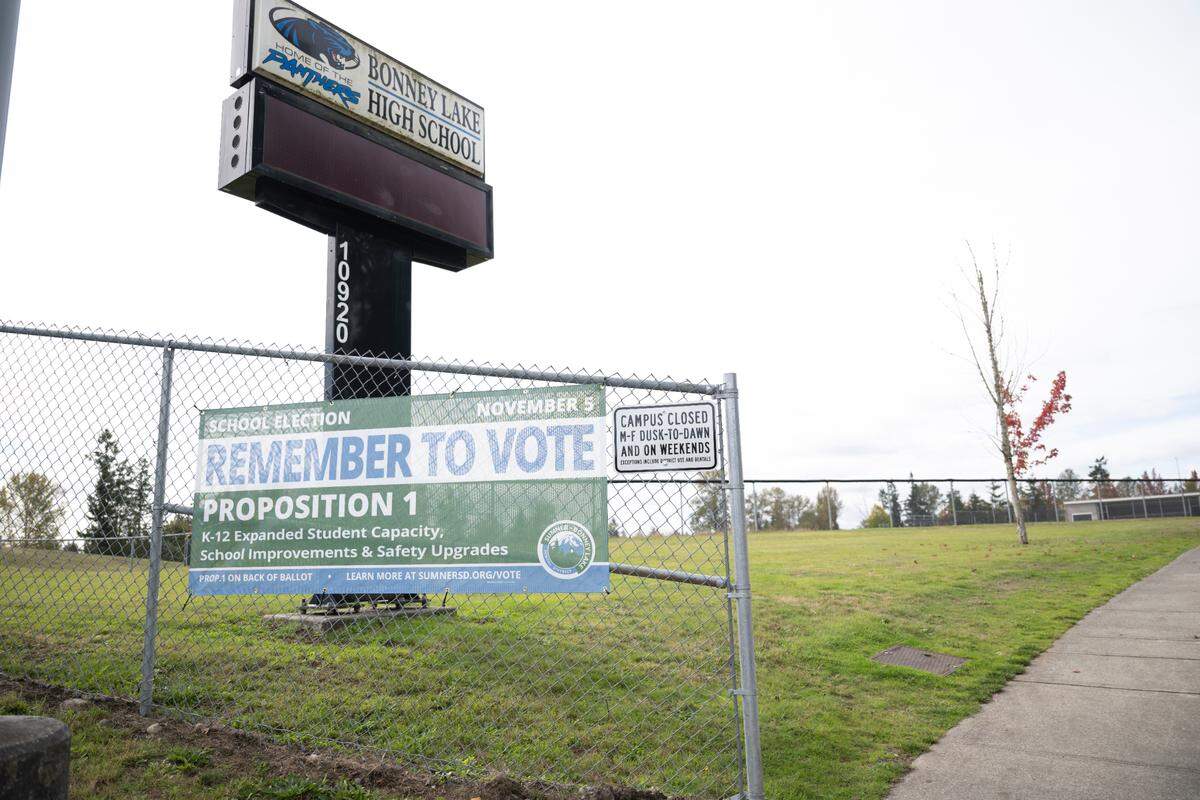
If voters approve the 21-year bond, the property tax rate homeowners pay to fund schools would essentially stay the same, at an average of $4.63 per $1,000 of assessed value for the next five years because other bonds are expiring.
There is no statement against the measure in the Pierce County Voters’ Pamphlet.
The bond would fund upgrades, including safety improvements, to schools across the district.
Priority projects would be to upgrade and expand Sumner High School and Bonney Lake High School, build a new middle school in Tehaleh and expand Tehaleh Heights Elementary. It also would build lighted turf fields, which students and other residents would be able to use year-round.
When it comes to construction, state funds cover an average of about 5 to 12 percent, Tanay said, essentially covering the sales tax of a project. In the case of the projects in the district’s bond package, Tanay said they should be eligible for $55 million in state funding.
If the bond passes in November, the district expects to start opening buildings in 2028, Tanay said.
“We need the space yesterday,” she said.
The district’s student population has grown about 18 percent in the past 10 years. It has about 10,500 students.
The rapidly-growing Tehaleh area accounts for some of that increase, district leaders said, but they’re also seeing growth elsewhere, including in Sumner.
“We like that families are coming here,” Summer-Bonney Lake School District spokesperson Elle Warmuth told The News Tribune. “It’s a good problem to have.”
The district just needs space for those students.
Classes are being held in hallways
Goetz said teachers have done a great job trying to make the portables at Tehaleh Heights Elementary seem fun.
They call the classrooms “cabins,” for example.
But Goetz worries about security. There are cameras and fences, but having kids in the main building would make her feel safer, she said.
The distance to the bathroom is also a problem.
A month into school, she said, her daughter already tells her she purposefully drinks less water during the day to avoid having to make the trip to the restroom.
“That’s the crummy part, is that the kids do think about that,” Goetz said. “They shouldn’t have to think about that.”
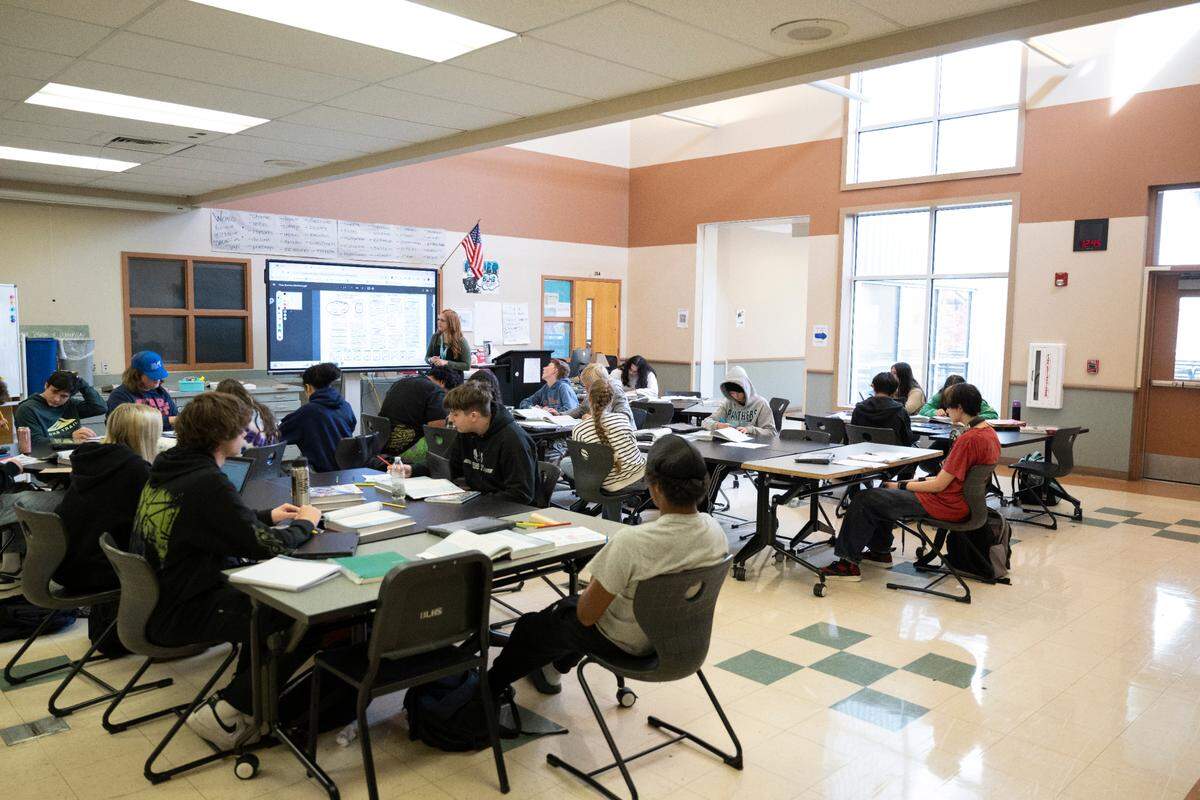
At Bonney Lake High School, her son has to navigate crowded hallways that make it hard to get from one end of the school to the other during passing periods, she said.
The school holds some classes in common areas that are essentially hallways and on performing arts stages — “basically any nook and cranny they can fit a classroom into,” she said.
She emphasized that the bond measure replaces an expiring bond, and that property tax rates won’t increase if it passes. She also wants voters to understand that bonds are for building, not for other expenses such as teacher salaries.
The bond would add at least 10 classrooms to Bonney Lake High School and eight to Tehaleh Heights Elementary, among other projects.
“If we don’t do this now, how much harder and worse is it going to be for our students to continue to learn?” she asked.
The district is highly regarded, she said. Families want their kids to go there.
If the bond fails, she said, “that may not continue to be the case.”
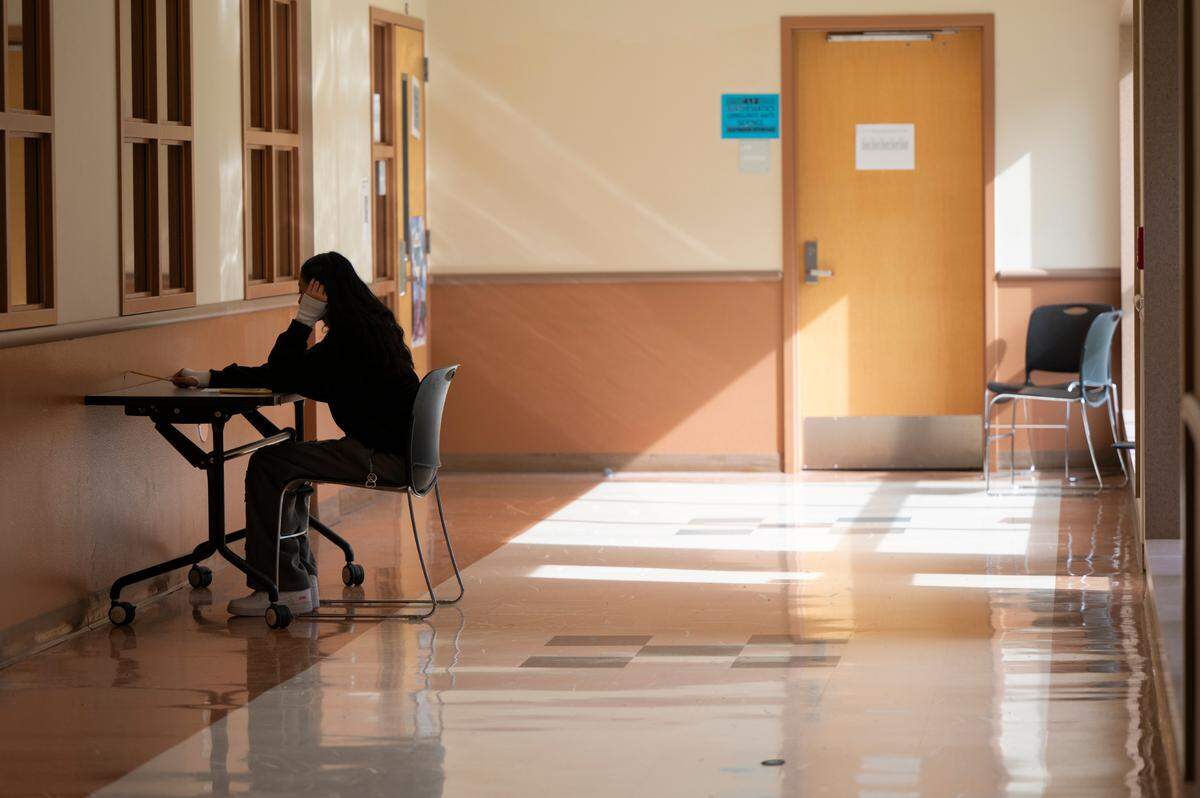
Senior Emily Bones, 17, said the senior parking lot at Bonney Lake High School is overcrowded because portables take up space in the lot. She also described the challenges of having classes in the “flex spaces,” which is what they call the hallway classrooms.
The enlarged corridors were designed for things like occasional group project work or as space for para-educators to work with students, not as full classrooms, according to the district, but they’ve been used as classrooms for several years.
The bathrooms are right there, next to the desks, Bones said, for everyone to hear. She’s seen that distress her peers, she said, such as when a student was upset that a class could hear her opening a feminine hygiene product.
Due to the corridors’ layout, Bones said, it’s not uncommon for students to have to interrupt classes to get from one side of the hallway to the other on their way to a classroom.
This is Emily Wojciechowicz’s 19th year teaching English at the high school. She taught in the hallways in prior years and is glad to be back in one of the main classrooms.
Students find it hard to focus in the flex spaces with the constant interruptions, she said.
It’s hard to hear. There’s nowhere for teachers to step out and have a one-on-one conversation with a student. The entire class is already in the hallway.
“There were times my kids were just done,” she said.
The bond, she said, is “a huge opportunity” for future students “to have a focused space.”
What does it cost to build a school?
Randy Kroum was part of the “yes” committee for the bond, listed in the voters’ pamphlet.
He has a fourth-grader at Donald Eismann and a seventh-grader at Mountain View Middle School.
“She sees the capacity issues every day,” he said about his middle-schooler. “She’d like that experience to change going into high school.”
Mountain View is nearly 200 students over capacity, and the student body there will increase by several hundred over the next couple years, he said.
Kroum sat on the capital facilities advisory committee that put together the bond package. He deals with complex infrastructure projects as part of his day job as a deputy director for Sound Transit.
Construction costs have gone up by as much as 30 to 40 percent in the last four years, he said. Building a new middle school, alone, is about $200 million, he said.
“It looks big on paper, but drawn out over time, it’s an investment,” he said.
It will also be good for property values, he figures.
“Good schools bring good home prices as well,” he said.
The committee considered about $900 million in projects initially, he said, and cut projects from the bond package down to $732 million to limit costs. For instance, he said, they opted not to build a new operations and maintenance facility, which eliminated $60 million to $80 million.
“We also had a pretty hefty debate on a pool,” he said.
In the end, they decided to keep replacing the Sumner High School pool on the list. Part of the reasoning, he said, is that the public would be able to use it. The Sumner and Bonney Lake areas don’t have a community pool.
The one the high school has now, he said, is on its last legs and isn’t generally open to the public.
He said one question he’s gotten from the public is about the decision to rebuild versus remodel Sumner High School. A remodel would last 20 to 30 years, he said, and a rebuild would last 50 to 60 years.
It’s the school that’s in the roughest shape, he said.
“There’s only so many patches you can put onto something before it completely fails,” he said about the deteriorating condition of the school.
He said getting residents to approve the bond will be tough.
“It’s going to be close,” he said. “It’s a hard vote to get. It’s not easy to get these things passed.”
Half of the students at Orting Elementary School are in portables
Orting is another East Pierce County school district with a bond on the November ballot.
At 2,884 students, the district is roughly 40 percent over capacity, school district spokesperson Brittany Piger said.
By 2033, the district expects to have more than 5,000 students, which would be 148 percent over capacity.
The $119.2 million proposal before voters would cost homeowners $1.51 per $1,000 of assessed property value — $755 a year for the owner of a $500,000 home if the bond passes.
The 20-year bond would build a new Orting Elementary School, build an addition to Orting High School for career and technical education, expand gym and cafeteria space at Ptarmigan Ridge Elementary, make safety upgrades in the district and upgrade HVAC systems in the schools, among other things.
The voters’ pamphlet doesn’t have a statement against the proposal.
November will be the fourth time the district has tried to pass the measure.
The district has made cuts to the projects included in the bond since it first put it before voters in February 2023. For example, new turf and track at the high school stadium is no longer part of the plan. The plan also no longer adds eight new classrooms to Ptarmigan Ridge Elementary School, Piger said.
“We know that times are tough,” she said. “We know that people are struggling to make ends meet.”
The district’s boundaries extend beyond the city limits of Orting and, like the Sumner-Bonney Lake district, encompass parts of some rapidly-growing areas of Pierce County, including Tehaleh.
“That area is growing really, really fast,” Piger said.
At Orting Elementary School, staff members are using closets as office space, she said. She said three staff members share one closet area, and that students who work with a para-educator in that closet have to sit on the floor due to the limited space.
“Our schools are significantly overcrowded,” she said. “There’s no more space at Orting Elementary School at all.”
The school was built for 290 students in the 1960s. Now it has 563 students.
Roughly half of the students at the school are in portable classrooms, and the bathroom those students use in a temporary building near the portables has long lines at lunch and recess, Piger said.
There are 47 portables total in the district.
The new elementary school would be expected to open in fall 2028. The work at Ptarmigan Ridge Elementary would be finished in fall 2027, work at Orting Middle School should be finished in the summer of 2027, and the Orting High School improvements should be done in the summer of 2026, Piger said, if the bond passes.
They’re in a similar boat to the Sumner-Bonney Lake School District, Piger said.
Both are over capacity, with aging facilities and student populations on the rise.
“We’re growing very, very fast,” she said.
This story was originally published October 15, 2024 at 5:30 AM.