Former medical examiner who conducted autopsy of Manuel Ellis testifies at police trial
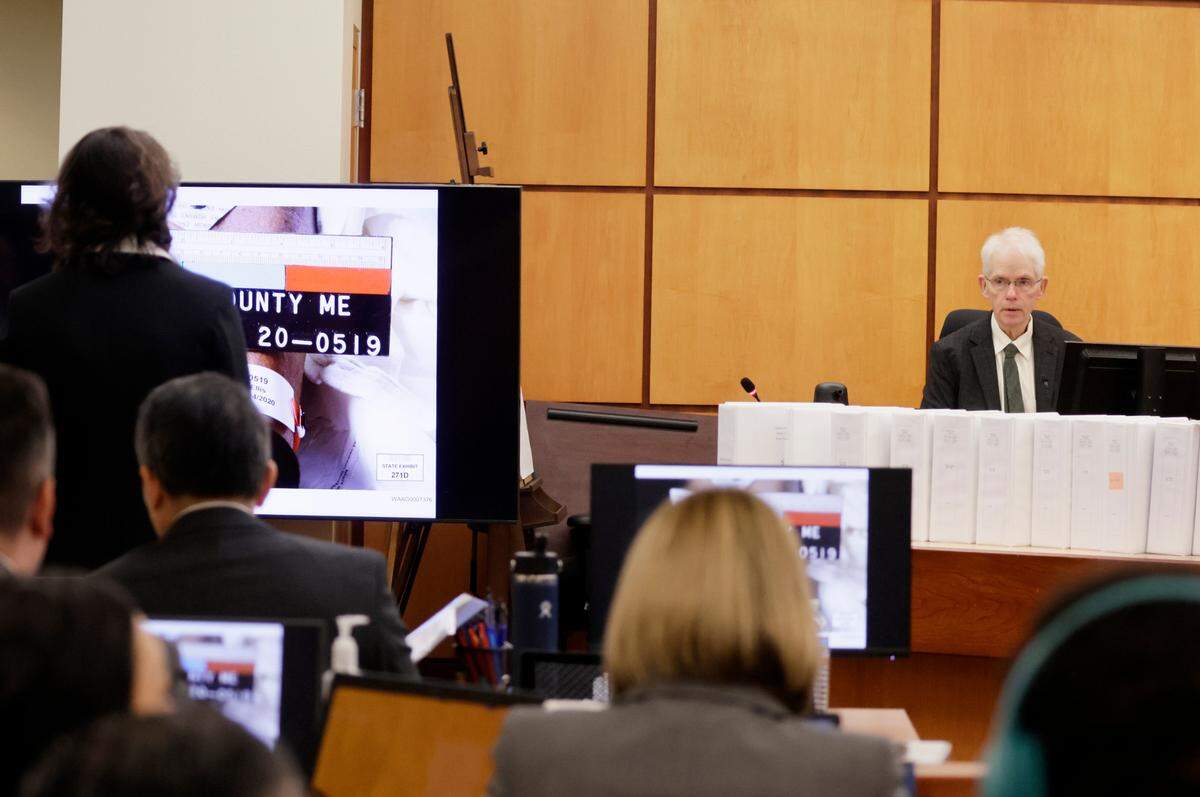
The former Pierce County medical examiner who ruled Manuel Ellis’ death a homicide in 2020 and found he died as a result of physical restraint testified Thursday morning in the trial of three Tacoma police officers charged in Ellis’ death.
Dr. Thomas Clark testified that there were multiple factors to consider in determining Ellis’ cause of death, and it was his job as a forensic pathologist to weigh each and make a decision based on both science and his own experience. He concluded May 11, 2020, that Ellis’ restraint by police — facedown on the street in handcuffs bound to his ankles with a spit hood over his head — was the primary factor in the man’s death.
At the time, Clark said he wasn’t “fully confident” in Ellis’ cause of death because he had conflicting information about the last moments of the man’s life, including whether he was speaking when paramedics arrived at his side and the initial rhythms of Ellis’ heart as recorded on a heart monitor.
But as he learned more from investigators and paramedics, Clark said, the evidence bolstered his findings.
“It’s my opinion Ellis was already brain dead when paramedics first examined him,” Clark said.

Ellis died the night of March 3, 2020, after encountering officers Christopher Burbank and Matthew Collins while walking home in the city’s South End neighborhood. Ellis was beaten and restrained face down in handcuffs tied to his legs while officers sat on top of him. A spit hood was also placed over his head.
Officer Timothy Rankine, who responded after a call for backup, told investigators he put all his weight on Ellis’ back when he arrived on the scene.
Burbank, Collins and Rankine are charged with first-degree manslaughter in the death of Ellis, who went by Manny. Collins and Burbank also face charges of second-degree murder. The defendants have pleaded not guilty, are free on bail and remain on paid leave from the Tacoma Police Department.

How Ellis’ interaction with police began has been in dispute during trial, but four eyewitnesses have testified that police instigated the deadly interaction, and that Ellis did not fight back as he was repeatedly struck, shocked with a Taser and pressed to the ground. That contradicted the statements the defendants gave investigators looking into Ellis’ death.
Lawyers for the officers have argued that police had to subdue Ellis because he was aggressive and resisted arrest. Collins and Burbank told detectives they saw Ellis try the door of a car passing through an intersection, and when they called him over to their patrol car, he began punching their windows. Collins reported that when he got out, Ellis fought him with “superhuman strength.”
Clark said Ellis’ autopsy was one of the last he conducted for the Pierce County Medical Examiner’s Office, where he’d led a team of medical investigators, autopsy techs and other staff for nearly 10 years. He retired at the end of 2020. Clark said he twice turned down inquiries from the State Attorney General’s Office asking him to consult in the case, and when he agreed, it came with the caveat that he would have to remain neutral.
Under questioning from special assistant attorney general Patty Eakes, Clark addressed each of the three factors listed in his autopsy report: methamphetamine intoxication, Ellis’ enlarged heart and the physical restraint.
Ellis had 2400 nanograms per milliliter of methamphetamine in his system, a concentration that Clark said was somewhere in the middle of the fatal range. He said the drug has unpredictable effects, to the point that a person could take the same dose of meth for a month without dying, and on the last day, the same concentration could kill them.
Looking at Ellis’ enlarged heart presents a similarly unpredictable scenario. Clark said a heart shouldn’t weigh more than 400 grams, and Ellis’ weighed 480. The doctor said it’s possible for people with that large of a heart to die for no apparent reason, and that each gram increases risk of death, but that some people live for years with hearts weighing 600 or 700 grams.
“There isn’t any magic number at which the heart becomes fatal,” Clark said.
The medical examiner was able to rule out the meth and the enlarged heart because a heart monitor paramedics used recorded the rhythms of Ellis’ heart. Clark said the data, which he didn’t have when he first made a ruling on the man’s cause of death, showed that Ellis’ heart was not in a state of ventricular fibrillation, a type of irregular heartbeat Clark said is caused by methamphetamine. Ellis’ heart also didn’t go into a sudden dysrhythmia, Clark said, a common scenario for people who experience sudden death as a result of an enlarged heart.
“Then it must be the other thing,” Clark said.
Defense attorneys began to cross-examine Clark before court adjourned for lunch. They questioned him about other in-custody death cases that he determined were accidents rather than homicides.
Jared Ausserer, an attorney for officer Collins, questioned Clark about why two deaths Clark certified in 2017 and 2018 where the deceased struggled with police, were restrained in some way and had methamphetamine in their systems weren’t determined to be homicides.
Clark told jurors that in those cases he didn’t have any possible causes of death that conflicted with meth being the primary factor, as Ellis’ did, but he said he was more trusting at the time of the information he received about a person’s death.
“Looking at a case like this does make me worry there was something I didn’t know,” Clark said.
In the 2017 case, Ausserer said, a man created a disturbance at a convenience store, and police responded and placed him in a lateral vascular neck restraint that caused him to collapse. The man was put in handcuffs, then became unresponsive and died shortly after. The attorney said the man’s meth concentration was 2000 nanograms per milliliter.
Ausserer pointed out that the meth concentration was lower than Ellis’ concentration, 2400 nanograms per milliliter, and yet Clark ruled the 2017 death accidental and due to meth. Clark reiterated his earlier testimony that meth is unpredictable, and he said it isn’t possible to compare meth concentrations between two people because the same dose could kill one person and leave the other alive.
Thursday morning, Clark conceded to jurors and Brett Purtzer, an attorney for Burbank, that of all the factors that contributed to Ellis’ oxygen deprivation, that there wasn’t one he could point to that killed the man. The factors included restraint on his stomach in handcuffs tied to his ankles, the weight of officers on Ellis and the spit hood placed on him.
“You just don’t know, frankly, how Mr. Ellis died given the constellation of issues he surrounded himself with,” Purtzer said.
“I think he died as a result of asphyxia, but if you get into which asphyxia mechanism, that becomes much harder,” Clark responded. “I think the best way that I can word that is that he died as a result of some combination of those events.”
Purtzer pointed out that in Clark’s autopsy report, he characterized the spit hood as possibly the most important factor in Ellis’ death. Defense attorneys have frequently noted that none of the officers on trial put the spit hood on Ellis. Prosecutors have argued that the officers heard Ellis say, “I can’t breathe,” and that they had a duty to render aid to him at the first possible opportunity, so they should have removed the hood.
Clark said he saw blood and other sticky secretions inside the spit hood, and if that material got on Ellis’ face, it had the potential to completely cut off his breathing. He said that was why he called the spit hood possibly the most important factor, but he still has a hard time choosing which asphyxia mechanism was most important.
“I can’t really point to one of them as being the incriminating event,” Clark said.
The cross-examination of Clark also got into what scientific research papers have to say about whether a person can die as a result of being restrained in a prone position. Clark said there’s about an equal number of papers on each side of the question, so they aren’t helpful.
Ausserer turned to a 2015 study Clark cited in communications with the State Attorney General’s Office, “On positional asphyxia and death in custody.” The attorney said individuals aged 22-42 were restrained in hobbles and put in various positions, including prone. Some had no weight on their backs, some had 50 pounds and some had 100 pounds placed on them. Ausserer said it found no difference in the participants’ oxygenation or their blood flow.
Clark agreed he cited it as a study, but that didn’t mean he necessarily agreed with everything in it. He said such studies are sometimes written for a specific patient population, and a paragraph of the study refers to a group of healthy males. Clark said he wouldn’t put Ellis in that category. The doctor said that area of study has opposing points of view, and there are an equal number of articles that say restraint does cause hypoxia.
Prosecutors briefly questioned Clark in a redirect examination before court adjourned Thursday, and after a few more questions from the defense, Clark was excused as a witness. Trial proceedings will continue Monday.
This story was originally published November 2, 2023 at 12:20 PM.