
Use-of-force expert doesn’t concede much to defense attorneys at Tacoma police trial
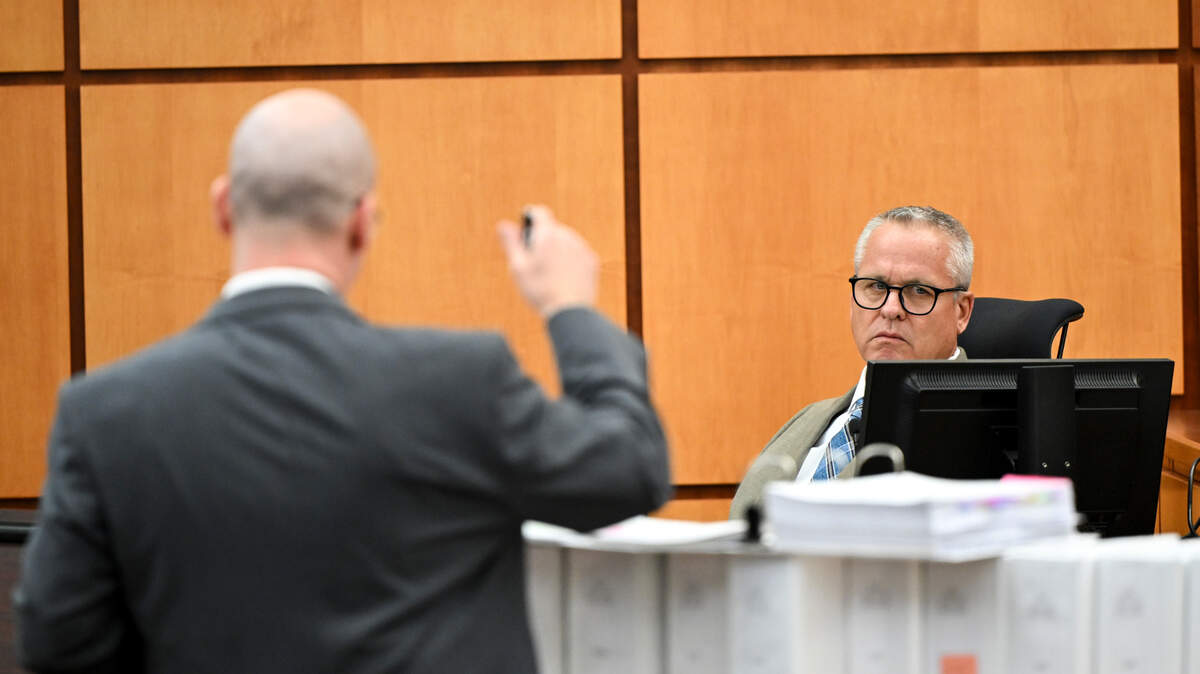
Lawyers for three Tacoma police officers on trial for the death of Manuel Ellis cross-examined a prosecution expert in police use of force on Tuesday morning as the prosecution progressed toward resting its case.
Special prosecutor Patty Eakes for the Washington Attorney General’s Office told the court Tuesday morning that the prosecution intends to call just one more witness and is on track to conclude its case against the officers Tuesday afternoon or sometime Wednesday. The defense is expected to begin calling witnesses next week.
Ellis, 33, died March 3, 2020, after a struggle with police. The Pierce County Medical Examiner ruled his death a homicide due to physical restraint. Lawyers for the officers have argued that Ellis died from the high level of methamphetamine in his system combined with a heart condition.
Officers Matthew Collins, 40, Christopher “Shane” Burbank, 38, and Timothy Rankine, 34, are charged with first-degree manslaughter. Collins and Burbank also are charged with second-degree murder. All three have pleaded not guilty, are free on bail posted by a Tacoma business owner and remain on paid leave with the Tacoma Police Department.
Collins and Burbank told detectives they saw Ellis trying to open a car’s door as it passed through an intersection and sought to question him about it. The officers said Ellis became aggressive and attacked them, but at least three eyewitnesses contradicted them. Those witnesses, two of whom recorded videos of Collins and Burbank handling Ellis roughly, said police were the aggressors. Ellis was recorded desperately telling officers at least five times that he couldn’t breathe.
Collins and Burbank denied they ever heard Ellis express that he was in respiratory distress, but a nearby home security camera picked up audio of Ellis saying he couldn’t breathe when only those two officers were present. Someone can be heard responding, “Shut the (expletive) up, man!”
Rankine arrived minutes after Collins and Burbank contacted Ellis, who was already handcuffed with his hands behind his back. Rankine told detectives he continued to sit on Ellis, who was in prone restraint on his stomach with a hobble linking his ankles to his wrists, even as Ellis said he couldn’t breathe.
National police use-of-force expert John Ryan testified that Collins used excessive force on Ellis by repeatedly striking him and placing his knee on the back of Ellis’s neck to pin him against the pavement. Burbank’s use of a Taser on Ellis also constituted excessive force because “based on the reports of the witnesses, there was no act of resistance,” Ryan testified Tuesday.
Ryan testified that Rankine, by sitting on Ellis’s back for a prolonged time, breached law enforcement standards that have been in place for decades about how to avoid harming subjects who are in prone restraint.
Even if the jury were to take Collins and Burbank at their word — that Ellis had hassled a passing car and turned aggressive — Ryan testified that the witness videos show Ellis was subdued and the officers should have turned their attention to placing him in a safe position instead of continuing to apply force.
If the jury believes the eyewitnesses, Ryan said, nothing the officers were shown doing on the videos was legally justified, Ryan said.
Under cross-examination by Burbank’s lawyer, Wayne Fricke, Ryan conceded there is leeway in police standards to break from policy in unpredictable situations, but only “when reasonable.”
Fricke oriented his questions around a series of photographs that show what appears to be white powder on and around the passenger’s side window of a police cruiser, where Burbank rode to the scene on the night Ellis died. Defense lawyers have implied that it proves Ellis slapped or hit the window as the confrontation began.
Ellis had purchased powdered raspberry-filled donuts at a nearby 7-Eleven store minutes before he encountered police; a box of them was found at the scene. Ryan downplayed the significance of the powder around the window, noting that Burbank had told detectives he used the door to knock Ellis to the ground to prevent him from attacking Collins.
“It could be objective evidence of him being hit by the door,” Ryan said. He declined to read more into the powder than that.
Fricke also trained the jury’s attention on the moments preceding the eyewitness videos. The officers’ defense teams have been adamant that the aggression by Ellis preceded eyewitnesses’ arrival, but that was cast in doubt by the lay witnesses’ testimony. They said they were present from the time both officers exited their police cruiser, and that Ellis never acted in a threatening way.
Defense lawyers on Tuesday afternoon emphasized reports that Ellis was resisting arrest, even after handcuffed, on the night he died.
During cross-examination, Ryan said what officers and their lawyers have called resisting arrest could in fact have been Ellis involuntarily struggling to gain air.
“Once a person is handcuffed, particularly in the prone position, it’s possible they’re actively resisting “ Ryan testified. “It’s also possible they’re fighting for air.”
Mark Conrad, a lawyer for Rankine, questioned Ryan about the circumstances when Rankine began sitting on Ellis’s back. Rankine told detectives that based on his military combat experience, he presumed Collins and Burbank had been killed when he heard empty clicks from one of their microphones over police radio dispatch channels.
Ryan conceded that it would be reasonable to be concerned for fellow officers’ safety at that point. When Rankine arrived with his partner, they helped restrain Ellis. Rankine reported Ellis, who was already handcuffed, was squirming and resisting officers. Rankine said he mounted Ellis and eventually placed his full weight on Ellis’s back while he lay prone and restrained.
“There’s multiple times he’s putting weight on [Ellis’s] back while he’s handcuffed and that’s inappropriate,” Ryan testified. Earlier in Tuesday’s testimony, Ryan noted that the threat from subjects who are handcuffed “goes down dramatically,” and police should adjust the level of force they’re applying accordingly, but he said Rankine did not.
Near the end of the day Tuesday, assistant attorney general Lori Nicolavo and special prosecutor Patty Eakes called Pierce County Superior Court Judge Bryan Chushcoff’s attention to an earlier remark he made during Ryan’s testimony.
It came when Ryan was considering, in hypothetical terms, what constitutes reasonable use of force by police. Chushcoff said he disagreed with Ryan’s interpretation of the law when he blurted out, “I don’t think so.”
Eakes argued that the judge’s commentary could leave an impression with the jury that the witness was not credible. Chushcoff declined to tell the jury to disregard his statement and said his jury instructions will be clear about what the jury should focus on and what it should disregard.
The prosecution expects to call its final witness, a DNA analyst, on Wednesday before resting its case. Collins’ legal team deferred its opening statement at the beginning of the trial. Casey Arbenz, a lawyer for Collins, is expected to deliver it upon completion of the prosecution’s case.
This story was originally published November 7, 2023 at 12:44 PM.