Police say crime-reduction plan working in Tacoma, set sights on Hosmer Street next
In a presentation to the City Council this week, the Tacoma Police Department said its Violent Crime Reduction Plan, focused on reducing hot spots of violent crime, was likely responsible for a 17% reduction in violent crime across the city as compared to the previous year.
Violent crimes include murder, robbery and aggravated assault.
The plan drew from evidence-based crime-control strategies, including increasing police visibility at addresses where violent crime is concentrated in the short-term, as well as a longer-term deterrence strategy to break the cycle of violence among the small number of repeat and high-risk offenders responsible for most of the violent crimes in Tacoma, according to the department’s presentation to the council Tuesday.
Since implementing the plan in July 2022, violent crime citywide dropped 17.5% compared to the previous year. Violence-related calls were also down nearly 20% in hot spots, according to police.
From July 2022 to June 2023, there were 143 violent incidents reported citywide, compared to 173 incidents reported the year prior, according to the department. Violent crime remains significantly higher than it was prior to the pandemic, police said.
The rate of murder was down 26.7%; business robberies were down 41.6%; and non-family related aggravated assaults were down 17.2%, according to police. Robberies against individuals were up 13.5%.
Violent crime in treated hot spots was down more than 25% compared to the previous year and was down a similar amount in surrounding areas, indicating that crime displacement did not occur as a result of the hot spot treatment, the department said.
Total arrests were up slightly citywide and in identified hot spots since the Violent Crime Reduction Plan was implemented, police said. However, in the hot spots violence-related arrests were down 38%, drug arrests were down 61% and illegal weapons arrests were down 7%, according to the presentation.
“All together, we think that this provides pretty strong evidence that the crime plan’s focus on your most crime-prone areas in Tacoma has moved the needle, and it’s helped to reduce violent crime significantly at those hot spots and also across your city,” said Michael Smith, a professor of criminology and criminal justice at the University of Texas at San Antonio, who gave the presentation to the council and helped Tacoma Police Department draft its violent-crime reduction strategy.
Although the numbers look promising, Police Chief Avery Moore cautioned council members to wait until the third phase of the plan is complete before making any long-term decisions.
“I strongly recommend that we at least get to the third phase, and then we can have a better picture of when we can move away from the crime plan, modify, etc.,” Moore said. “I think it would be a huge mistake to really kind of celebrate — it’s kind of like you celebrate, you won the championship, and then you get voted out in the Super Bowl. So we don’t want to do that. So let’s at least get to the third phase of the crime plan, and then we can assess from there.”
What is the city’s violent crime strategy?
The city is using a Problem-Oriented, Place-Based Policing approach. Phase 1 begins with focus on increasing police visibility substantially at hot-spot addresses where violent crime is concentrated and prioritizing street-level deterrence (rather than generalized “stop and frisk” and “zero tolerance” policing), according to the final plan.
Phase 2 includes the police coordinating with other government and community stakeholders to identify and improve “the underlying conditions that contribute to violent crime at crime-pone places,” according to the final plan. In addition to investigations and arrests, police will focus on code enforcement, nuisance abatement, trash clean-up and other efforts “to alter the criminogenic nature of the targeted places,” the plan said. “As crime declines in the targeted areas, new places will be identified and brought into the strategy.”
Over the longer term, Phase 3 will include a focused deterrence strategy designed to help break the cycle of violence among a small number of repeat and high-risk offenders.
“The goal of focused deterrence is to change the behavior of high-risk offenders through a combination of deterrence, incapacitation (arrest), community involvement and the provision of alternatives to violence,” the final plan said. “A key feature of most successful focused deterrence strategies is the clear communication to gang members and other violent offenders of the risks associated with continued criminal activity and the alternatives available to them under a robust suite of social services, education and job-related services made available to them under the strategy.”
Although Washington has seen significantly fewer violent crime offenses by population compared to the national average since 1985, data from the Federal Bureau of Investigation shows that a steep rise in violent crime since the pandemic has put Washington on track to potentially exceed the national average in 2023.
In 2022 there was an average of 376 violent crimes reported per 100,000 people in Washington, compared to about 381 violent crimes per 100,000 people nationwide. In 2020, that number was 294 in Washington and 399 nationwide.
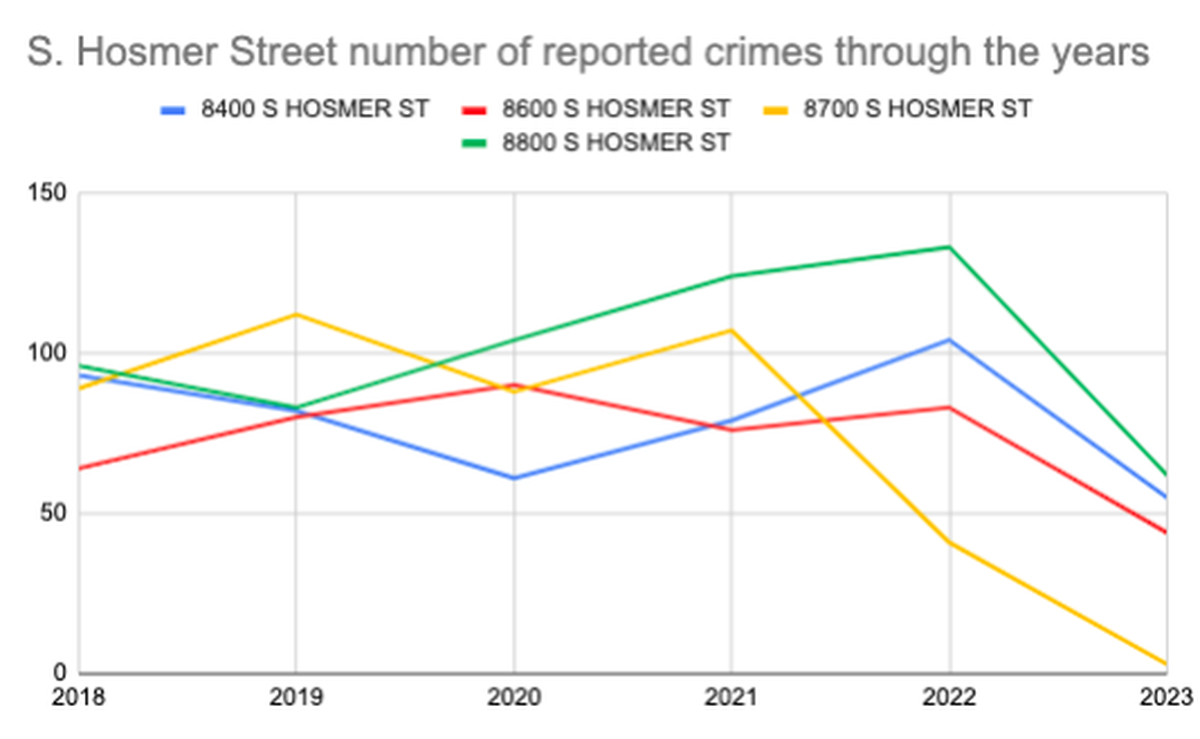
Hosmer Street is future focus
The Tacoma Police Department is developing a strategy to address crime at 8810/8820 Hosmer St., near Quality Inn & Suites, Smith said. A plan is underway to work with the owners and managers of the hotel to reduce crime, he said.
An investigation from the News Tribune last year deemed Hosmer Street the most dangerous in the city.
Five additional sites were identified as possible locations to focus on in the future, upon analyzing several years worth of crime and calls for service data, Smith said.
“The working group and others are involved I think right now in deciding which of those five sites will be the next location to be treated with this particular strategy,” he told the council.
Engagement with stakeholders and community members in the area have already produced improvements in crime and data collection on the effectiveness of the strategy is underway, he said.
Another report analyzing crime data and implementation and outcome metrics is expected to be published in January or February, Smith said. This will include outcomes on the Hosmer site and others, he said.