Bad heart and meth killed Manuel Ellis, defense witness testifies at Tacoma police trial
An emergency physician called as a witness Thursday by defense attorneys in the trial of three Tacoma police officers accused of killing Manuel Ellis challenged the original autopsy findings of what caused Ellis’ death.
Dr. Jennifer Stankus, who works at Madigan Army Medical Center, said Ellis’ death was related to his heart, not his respiratory system as prosecutors have claimed. She said it was her opinion that Ellis’ had a lethal amount of methamphetamine in his system and that the drug’s effects along with his enlarged heart led to his death by heart failure.
Ellis, 33, died the night of March 3, 2020, after encountering officers Christopher Burbank and Matthew Collins in Tacoma’s South End. Ellis was beaten and hit with a series of Taser shocks, then pressed to the ground face-down with pressure on his back. Timothy Rankine arrived minutes later as backup, and he later told investigators that he put all of his weight on Ellis’ spine. Ellis was also bound in handcuffs tied to hobbles on his legs, and a spit hood was placed over his head.
The former Pierce County medical examiner, Dr. Thomas Clark, ruled Ellis’ death a homicide and determined that he died of a form of oxygen deprivation caused by physical restraint. Ellis had 2400 nanograms per milliliter of methamphetamine in his system, which Clark characterized as an “extremely high” concentration.
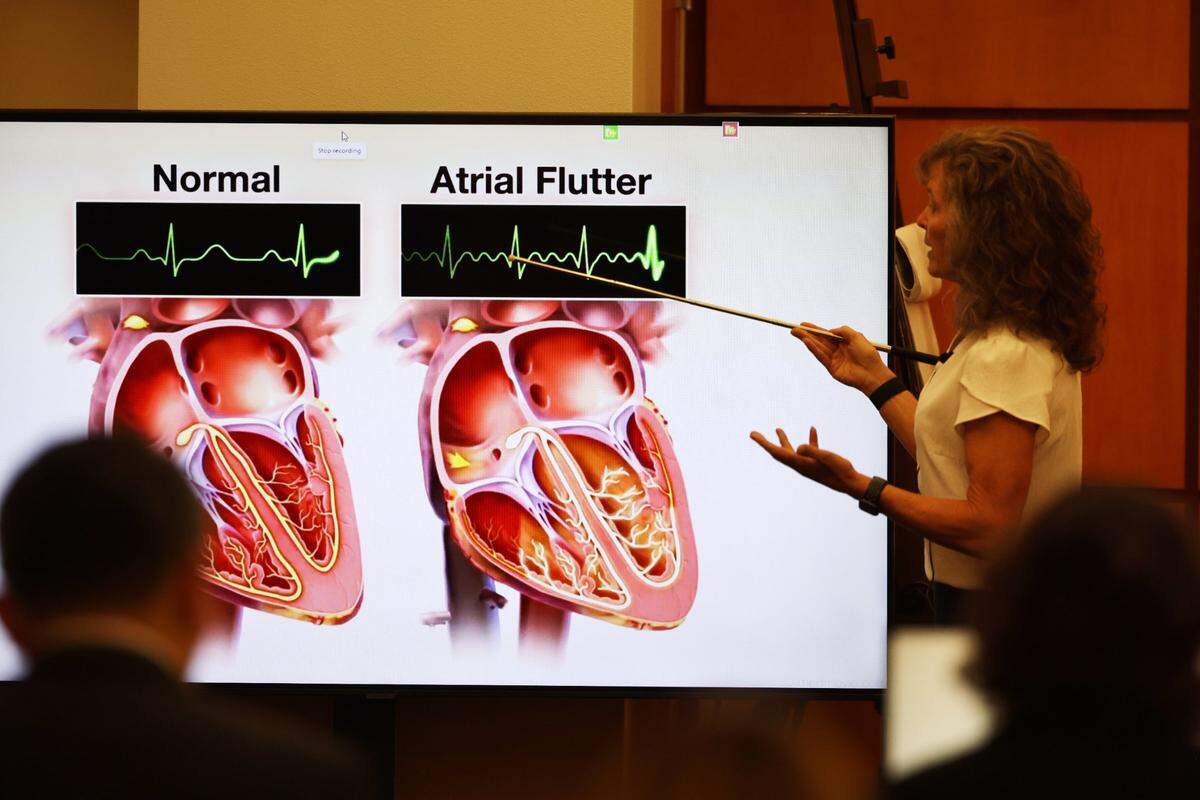
As a witness for the state, Clark testified earlier in the trial that meth had unpredictable effects, and it was the rhythm of Ellis’ heart as recorded on a heart monitor attached by paramedics that helped him rule the drug out as a primary factor in his death. He said the rhythm showed Ellis’ heart was not in a state of ventricular fibrillation, a type of irregular heartbeat Clark said is caused by methamphetamine. Ellis’ heart also didn’t go into a sudden dysrhythmia, Clark said, a common scenario for people who experience sudden death as a result of an enlarged heart.
Stankus disagreed. Under direct examination by an attorney for Rankine, Mark Conrad, the doctor said the heart monitor data showed that Ellis’ heart rhythm was “all over the place.”
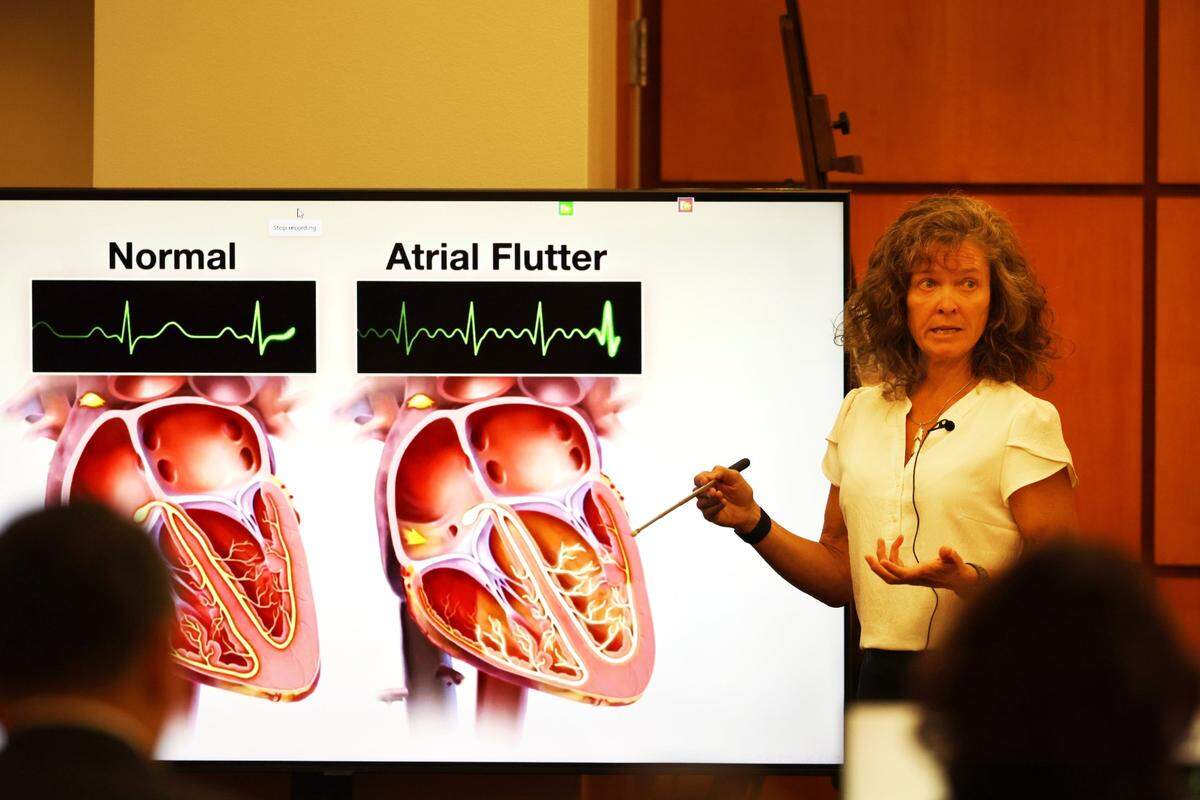
Clark’s original autopsy report stated that Ellis’ heart rhythm was normal when paramedics arrived. The heart monitor data was displayed on courtroom televisions, and Stankus said it showed that Ellis’ heart rhythm wasn’t normal.
“That’s a sick heart. This is a cardiac problem,” Stankus said. “This is not normal sinus rhythm.”
Asked why it wasn’t positional asphyxia that caused Ellis’ death, Stankus said the man still had a pulse when paramedics arrived and had shallow breathing. She said medics should have been able to save Ellis’ life if he was suffering from a respiratory issue. She pointed out that medics breathed for the man using a bag valve mask for five to six minutes, but Ellis’ condition still didn’t improve.
Rankine, Burbank and Collins are charged with first-degree manslaughter for Ellis’ death. Burbank and Collins also face charges of second-degree murder. All three have pleaded not guilty, are free on bail and remain on paid leave from the Police Department.
Stankus’ testimony supported defense attorneys’ contention that Ellis died not due to the actions of police but because of his meth use and underlying health conditions, including an enlarged heart. Prosecutors and their medical experts have stated that the way officers’ restrained Ellis, combined with a violent beating by police and the weight of officers on his back, caused him to asphyxiate.
Earlier in the morning, Conrad discussed Stankus’ extensive education, and he delved into Ellis’ medical history.
Stankus said she’s been practicing medicine since 2009, and aside from her work at Madigan Army Medical Center, she’s worked at hospitals in Tacoma, where she frequently saw patients visiting for drug-related issues or their mental health. Stankus also holds a law degree, and she once worked as a police officer in Colorado.
The doctor reviewed Ellis’ medical history to help her form her opinion on his cause of death. Stankus said he had dozens of visits to the emergency room before his death, which she said would be unusual for a 33-year-old if he didn’t have an underlying health condition. She said many visits were drug-related or to get help for shortness of breath and chest pain.
On one occasion, Ellis came into the emergency room with a very high heart rate of 206, Stankus said, and his healthcare providers spoke with him about how his drug use was problematic. On another visit regarding his mental health, Stankus said, the treatment section had to be cut short because he complained of “significant” shortness of breath and described waking up that morning feeling like he was breathing underwater. The doctor treating him at the time directed him to go to urgent care.
Before court broke for lunch, assistant attorney general Kent Liu began to cross-examine Stankus. The doctor conceded that pressure on a person’s back would restrict their ability to breathe to some extent, but she said it might not be clinically significant.
Liu also pointed out that Stankus hadn’t ever actually examined Ellis’ heart or other organ tissue.
After lunch, Liu questioned an opinion that Stankus included in her report to the defense: That Ellis would have died on the night of the incident regardless of whether he’d encountered law enforcement officers.
“Is it your medical opinion that even if Mr. Ellis had never encountered law enforcement that night, that if he was home watching TV, he would have died that night?” Liu asked.
“A person who takes methamphetamine, a toxic level of methamphetamine, I’ve never seen that person just chilling, watching TV,” Stankus replied.
Asked what basis she had to provide that opinion, Stankus said her review of Ellis’ medical records and prior encounters with police showed that when he took meth, his hallucinations and agitations worsened, and it caused him social and legal problems. The doctor referred to Ellis’ 2019 arrest following an alleged attempted robbery at a fast food restaurant that Ellis later said was the result of a meth-induced psychosis.
“Given that and given the severity of this heart rhythm, which again I’ve never seen a flutter with that much variability,” Stankus said. “Given the fact that he’s diaphoretic on a 41-degree night, it was my opinion on a more probable basis than not that, yeah, he was in trouble. He was in trouble medically from the outset.”
Liu asked if she’d read the accounts of others who saw Ellis the night he died before he encountered officers. Stankus couldn’t recall their statements. Cedric Armstrong, who operates the sober-living home where Ellis was staying at the time of his death, testified earlier in the trial that he saw Ellis at 10 p.m., less than an hour before he encountered police, and Ellis didn’t appear to be under the influence of drugs.
Stankus said she read the officers’ accounts of what happened, and she said they would be the only ones in contact with him who could see that he was sweating profusely. She said she’d also read the accounts of eyewitnesses — who said police instigated the interaction — but that this incident was consistent with someone on a toxic dose of meth and consistent with Ellis’ prior law enforcement contacts.
Liu said Stankus was giving credit to the officers she wasn’t giving to civilian eyewitnesses, and he was met with objections from the defense.
Earlier in his cross-examination, Liu brought up an pre-trial interview with the Washington State Attorney General’s Office in which Stankus was asked if she was pro law enforcement. Stankus said she was because she believes there has to be law and order, but that she believes in the fair enforcement of laws and appropriate treatment of defendants.
This story was originally published November 16, 2023 at 12:54 PM.