Why would officer risk ‘everything’ to attack Manuel Ellis, defense attorney asks jury
A Pierce County jury heard the defense’s penultimate closing arguments Wednesday morning in the trial of three Tacoma police officers accused of killing Manuel Ellis.
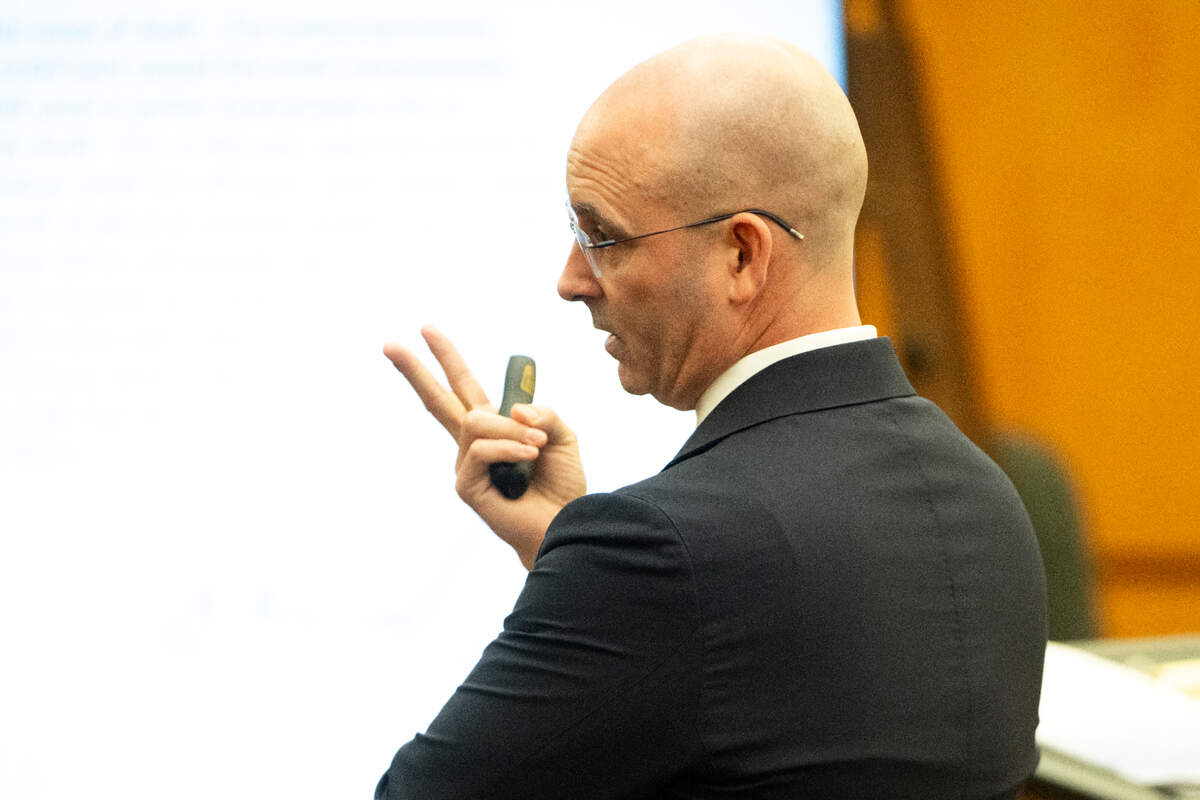
Jared Ausserer, an attorney for officer Matthew Collins, took jurors through a list of 18 reasons why they should doubt prosecutors’ theory of how his client and the other defendants are criminally responsible for Ellis’ death.
The lawyer began his closing arguments Tuesday afternoon, and in about two hours stretched over two days he has told jurors there is reason to doubt nearly every aspect of the state’s case, including the credibility of their eyewitnesses, the findings of their medical experts, their selection of witnesses and even prosecutors’ interpretation of video evidence.
Ausserer said prosecutors had ignored facts that didn’t fit into their story of how Ellis died — unjustly attacked by two officers, restrained and sat on to the point of asphyxiation while the two officers and a third ignored the man pleading with them that he could not breathe.
“You have to ask yourself, ‘Why in the world would Matthew Collins risk everything?’” Ausserer said. “He just had a baby. Why would he randomly attack some guy walking down the street?”
Ellis, 33, died the night of March 3, 2020, after a struggle with police that led to him being pressed to the street on his stomach with all of his limbs tied behind his back and a series of officers putting their weight on him. Ellis’ last words were, “I can’t breathe.”
The former Pierce County medical examiner ruled Ellis’ death a homicide caused by oxygen deprivation from physical restraint. His autopsy report noted Ellis had a methamphetamine concentration of 2400 nanograms per milliliter and an enlarged heart, facts that the defense has continuously pointed to as evidence Ellis death was an overdose, not a murder or manslaughter committed by police.
Officers Collins and Christopher Burbank, partners who had been with the Tacoma Police Department for about five years before Ellis’ death, are charged with second-degree murder and first-degree manslaughter.
Timothy Rankine, who had been a Tacoma officer for just under two years before the fatal incident, responded as backup minutes after Ellis first encountered Collins and Burbank at South 96th Street and Ainsworth Avenue. He’s charged with first-degree manslaughter.
The three officers could also be convicted of the lesser offense of second-degree manslaughter. All three have pleaded not guilty, are free on bail and have remained on paid leave from the Tacoma Police Department.
The trial is the first test of Initiative 940, a new police accountability law adopted in Washington state in 2019. It lowered the bar to charge police officers for on-duty offenses, and it requires officers to provide first aid to people in their custody at the earliest opportunity.
The officers are not accused of intentionally killing Ellis, prosecutors have said. Collins and Burbank are charged with felony murder, accused of committing unlawful imprisonment, second-degree or third-degree assault and causing Ellis’ death while carrying out those crimes.
Those allegations are related to Collins and Burbank’s initial detainment of Ellis. Prosecutors claim they didn’t have reason to arrest the man, and that Collins use of a lateral vascular neck restraint on him constituted second-degree assault, and Burbank’s repeated use of a Taser was third-degree assault.
The manslaughter charges have to do with the subsequent restraint of Ellis, accusing the defendants of acting recklessly by continuing to apply force on the man after he said he couldn’t breathe. Trial evidence showed Ellis said he couldn’t breathe at least five times.
Attorneys for the prosecution and defense are in the third day of closing arguments, weaving together for jurors nine weeks of testimony to make their cases for why the panel should either convict Collins, Burbank and Rankine or acquit them.
Prosecutors from the Washington State Attorney General’s Office and attorneys for Burbank and Collins spent much of their time in front of the jury attacking the credibility of their opponents’ most vital witnesses.
Special prosecutor Patty Eakes on Tuesday zeroed in on the statements the defendants gave to investigators looking into Ellis’ death days after the fatal incident. She pointed to Collins’ describing Ellis as having “superhuman strength” and continuing to fight him throughout the entire incident, which is contradicted by video evidence, telling jurors that the officer’s words were designed to justify his use of force.
In one example, Eakes said Collins told investigators he tried to use the lateral vascular neck restraint on Ellis because he didn’t know where Burbank was and thought his partner might be unconscious somewhere. Collins said he felt the headlock was his only option, but Eakes played cellphone video that showed Burbank was standing right behind him.
Collin’s attorney defended his credibility Wednesday morning, asking jurors to consider why, if he was lying, he left out details in his statement that would have supported his case, such as Ellis saying, “Try it again,” after he was shocked with a Taser.
It’s because Collins didn’t hear it, Ausserer argued, just as he didn’t hear Ellis repeatedly say, “I can’t breathe.” Even if Collins had heard Ellis say those words 100 times, the lawyer said, it doesn’t make his client criminally responsible.
Going after the credibility of the state’s medical experts, including Dr. Thomas Clark, who conducted Ellis’ autopsy, Ausserer suggested that most of the experts could not come to a definite conclusion about what caused Ellis’ death, saying Clark had incomplete information when he ruled Ellis’ death a homicide.
The doctors who did back up Clark, such as the state’s cardiologist, Dr. Daniel Wohlgelernter, were “hired guns,” Ausserer said, and they were working with what he characterized as inherently flawed findings.
“They don’t know. The state doesn’t know what caused the death, and so they’re characterizing this as an indictment of everybody at the scene,” Ausserer said.
Jurors began to hear closing arguments from an attorney for Rankine, Mark Conrad, before court broke for lunch. Conrad will continue to make his case to the jury Wednesday afternoon, followed by prosecutors’ rebuttal.
This story was originally published December 13, 2023 at 1:01 PM.