
Man serving life for contract killing of Pierce County woman gets new sentence
AI-generated summary reviewed by our newsroom.
- A judge reduced Randy Capps’s life term to 45 years, 10 months.
- Judge Thornton cited Capps’s white supremacist ties and need for more rehabilitation.
- Court rulings have allowed resentencings for offenders aged 18–20 serving mandatory LWOP.
A man who has long been serving life in prison without parole for his part in a murder-for-hire plot targeting a Sumner woman saw his sentence reduced Friday to 45 years, 10 months based on rulings from the Washington state Supreme Court.
Randy Phillip Capps, 53, was 20 years old at the beginning of 1994 when he, Jason Allison and Dokdinh Sayasack agreed to kill Marietta Dela Cruz at the request of her daughter, Filomena Washington, in exchange for money.
Dela Cruz, 59, was a longtime Sumner resident and activist in the Filipino community. According to court documents, Washington had a difficult relationship with her mother, had reportedly fallen into debt and believed she might inherit as much as $1.4 million through insurance money after her mother’s death as her only daughter.
The men expected to receive between $35,000 and $75,000 for their efforts, Pierce County Superior Court Judge Philip Thornton said Friday, citing trial testimony.
After days or even months of planning, on March 15, 1994, at around 2 a.m., Sayasack drove Capps and Allison to Dela Cruz’s house on Chestnut Street. Capps kicked in the back door after failing to enter through a window. There are conflicting accounts of whether Capps or Allison fatally shot Dela Cruz.

A ring was reportedly removed from Dela Cruz’s finger, which Capps pawned the next day. After the murder, Allison and Capps threw their clothes and the gun in a river.
Investigators later found Dela Cruz at the door of her home, shot twice in the face and the neck. Her telephone line had also been disconnected.
Washington was in Louisiana at the time with her husband, and Capps and Allison reportedly tried to disguise the contract killing as a burglary gone wrong, according to news reports at the time. But neighbors heard the attackers talking about the conspiracy and provided the information to law enforcement.
Allison, Sayasack and Filomena were convicted in jury trials of aggravated first-degree murder in 1995, and Capps pleaded guilty to the same charge. At the time, the only punishment available was either life in prison without possibility of parole or execution. Former Pierce County Prosecutor John Ladenburg declined to pursue the death penalty due to the defendants’ ages and minimal criminal history.
Capps is the second and likely last person convicted in Dela Cruz’s murder to receive a new, shorter sentence. In 2021, the Washington Supreme Court ruled that mandatory life imprisonment for people ages 18-20 is unconstitutional. And in 2024, the high court decided that sentencing courts have the option to give people of this age a sentence with a set length of time.
The same year, Allison was resentenced to a little over 33 years in prison, and he has since been released. At his resentencing hearing, deputy prosecuting attorney Brittany North was impressed by Allison’s relatively clean prison record and his detailed plans for reentering society. She asked for a new sentence of 35 years.
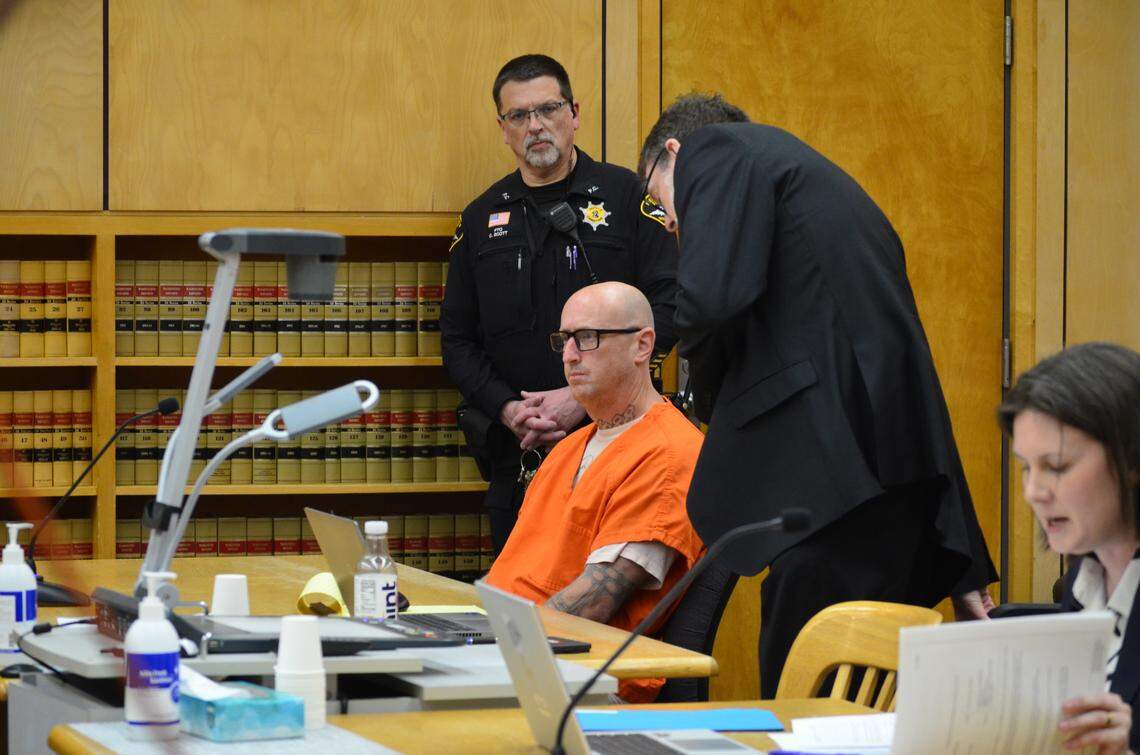
At Capps’ resentencing hearing Feb. 27, however, North requested that he either continue to serve life in prison without parole or be sentenced to at least 58 years. Capps’ defense attorney, Kent Underwood, argued for the same sentence that Allison received in 2024. With earned release time for good behavior factored in, prosecutors said that would have led to Capps’ immediate release.
On Friday, Thornton issued his decision, telling Capps that it was concerning to him that as recently as 2021 he was found to be continuing to associate with violent white supremacist groups in prison.
Sitting in court in an orange jail uniform, a tattoo of a swastika was visible on Capps’ wrist. The numerals 88, classified as a hate symbol by the Anti-Defamation League, peeked out above the shirtline on his neck. Court documents filed by the defense state that Capps has explored getting these marks removed.
Thornton said Capps had received three rehabilitative certificates while incarcerated and sought to learn skills to become a productive member of the community, but that he had more work to do.
“Additional steps are needed,” Thornton said. “Those steps are needed to ensure the safety of the community from potential harm at the hands of Mr. Capps. This court believes further incarceration would be useful for Mr. Capps to make the changes he indicated he wants to make in himself.”
Thornton also had to consider the mitigating factors of youth that may have affected Capps when he committed this crime. These include immaturity and impetuosity, failure to appreciate the risks and consequences, the defendant’s environment, family circumstances and peer pressure.
The judge went through his analysis of each factor in detail, explaining that he found evidence that Capps was immature at the time, but that his actions were not impulsive, and he did not fail to appreciate the risk and consequences of carrying out the murder. Thornton also said Capps’ childhood was not ideal.

Capps was born and raised in Puyallup. As a child, according to court documents, he suffered abuse at the hands of his mother.
“It is not surprising that when he was kicked out of his mother’s home in his early adolescence that he turned to his peers for acceptance and a feeling of belonging,” Thornton said. “Some of those influences led him to deviant and criminal behaviors.”
Prosecutors wrote in court documents that due to a quirk in state law, aggravated first-degree murder is not classified as a serious violent crime for the purpose of the Department of Corrections calculating earned release time for good behavior. The issue is being litigated in appeals courts, but in the meantime, according to prosecutors, DOC has awarded as much as 33 percent of an offender’s sentence as earned release time.
The other defendants in the case, Sayasack and Washington, were both older than 20 at the time of the murder and thus ineligible for the same type of resentencing hearings that Capps and Allison have received.
Information from The News Tribune’s archives contributed to this report.
