Free student lunch for all? Not for long. Here’s how change might look in Pierce County
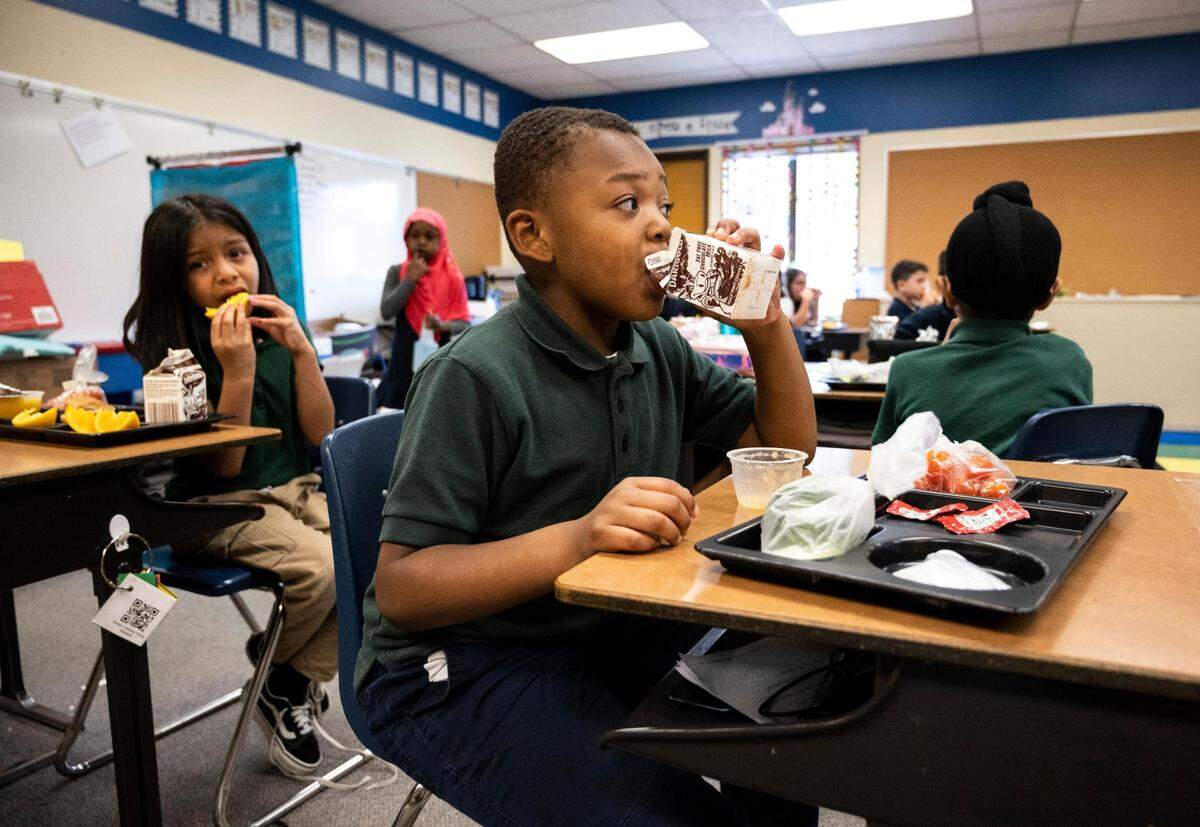
The era of universal free school meals in Pierce County is seemingly nearing an end.
For roughly two years, students across the United States — regardless of family economic status — were fed without paying a single cent, as school districts saw higher federal reimbursements than normal to cover the costs of giving out food. But the federal waiver that facilitated those free meals is set to expire June 30 unless extended by Congress.
Families of tens of thousands of students in Pierce County could now be in for an unwelcome return to a pre-pandemic normality: Paying for school breakfast and lunch.
“It just doesn’t make sense, and the press on the pocketbook for people right now is real,” said state Rep. Marcus Riccelli, D-Spokane, who sponsored a recently signed bill in the Washington Legislature that sought to provide free meals to more children through another federal program. “I think when (the waiver) goes away, it’s going to be a real burden and concern for a number of families.”
Pupils can still seek to qualify for free or reduced-rate meals as part of the National School Lunch Program and School Breakfast Program as they had prior to the coronavirus health crisis. Schools with a certain percentage of students in need can serve food at no charge to everyone under the federal Community Eligibility Provision, which is also through the U.S. Department of Agriculture.
But it is inevitable that certain students will get left out when the so-called Seamless Summer Option waiver, which allowed for no-questions-asked free meals across the board, is no more.
As many as 53,000 students in the county could no longer be eligible for free school meals, according to a News Tribune analysis of state data. Making matters worse, the renewed financial obligation for parents comes at a time when school nutrition leaders worry about the rising costs of food due to inflation and as supply-chain issues limit food options for districts.
Officials also say that blanket participation in free meals had removed the stigma associated with receiving that benefit and the burden on schools to track enrollment and collect debts.
“I’m always thinking about those families that are on the fringe and barely will not qualify (for free or discounted meals),” said Leeda Jo Beha, director of child nutrition and warehousing services for the Bethel School District. “And then what do they do?”
Return to traditional programs
If the waiver expires, Pierce County schools will revert to two systems that govern student meals. One is seemingly straight-forward. The other is decidedly more complex and, in some cases, has proven problematic, although it could potentially be the channel to bring universal free student meals into the state.
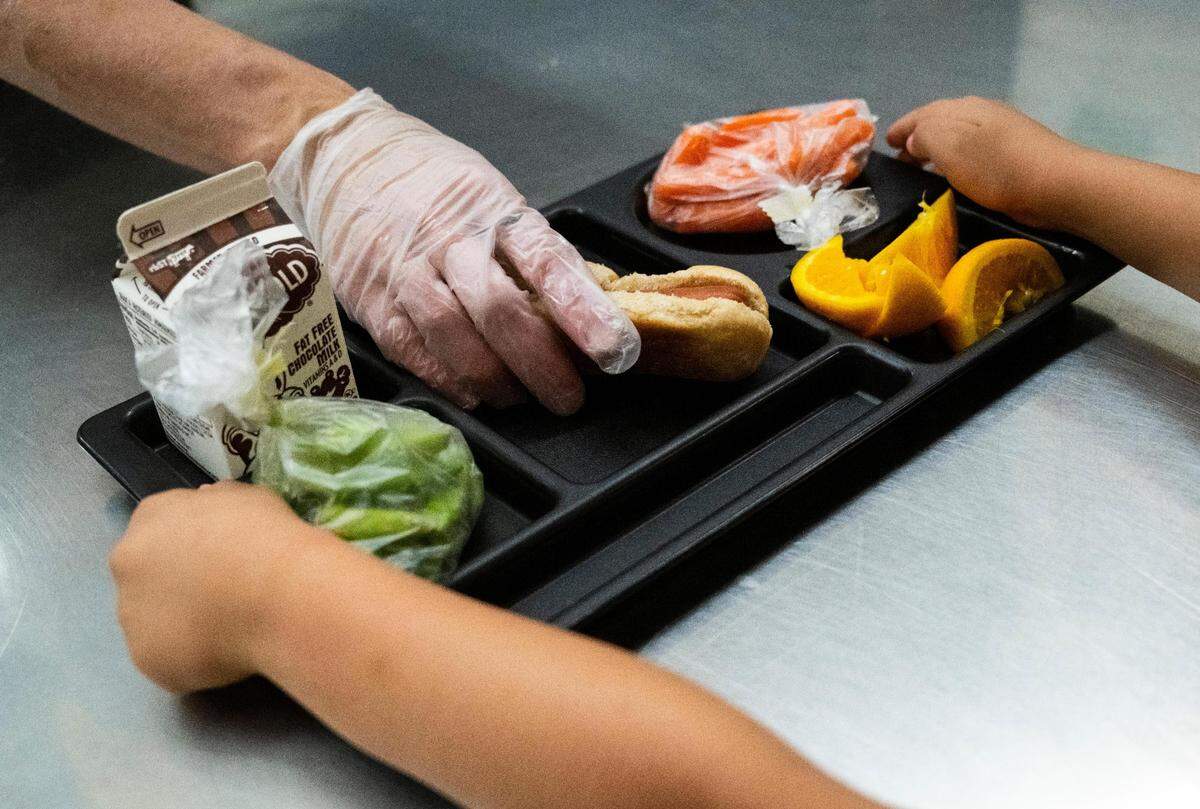
The National School Lunch Program and School Breakfast Program each look at a child’s family’s household income and size to determine eligibility for free meals. Students who apply can also qualify for discounted meals, which are now effectively free after state lawmakers eliminated the reduced-rate copay last year.
According to federal income eligibility guidelines as of July 1, a family of four that makes under $33,874 annually would qualify for free meals.
The second vehicle to feeding students is the Community Eligibility Provision (CEP). It examines a school’s share of students who are directly certified for free meals because they are in foster care or their families struggle with stable housing or participate in certain federal aid programs such as the Supplemental Nutrition Assistance Program or Medicaid. The CEP program has been a growing focus in Washington.
In effect nationwide since the 2014-15 school year, the program essentially allows any school to offer free meals to all students if at least 40 percent of its student population is directly certified for free meals. While it eliminates household applications, school districts still must apply for eligible schools to participate.
The vast majority of the roughly 130,000 students in Pierce County do not appear to be presently situated to receive free meals through the program. Only about 37,000 attend a school currently participating in CEP, according to state CEP eligibility data for the upcoming 2022-23 school year. And fewer than 10,000 students in Pierce County attend schools eligible to participate in the program that are not currently doing so, according to state data.
In March, Gov. Jay Inslee signed into law the Riccelli-sponsored House Bill 1878, intended to boost the program’s participation by requiring that every qualified public school join in. The bill will more than double the number of Washington schools participating in the program — to more than 1,100 — and raise enrollment to about 300,000 students, according to a news release from Riccelli’s office in March.
Students caught in the gap
Most schools in Pierce County do not, by themselves, qualify for CEP under the federal standard, leaving the traditional free and reduced-rate food programs as the lone safety net to capture the neediest students.
A News Tribune analysis of state data illustrates how large that gap is, although there are caveats.
CEP eligibility data for the 2022-23 school year show that roughly 82,000 students were in schools not currently eligible for the program. More than 53,000 of those students also did not qualify for free and discounted meals under the National School Lunch Program and School Breakfast Program, according to a review of state figures, current as of Oct. 31.
Officials warned that free and reduced-cost meal figures are artificially low right now since there was no need for parents to submit those applications with the federal waiver in place. Also, CEP eligibility could still grow, and it is unclear how many of the students estimated to be ineligible for either program could choose to bring food from home or to eat elsewhere.
The ultimate goal for Riccelli is to move toward a “hunger-free Washington” and follow in the footsteps of other states, such as California, that have made student meals universally free. He said he believed that target, which would require recurring state funding, could be reached through CEP, although he acknowledged the program has thus far been “complicated” to navigate.
“There’s a bigger vision here,” he said. “But the first vision is simple: Hungry kids can’t learn, and no kid should go hungry.”
Group effort
The bill sought to address CEP’s eligibility dilemma, as well as funding constraints that previously have kept some schools from participating. Lawmakers set aside $44 million over the next two years to cover gaps between school district costs and federal reimbursement, Riccelli said, and they encouraged school administrators to group schools together so that they could qualify as a collective and stretch the benefit as far as it can go.
CEP allows schools under the 40 percent threshold to participate in the program if they can hit the mark when grouped with others. Two entire school districts in Pierce County qualify by that measure, according to state data.
All 28,000-plus students enrolled in Tacoma Public Schools, the largest school district in the county, will continue to receive free meals during the upcoming school year, as a result of 46.5 percent of all of its students being directly certified for free meals, according to Alicia Lawver, the district’s director of strategic planning.
Lawver said that the district has traditionally had a high number of students qualify for free and reduced-price meals — a need that only increased during the pandemic.
“Knowing that families would continue to face struggles, Tacoma Public Schools proactively worked to apply for CEP last year and work through the process in order to be able to continue to provide free meals to all of our students,” she said in a statement.
The Clover Park School District is also entirely eligible for CEP, despite it too having schools that do not individually meet the threshold, because 40.3 percent of all students in the district are certified for free meals, state data shows.
In the smaller Franklin Pierce School District, where 52 percent of all 7,700 students are directly certified for free meals, the program was implemented districtwide in 2019, according to Karen Brown, the district’s nutrition services director. Each of its 14 schools qualify on their own, unlike in Tacoma Public Schools and the Clover Park School District.
“I wish the federal government could just make this permanent for all school districts,” Brown said, “not just high-need districts like ours.”
The Puyallup School District has more than 23,000 students and will be transitioning back to paid meals at most of its 34 schools for students who do not qualify for free or reduced rates. The district is seeking approval to bring seven eligible schools into CEP for the upcoming school year, according to spokesperson Sara Gillispie.
‘Really hard’ decisions
On a recent afternoon at Evergreen Elementary School, one of 28 in the nearly 20,000-student Bethel School District, Beha said that number-crunching to try to group more schools to meet the 40 percent threshold for CEP qualification has been difficult. She grew emotional discussing the potential implications.
“That is a really hard decision, as a nutritionist, to have to be put in and a hard spot to be put in, to think about who’s going to go hungry because of this line I have to draw in the sand,” she said. “It’s horrible.”
Nine schools, including Evergreen, are preparing to participate in CEP during the upcoming school year, according to Beha, but she said she believed there still might be more eligible through grouping. With 35.29 percent of its total student population directly certified for free meals, Bethel School District is considered “near eligible” to providing food to all of its students at no charge, according to state data.
As the demand for free meals increases at Bethel School District, Beha urged Congress to act to extend school meal waivers, including one that would ensure school districts do not have to drastically cut back community feeding sites during the summer. Two bills in Congress — the Support Kids Not Red Tape Act of 2022 and the Keeping School Meals Flexible Act — would extend waivers through the upcoming school year, but neither has yet to progress far.
As some states have enacted or are considering universal free school meals, and Washington has moved to backfill CEP funding gaps and remove co-pays for discounted meals, Beha said she is concerned about creating inequities across the country without meaningful federal action. Feeling strangled by red tape, she said that the ideal resolution is for there to simply be free meals for all.
After two-plus years of working to feed children during the pandemic, Beha said, her team is tired. One staff member asked at one point if they could hand-deliver meals to students because they knew it was the only way those students would get them.
“Kids shouldn’t have to think about those things,” Beha said.
This story was originally published June 17, 2022 at 5:00 AM.